
Tech
Internet access

With the ACP at risk of ending, lower-income families could lose internet access

Staying connected

A last-ditch bipartisan effort to save the Affordable Connectivity Program (ACP) — a government initiative that subsidizes home broadband for more than 20 million low-income households — could soon hit Congress, according to the WSJ, just as funding for the scheme looks set to run dry.

The proposal to pump a further $7B into the program would extend the stipends, issued as $30-75 vouchers towards monthly home Wi-Fi bills, until the end of the year. The scheme has been praised for keeping seniors, minorities, and veterans (almost 50% of households that benefit are military families) online across the US.

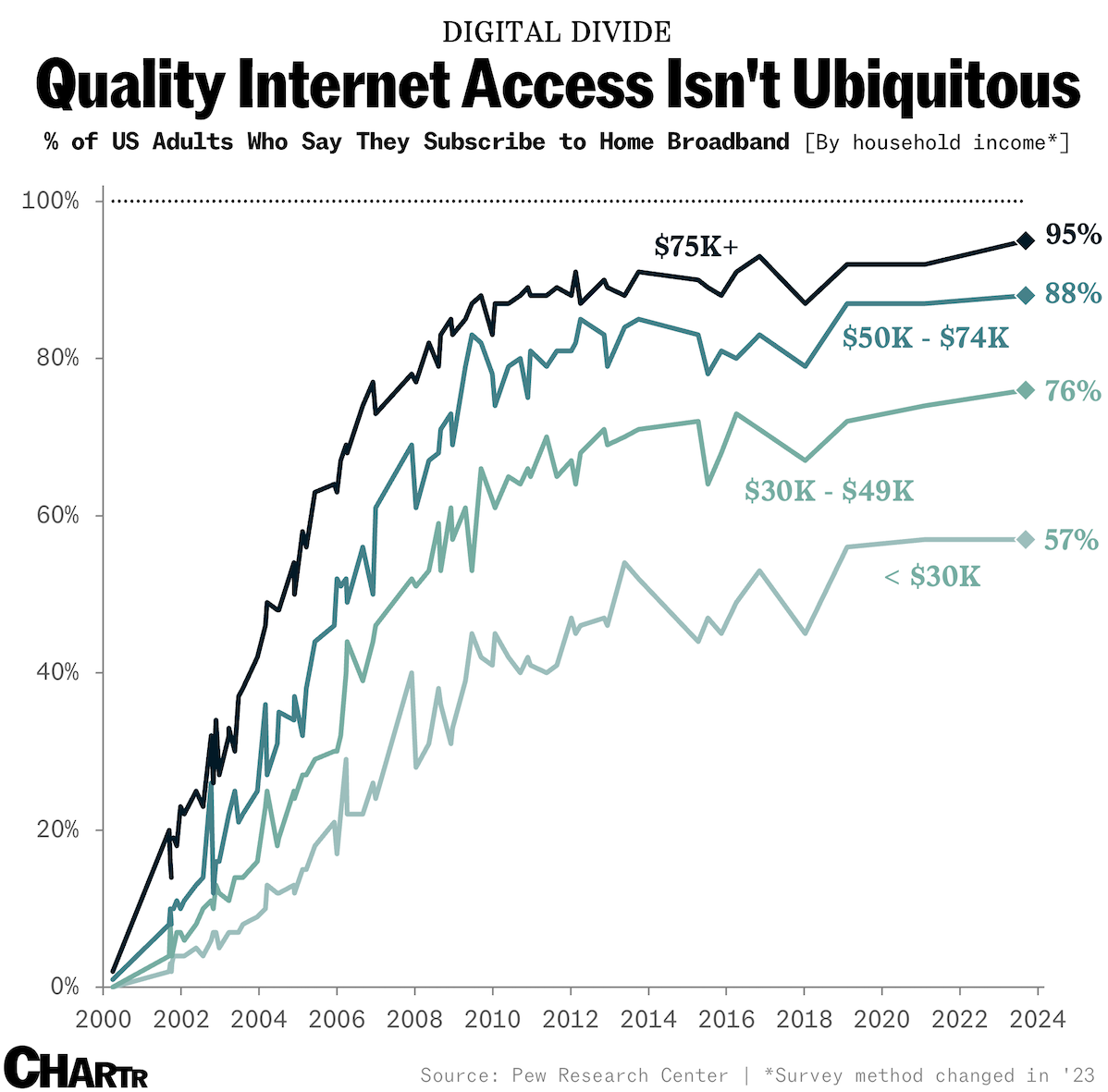
Given how essential the internet now is to modern life, America remains worryingly uneven in its adoption of home broadband. According to a set of surveys that Pew Research Center has been running for the last 23 years, just 1% of American adults had a home broadband subscription in 2000; last year, 80% said the same. However, that growth hasn’t been mirrored across all income groups, with only 57% of adults in households where annual income is below $30K reporting a subscription to broadband at home late last year… and that was with the ACP in place.

Despite a reasonable amount of cross-aisle support, injecting more cash into the ACP has proven difficult. While Congress enacted the ~$14B ACP as part of Biden’s Bipartisan Infrastructure Law in 2021, the president’s request for a supplementary $6B to extend the scheme last October hasn’t gone anywhere. If the same fate befalls this latest bid, millions of Americans could lose access to the internet at home, or be forced to cut spending elsewhere.


More Tech

See all Tech
tech

Alphabet, Amazon, Microsoft, and Meta plan to spend more than $700 billion on capex this year

Big Tech’s big capital spending continues to surge even higher than the companies had previously expected.

Alphabet raised its 2026 capex outlook to between $180 billion and $190 billion, up from $175 billion to $185 billion. Meta increased its 2026 forecast to $125 billion to $145 billion, up from $115 billion to $135 billion. Microsoft, meanwhile, said it’s planning on spending $190 billion this calendar year, about $55 billion more than the FactSet analyst consensus. Amazon, the lone outlier, didn’t boost its capex forecast, keeping it at a cool $200 billion.

Combined, Alphabet, Amazon, Microsoft, and Meta plan to spend more than $700 billion on capex in 2026, nearly double what they spent last year and $100 billion more than they’d expected just last quarter, as they continue to build out the AI infrastructure to support their AI futures.

big 4 tech capex meta microsoft google amazon
Sherwood News
Microsoft AI Tour

Microsoft’s capex outlay this year would be enough to buy every outstanding share of Disney

CFO Amy Hood said on last night’s earnings call that the company will spend $190 billion on capex in 2026.

Senate bipartisan Artificial Intelligence (AI) Insight Forum on Capitol Hill in Washington

A tale of two capex increases: Why investors are responding to Google and Meta so differently

Two Big Tech companies posted stellar earnings and upped their capex forecasts. One stock is up, one is down.

Latest Stories

Sherwood Media, LLC produces fresh and unique perspectives on topical financial news and is a fully owned subsidiary of Robinhood Markets, Inc., and any views expressed here do not necessarily reflect the views of any other Robinhood affiliate, including Robinhood Markets, Inc., Robinhood Financial LLC, Robinhood Securities, LLC, Robinhood Crypto, LLC, Robinhood Derivatives, LLC, or Robinhood Money, LLC. Futures and event contracts are offered through Robinhood Derivatives, LLC.
