Crypto
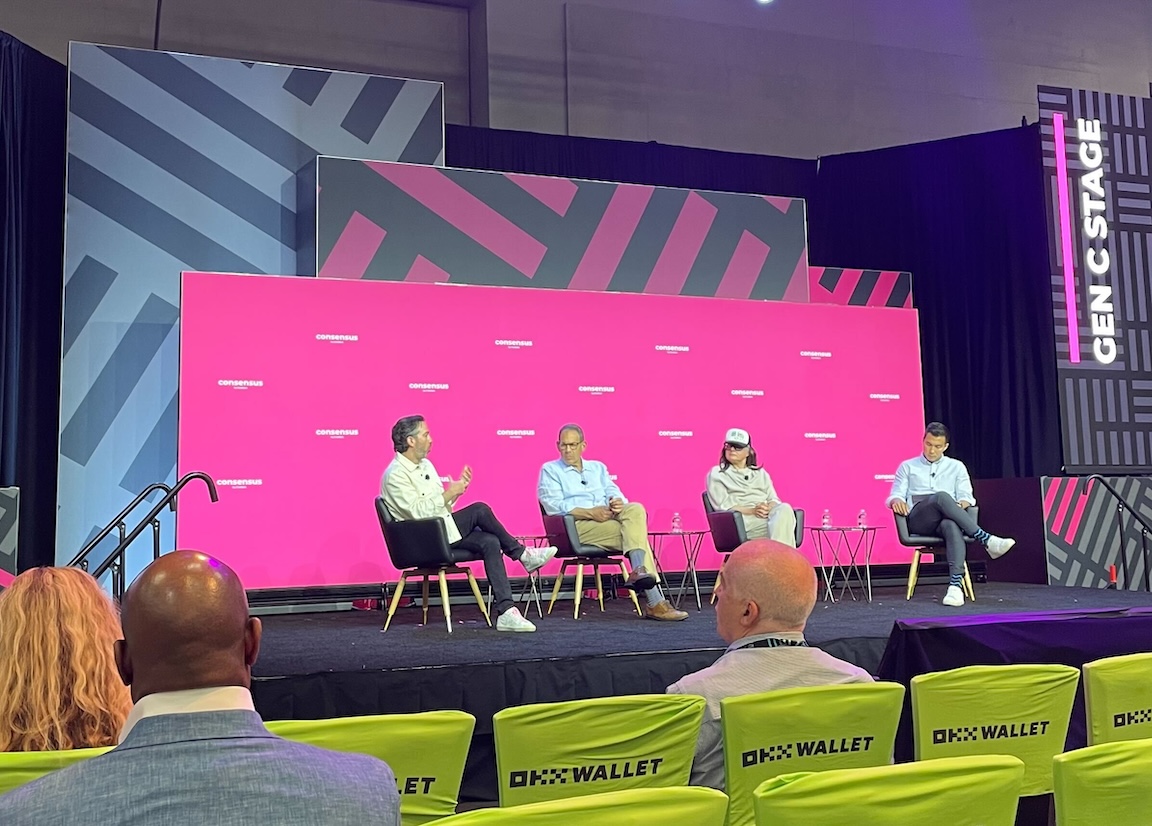
AI Blockchain and the Creator Economy Panel at Consensus
Panelists at Consensus 2024 in Austin, TX (Jack Morse)
Consensus2024

Blockchain's newest use case is defeating AI deepfakes

Jack Morse

At the 10th annual Consensus crypto conference in Austin, Texas, a group of media execs and technologists explained how blockchain technology is well suited to combat what they see as an incoming wave of deepfakes that threatens creators’ rights. 

"Blockchain really helps in establishing ownership of content and protecting those rights in a way that is really hard to do IRL,” explained Maya Draisin, Time’s chief brand officer.

At a panel discussion dubbed “AI, Blockchain and the Creator Economy,” the recent conflict between OpenAI and Scarlett Johansson was very much top of mind. OpenAI had been accused of copying the actor’s voice for its latest AI assistant (it denied this), and the panelists said that blockchain is a potential solution for artists worried about a similar fate. 

David Tackel, the senior vice president of Fox Corp’s technology research and development arm, said blockchain tech will allow consumers to check in real time whether a piece of art or online content was, in fact, made by that artist. Picture digital signatures, verified on chain. 

Stuart Levi, a partner in the Intellectual Property and Technology Group at the law firm Skadden Arps, agreed. “I do feel that ledger technology is a way to address and solve for that.” For this to happen, Levi argued that the industry has to move past thinking of NFTs as speculative assets such as Bored Apes. 

Time has explored NFTs as a way to access the magazine’s content, and Drasin emphasized that the industry needs to rethink its relationship with blockchain tech more broadly. "The most interesting stuff of NFTs is as tokens, not as art," she said. 

If blockchain tech and tokens helps artists defend against deepfakes, even some digital NFT artists may end up agreeing with her. 

More Crypto

See all Crypto
crypto

Ripple launches treasury platform to manage cash and cryptocurrencies

Ripple, the firm closely tied to the fifth-largest cryptocurrency, XRP, introduced a new treasury platform for digital asset and traditional cash management for users like financial officers, treasurers, and accountants. 

Ripple’s move comes more than three months after it acquired treasury software provider GTreasury for $1 billion, one of several steps to grow the firm’s position in corporate finance.

Combining Ripple’s blockchain rails and GTreasury’s software, the new platforms goal is to simplify treasury operations. It eliminates settlement delays with payment times of three to five seconds and optimizes yield from working capital 24/7 through tokenized money market funds such as BlackRock’s BUIDL and overnight secure repo markets with RLUSD, according to a Tuesday blog post

Ripple Treasury also aims to provide “real-time cash positions, automated forecasting, and seamless reporting across traditional cash, digital assets, RLUSD, and XRP holdings,” the blog post stated.

Last year, Ripple filed its national banking license application with the US Office of the Comptroller of the Currency, while the firm’s subsidiary Standard Custody & Trust Company applied for a Federal Reserve master account, which would allow Ripple to hold RLUSD reserves directly with the Fed.

XRP has seen $2.4 billion in trading volume in the last 24 hours, increasing 1.8% in the period. The tokens all-time high was set in July 2025 at $3.65. Meanwhile, spot XRP ETFs had nearly $9.2 million worth of inflows on Tuesday, bringing cumulative inflows to $1.4 billion.

$82B

Crypto money laundering activity totaled more than $82 billion in 2025, more than 8x higher than 2020’s figure of $10 billion, according to a Tuesday report published by crypto analytics firm Chainalysis. Chinese-language networks dominated the ecosystem, accounting for roughly 20% of the illicit activity, or $16.1 billion, last year:

“Compared to other laundering endpoints, since 2020, inflows to identified CMLNs [Chinese-langugage money laundering networks] grew 7,325 times faster than those to centralized exchanges, 1,810 times faster than those to decentralized finance (DeFi), and 2,190 times faster than intra-illicit on-chain flows.”

Tom Keatinge, director at the Centre for Finance & Security at security think tank Royal United Services Institute, told Chainalysis that the rapid development of Chinese-language networks is an “an unforeseen consequence” of China’s imposition of capital controls.

“Wealthy individuals seeking to move money out of China and evade these controls provide the impetus and liquidity pool needed to service organized crime groups based in the West,” he noted.

Keatinge told Chainalysis, “The professional enablers of this capital flight provide the services necessary to match these two independent yet mutually beneficial needs.” 

Chinese-language networks offer six primary money movement techniques to clean dirty money, which include recruiting individuals to rent out their financial identities, selling illicit cryptocurrency at a discounted rate, and obscuring fund origins through multiple transactions. 

Overall, this Chinese ecosystem processed nearly $44 million per day last year. 

Latest Stories

Sherwood Media, LLC produces fresh and unique perspectives on topical financial news and is a fully owned subsidiary of Robinhood Markets, Inc., and any views expressed here do not necessarily reflect the views of any other Robinhood affiliate, including Robinhood Markets, Inc., Robinhood Financial LLC, Robinhood Securities, LLC, Robinhood Crypto, LLC, or Robinhood Money, LLC.