
Business
United Airlines Boeing 787 Dreamliner Flight
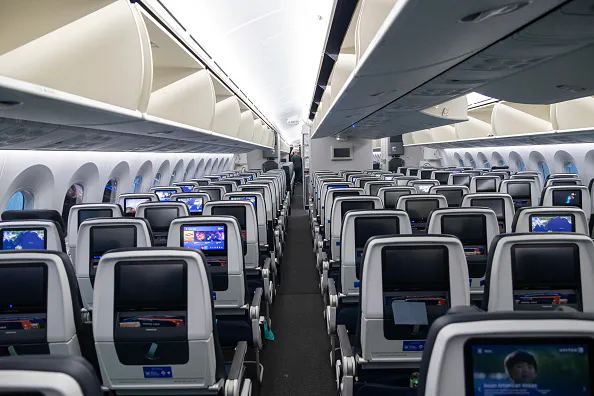
Empty section of the Economy Class in a United Airlines Boeing 787 Dreamliner aircraft, on April 20, 2024 (Getty Images)
Slow coach

US airlines are still doubling down on premium seats, as the K-shaped economy takes off

There's really not much room in economy these days.

With airports across the nation still seeing delayed security wait times amid ongoing TSA chaos, some travelers might be wishing they had shelled out for a first or business class ticket to get into the “Priority” lane.

And it seems America’s biggest airlines are also betting that passengers are now more willing to upgrade: a new report from the WSJ, published Sunday, details how airlines have shrunk traditional economy cabins over the last decade to make room for a growing number of premium offerings.

Indeed, according to aviation data from Visual Approach Analytics cited in the report, the number of scheduled first- and business-class seats on domestic flights has expanded by 27% since January 2020 — almost 3x greater than the 10% growth seen for scheduled economy seats.

That’s not even accounting for premium economy, an intervening class that became a standard option for many major airlines in the 2010s, which, the WSJ wrote, can be “priced at least twice as high as regular economy seats and only take up slightly more room on the plane.”
premium seats
Sherwood News

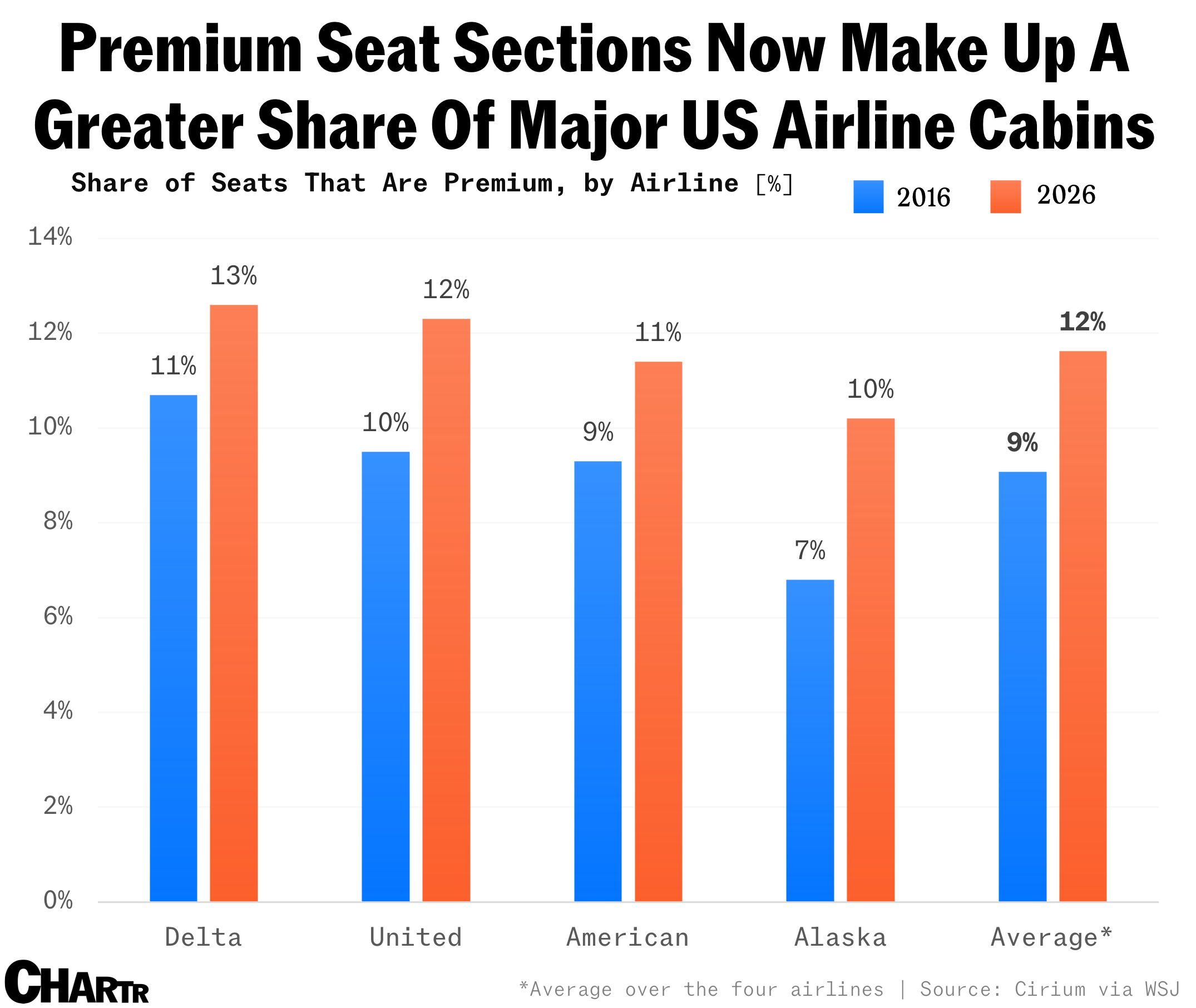
Looking at four of the biggest air carriers in the US — Delta Air Lines, United Airlines, American Airlines, and Alaska Airlines — all have increased their respective shares of premium seats since 2016, now comprising 12% of their cabins on average in 2026.

Business end

Many airlines are rolling out redesigned cabins to make planes “financially efficient,” adding room for more expensive tiers by cutting into cheaper sections. The trend speaks to the emergence of America's K-shaped economy, in which wealthier consumers continue to splurge as lower-income spenders cut back.

For example, United’s new Dreamliner jet layout includes 16 more business class seats, 14 more Premium Plus seats... and 65 fewer seats in the economy section. Delta has already found success squeezing profits from the top, with its premium ticket sales growing more than 7% last year, while main cabin ticket sales fell 5%.

More Business

See all Business
business

Danone acquires meal replacement shake maker Huel for ~$1.2 billion

Very big things happening today in the world of nutritionally-complete products that taste like chalk, as Danone agrees to buy the celebrity-backed protein bar, powder, meal, and meal-replacement shake maker Huel for €1 billion, or around $1.2 billion.

In a statement announcing the acquisition, Danone — apparently the number-one yogurt producer in the US and the nation’s top plant-based food and beverage company as well — said that buying Huel will enhance its “presence in functional nutrition and extend its portfolio into the fast-growing Complete Nutrition space.” Danone, the parent company behind Evian and Actimel, also praised Huel’s “best-in-class digital execution” and fan bases across the UK, Europe, and the US.

Bulking season

Huel, a portmanteau of “human” and “fuel,” was only set up just over a decade ago, but thanks to its marketing efforts; a buzzy product range that marries on-the-go eating with nutrient-dense, plant-based ingredients; and a decent list of (mostly UK-based) celebrity investors, like actor Idris Elba and talk show host Jonathan Ross, sales have soared.

business

China’s EV startup trio have all become profitable

China’s EV startup trio, Nio, Li Auto, and XPeng, are now all profitable, following the latter’s Q4 results released Friday.

XPeng reported a quarterly net profit of about $55 million, compared to rival Nio’s Q4 net profit (also its first) of about $40 million. Li Auto posted Q4 net profit of less than $1 million.

All three companies being profitable offers a stark contrast to the EV market in the US, where Rivian quietly delayed its 2027 profitability target in a filing about its Uber robotaxi partnership yesterday. Lucid is likely further away, and last month cut 12% of its US workforce as part of its “path toward profitability.”

Still, it’s not all rosy for China’s EV startups, either. XPeng ADRs were down more than 6% in Friday morning trading as its Q1 sales forecast came in below estimates. As China rolls back subsidies, auto sales are slumping. Chinese retail EV and hybrid sales fell 32% in February from the same month last year.

9.3%

As the war with Iran produces the biggest spike in US gas prices since Hurricane Katrina, car retailer CarMax is continuing to see heightened interest in EVs, hybrids, and plug-in hybrids.

“From Feb 1st - March 1st (inclusive), compared to March 2nd to March 15th (inclusive), we saw a 9.3% lift in page views for these vehicles,” a spokesperson for the company told Sherwood News.

As industry insiders recently told us, EV interest climbs when gas prices rise. That appears to be holding true even without EV tax credits, which the Trump administration ended under its new budget package.

CarMax also saw EV searches spike in 2022, amid Russia’s invasion of Ukraine and the resulting oil price spike.

Walt Disney Chairman And CEO Bob Iger Rings Opening Bell At NY Stock Exchange

It’s the end of Disney’s Iger era (again)

Incoming CEO Josh D’Amaro is replacing Bob Iger on Wednesday, though Iger will remain a senior adviser through the end of the year.

Latest Stories

Sherwood Media, LLC produces fresh and unique perspectives on topical financial news and is a fully owned subsidiary of Robinhood Markets, Inc., and any views expressed here do not necessarily reflect the views of any other Robinhood affiliate, including Robinhood Markets, Inc., Robinhood Financial LLC, Robinhood Securities, LLC, Robinhood Crypto, LLC, Robinhood Derivatives, LLC, or Robinhood Money, LLC. Futures and event contracts are offered through Robinhood Derivatives, LLC.