Half of new US companies disappear within 5 years — and only 1 in 3 makes it to year 10
Survival depends on more than luck, from where it starts, to what it does, to when it’s born.
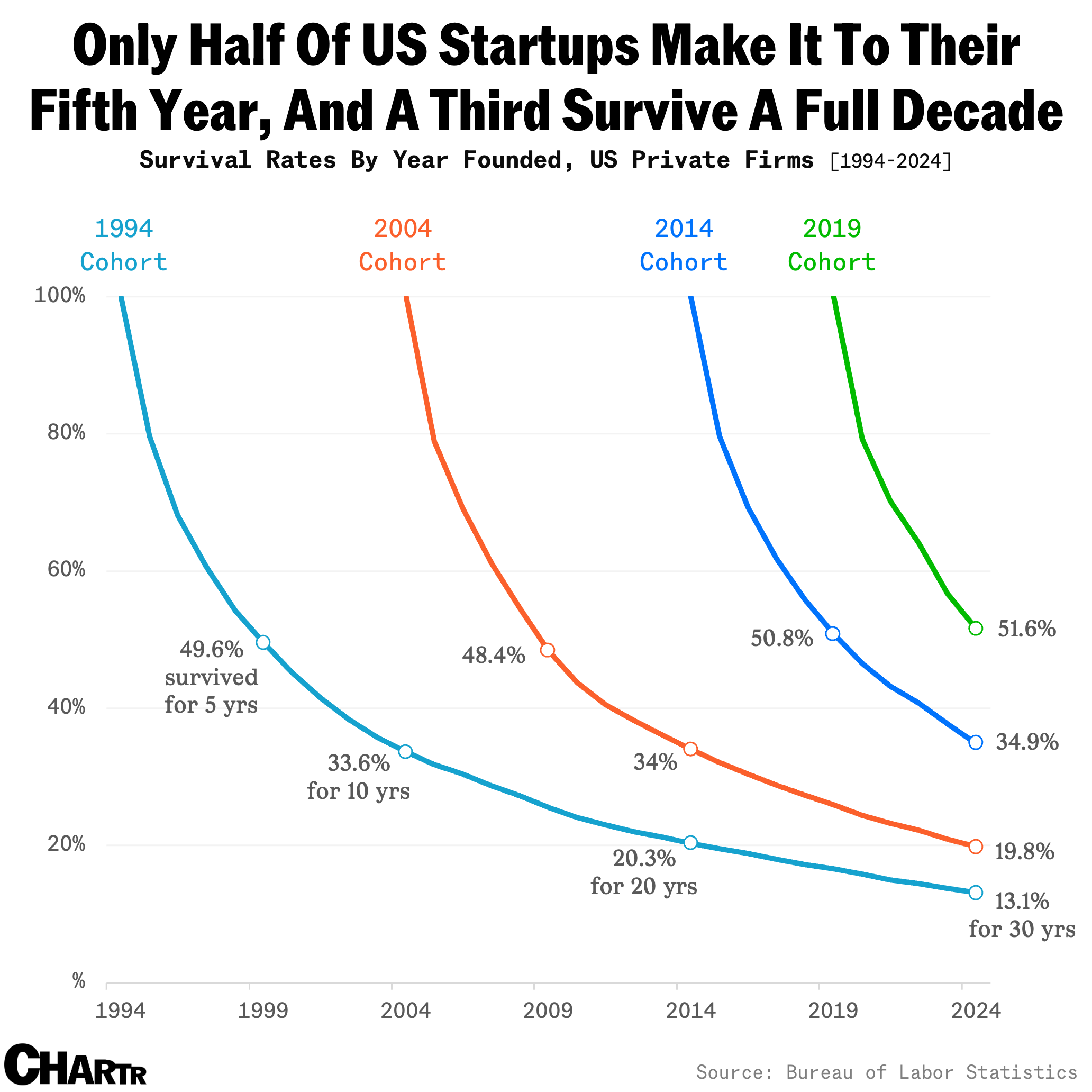
Roughly half of new US startups make it to their fifth birthday — and the most recent ones have even dodged the recession curse (so far).
According to an Axios analysis on the latest Bureau of Labor Statistics data, 51.6% of private sector firms founded in March 2019 were still operating as of March 2024. Zooming out, the typical life cycle of an American startup follows a familiar curve.
Limited life company
Of those founded since 1994, about one-third survived a full decade, roughly one in five makes it to year 20, and only around 13% are still standing after three decades, per data from the BLS.
So, who manages to last — and who doesn’t? Several factors are at play, including location and industry. Axios found that West Virginia (57.6%) and Connecticut (57.5%) had the highest five-year survival rates as of 2024, while Washington (41.1%), Missouri (43.2%), and DC (44.7%) ranked lowest, well below the national average.
Meanwhile, sectors with stable, regulated demand and high entry barriers — like agriculture and utilities — tend to endure longer, while those like mining and technology see faster churn, as innovation races, winner-take-all markets, and price swings can make longevity harder to achieve.
Beyond geography and type of business, timing matters, too, as business survival tends to rise and fall with the economic cycle.
Indeed, startups born just before or during downturns, like those from 2001 and 2006-7, typically show lower five-year survival rates than those born in the subsequent recovery periods (2003, 2010), according to BLS analysis.
What’s interesting, though, is that the pandemic era might have broken that pattern, with startups launched in 2018-19 posting the highest five-year survival on record. Several tailwinds could’ve helped, such as loans for small businesses rolled out during early Covid, government stimulus that propped up consumer demand, record-low borrowing costs, and a whopping 43% surge in e-commerce sales — all of which perhaps made the early 2020s an unexpectedly fertile moment for new companies.