Business
Indianapolis - March 2016: Chase Bank III
Chase Bank in Indianapolis, Indiana (Getty Images)
WITHDRAWALS

Bank branches are still closing at breakneck speed in the US

Institutions like Chase and Wells Fargo closed 76 locations in just six weeks over the summer, per the OCC.

Millie Giles

In the 1990s, Bill Gates said, “Banking is necessary, but banks are not.” At the time, this was a radical idea, but in hindsight, the Microsoft founder was onto something.

On Tuesday, an updated report from the Office of the Comptroller of the Currency revealed that major US banks closed a total of 74 locations — including Chase, Bank of America, and Wells Fargo, which all shuttered 14 branches each — in just the six weeks between July 17 and August 28 this year.

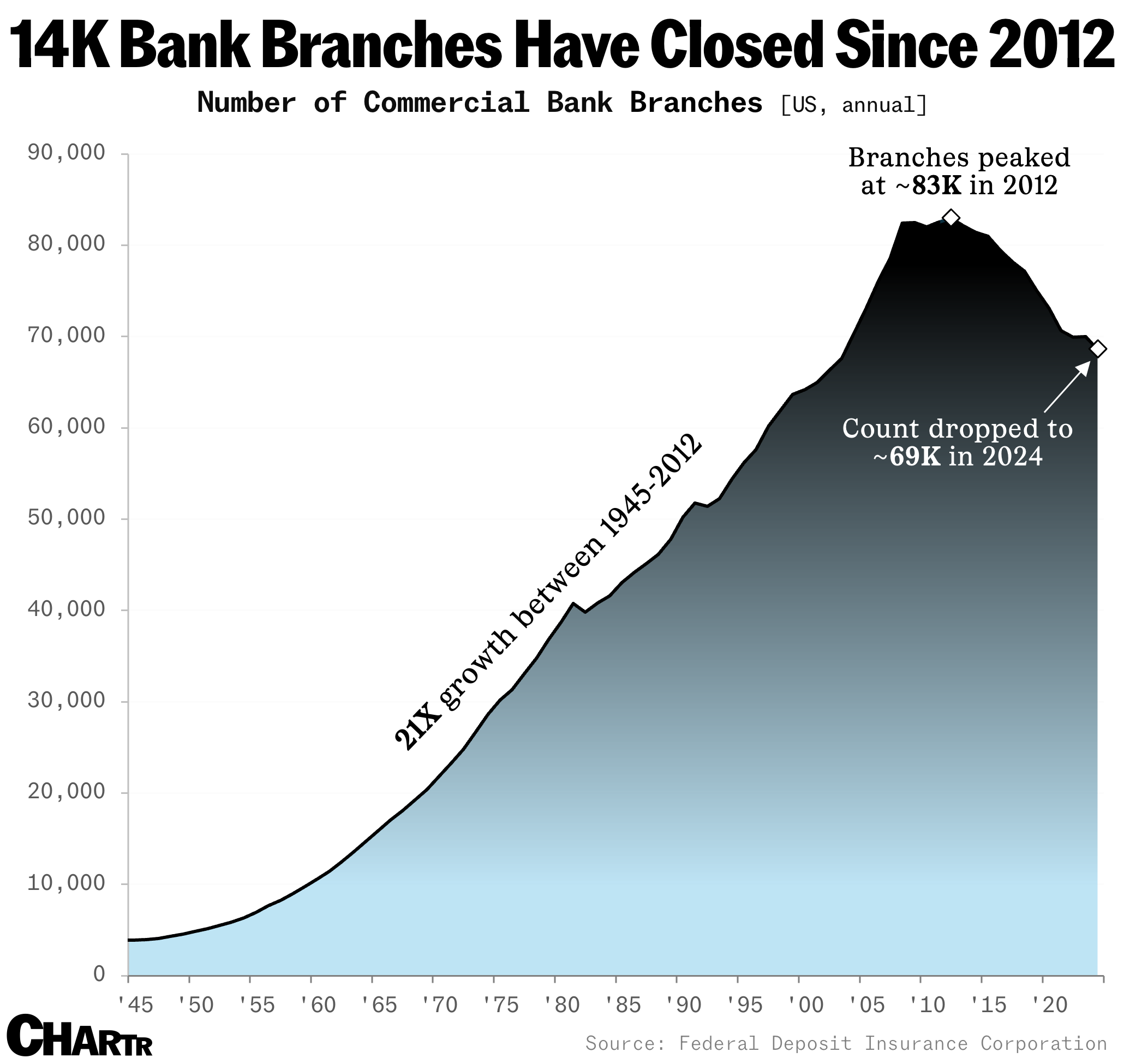
This follows a larger industry trend: according to data from the Federal Deposit Insurance Corp., following decades of near constant expansion throughout the 20th century, the number of commercial bank branches hit an all-time high of ~83,000 in 2012. Since then, more than 14,000 outposts have been culled, counting less than 69,000 branches in the US last year.
Bank branch closures 2024
Sherwood News

The tables haven’t just turned away from physical tellers; the data also shows that the number of commercial banks has fallen 35% since 2012, as smaller, regional institutions slowly disappear. Approximately 37 major US banking arms available in the 1990s are now consolidated into the “Big Four” — and, just this week, PNC Financial announced plans to buy Colorado-based FirstBank for $4.1 billion.

The decline in branches has occurred alongside the rise of online and mobile banking, with over half of Americans using in-app banking services more than any other method in 2024, per a survey from the American Bankers Association. But, even if some are missing the in-person experience, the banking sector itself isn’t finding a lack of branches a problem: the industry has posted a 15-year run of consistent profits, notching ~$70 billion in net income in the most recent quarter.

More Business

See all Business
business

Lucid climbs after Uber revealed to be its second-largest shareholder following recent investment

Shares of luxury EV maker Lucid are up more than 7% in premarket trading on Tuesday, following the release of a regulatory filing that revealed Uber is now its second-largest shareholder, trailing only Saudi Arabia’s PIF sovereign wealth fund.

The news follows an announcement earlier this month that Uber and Lucid would expand their robotaxi partnership from 20,000 planned vehicles to 35,000. Along with the expansion, Uber also said it would invest an additional $200 million into the EV maker.

Per Monday afternoon’s filing, it seems that investment pushed Uber’s ownership stake in Lucid to 11.52%.

Lucid’s stock is down 29% in April. It hit an all-time low of $6.75 on Monday ahead of the regulatory filing becoming public.

In a mark of just how painful the slide has been for Lucid shareholders, as of Monday, the company’s market cap had dropped to a quarter of the approximately $9.5 billion that Saudi Arabia’s PIF has sunk into it.

Capsule Pill and Dots

Justice Department accuses telehealth Zealthy of fraud, says remedy may bankrupt it

The feds say they don’t think Zealthy has the liquidity to pay what it owes customers.

Latest Stories

Sherwood Media, LLC produces fresh and unique perspectives on topical financial news and is a fully owned subsidiary of Robinhood Markets, Inc., and any views expressed here do not necessarily reflect the views of any other Robinhood affiliate, including Robinhood Markets, Inc., Robinhood Financial LLC, Robinhood Securities, LLC, Robinhood Crypto, LLC, Robinhood Derivatives, LLC, or Robinhood Money, LLC. Futures and event contracts are offered through Robinhood Derivatives, LLC.