
Tech
Xiaomi 2025 Q2 Revenue Growth
A Xiaomi electric vehicle is displayed in a Xiaomi Smart Home store in Shanghai, China (Costfoto/Getty Images)
On the shoulders of giants

Xiaomi is speedrunning building an electric vehicle business

Apple decided pivoting from phones to EVs was too hard. Xiaomi is finding it a piece of cake.

Going first is hard, and scary. You have to forge a path, fixing problems no one else has ever faced, without the ability to ask anyone for help. There’s a reason Google wasn’t the very first search engine and Facebook wasn’t the OG social media platform. It’s almost always easier to build on existing work — and no company is proving that better than Chinese tech giant Xiaomi with its new electric vehicle business.

Su got a fast car

In 2021, no one at Xiaomi knew how to make cars. Indeed, going from smartphones to EVs isn’t exactly a logical or easy next step — just ask Apple, which finally gave up on its moon shot car project after a decade.

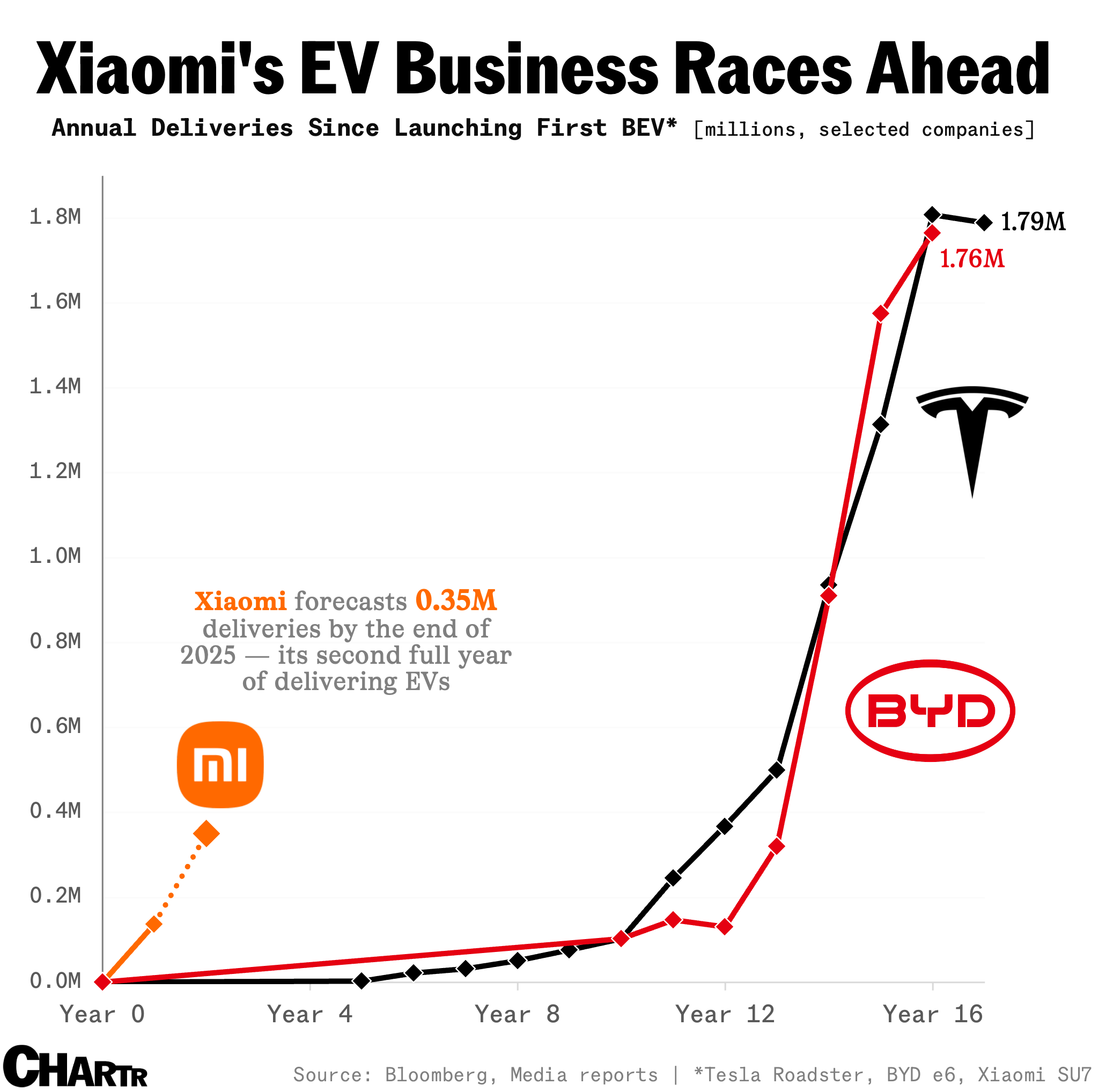
But facing a fresh round of US trade sanctions in 2021, execs at Xiaomi ran a scary thought experiment — what would happen to the company if the sanctions killed off its phone business? Xiaomi Auto was founded in September of that year, and now, less than four years on, the company thinks it can deliver 350,000 electric vehicles like its SU7 this fiscal year. That’s a milestone that took Tesla more than a decade, and domestic rival BYD even longer.
Xiaomi's EV business
Sherwood News

Phone down, car up

As yesterday’s earnings report revealed, cars are speeding up to become Xiaomi’s future, as the company — which has a ~15% share of the smartphone market — noted that the global smartphone industry itself is likely to experience near to zero collective growth this year, while intense price wars continue to chip away at profitability.

Meanwhile, Xiaomi’s smart EVs, AI, and new initiatives segment reached some $3 billion (RMB 21.3 billion) in revenue — finding a swath of middle- to high-income consumers that already love Xiaomi and aren’t swayed by rival BYD’s cheaper EV alternatives. The company is now looking to expand into Europe by 2027.

Being first is nice, but being second (or more like 50th in Xiaomi’s case) clearly doesn't prevent you from catching up quick.


More Tech

See all Tech
tech

Microsoft loses exclusive access to OpenAI’s models and tools while ending revenue-sharing deal with ChatGPT maker

Microsoft shares dropped as it announced a revised agreement with OpenAI.

The amended agreement ends revenue-sharing payments from Microsoft to OpenAI, and also ends Microsoft’s exclusive access to OpenAI’s intellectual property (i.e. models and products).

OpenAI’s revenue sharing with Microsoft will end in 2030, is subject to a total cap, and is no longer dependent on its achieving artificial general intelligence.

Amazon, a likely beneficiary of this lack of exclusivity, initially popped on the news but erased those gains.

This is a developing story.

tech

China just blew up one of Meta’s key AI bets

China has ordered Meta to unwind its $2 billion acquisition of Manus, a Chinese startup (since relocated to Singapore) that makes AI agents and was central to Meta’s push to turn its massive AI investments into a real business. The move is part of the Chinese government’s effort to stop US firms from gaining access to Chinese talent and intellectual property, as Washington continues to restrict sales of advanced AI chips to Chinese companies.

Unlike its tech peers, which can sell AI through cloud services, Meta mainly uses AI to improve its existing ad business rather than as a stand-alone revenue driver. The decision strips away one of Meta’s clearest paths to monetizing AI — leaving it spending like a hyperscaler, without a hyperscaler business model.

Unlike its tech peers, which can sell AI through cloud services, Meta mainly uses AI to improve its existing ad business rather than as a stand-alone revenue driver. The decision strips away one of Meta’s clearest paths to monetizing AI — leaving it spending like a hyperscaler, without a hyperscaler business model.

tech
Jon Keegan

DeepSeek releases new V4 series models highlighting efficiency and long context

Chinese AI lab DeepSeek has released a major new version of its eponymous open-source AI models that are nipping at the heels of leading frontier models in some areas.

The most significant DeepSeek-V4 Pro and DeepSeek-V4 Flash both have a 1 million-token context — the amount of information the model can actively work with in a single session — which is a crucial feature for complex, long-running coding tasks.

DeepSeek rebuilt how the models process information under the hood, making them substantially more efficient — and that efficiency is what makes the large context window actually usable.

Also, the new models’ coding skills have closed the gap with the major frontier models from Anthropic, OpenAI, and Google.

The authors of the model acknowledge some of V4’s shortcomings, such as its lower scores on reasoning benchmarks, saying that V4 “trails state-of-the-art frontier models by approximately 3 to 6 months.”

As open-weight models, V4 can be run on any user’s own hardware, making the V4 models among the top-performing open-source models out there. V4’s large context and token efficiency are especially significant among open-source models.

But like with earlier DeepSeek models, don’t ask it about Tiananmen Square.

DeepSeek rebuilt how the models process information under the hood, making them substantially more efficient — and that efficiency is what makes the large context window actually usable.

Also, the new models’ coding skills have closed the gap with the major frontier models from Anthropic, OpenAI, and Google.

The authors of the model acknowledge some of V4’s shortcomings, such as its lower scores on reasoning benchmarks, saying that V4 “trails state-of-the-art frontier models by approximately 3 to 6 months.”

As open-weight models, V4 can be run on any user’s own hardware, making the V4 models among the top-performing open-source models out there. V4’s large context and token efficiency are especially significant among open-source models.

But like with earlier DeepSeek models, don’t ask it about Tiananmen Square.

Latest Stories

Sherwood Media, LLC produces fresh and unique perspectives on topical financial news and is a fully owned subsidiary of Robinhood Markets, Inc., and any views expressed here do not necessarily reflect the views of any other Robinhood affiliate, including Robinhood Markets, Inc., Robinhood Financial LLC, Robinhood Securities, LLC, Robinhood Crypto, LLC, Robinhood Derivatives, LLC, or Robinhood Money, LLC. Futures and event contracts are offered through Robinhood Derivatives, LLC.
