
Tech
CHINA-ECONOMY-FORUM
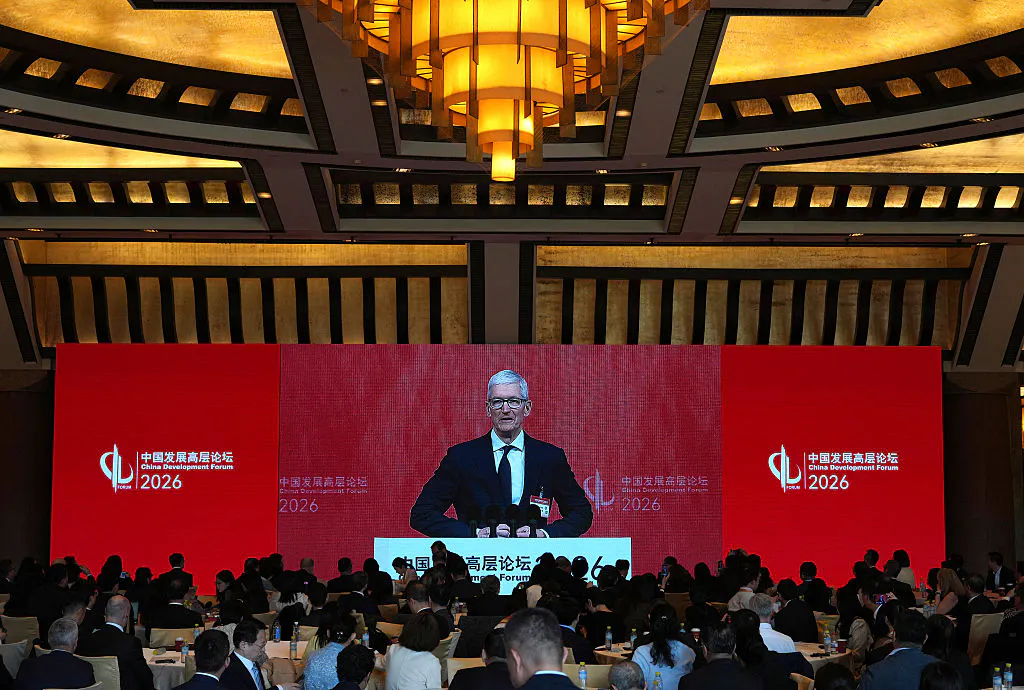
Apple CEO Tim Cook on a big screen broadcasting his speech live at the opening of the China Development Forum 2026 in Beijing in March (Ng Han Guan/Getty Images)
Let Tim Cook

Apple is on its way to becoming the biggest smartphone seller in China

The memory crunch has made iPhones a more popular alternative as competitors’ prices rise.

Rani Molla

Apple CEO Tim Cook earlier this year hailed the company’s holiday quarter as “the best iPhone quarter in history in Greater China,” with sales jumping 38%. New data for the first quarter of 2026 suggests Apple’s success in the world’s largest smartphone market is continuing, with shipments up double digits even as overall smartphone sales in China declined. That growth was fueled in part by the iPhone 17 itself, whose new design and colors helped Apple capitalize on a massive upgrade cycle.

The result: Apple’s smartphone shipment market share jumped to 19% in Q1 — typically a weak quarter for Apple — putting it just behind China’s own Huawei. And analysts expect Apple’s string of luck to continue, even as Cook, who is largely responsible for Apple’s success in China, steps down as CEO.

“Apple will very likely become number one in China,” Francisco Jeronimo, vice president of client devices at IDC, told Sherwood News, noting that in the first quarter, the gap between Huawei and Apple’s market share was less than 1% — a vulnerability exacerbated by recent launch delays for Huawei’s latest Mate 80 series. He estimates that Apple could take the top spot as early as the end of the year.

How did Apple get to this spot, when many American tech companies struggle to gain a foothold or even access to the Chinese market? There are two main reasons: one old, one new.

Apple became such a strong brand in China partly because the iPhone is manufactured in China, a move driven and nurtured by Cook that not only made Apple a household name there, but unintentionally set off a wave of copycats that also further boosted Apple’s cachet.

“Manufacturers in China learned how to build iPhones and started replicating that design,” Jeronimo said. “That gave consumers an option to buy a device that is not an iPhone, but looks exactly as an iPhone.”

Meanwhile, those who could afford the real thing bought the actual iPhone.

The result was a powerful dual effect: Apple’s design became the standard across China’s smartphone market, while the iPhone itself remained a premium, aspirational product. Building its devices in China also gave Apple the relationships and footing needed to operate in the lucrative market in the first place. Even as cheaper look-alikes spread, they reinforced demand for the real thing, helping cement the iPhone as a status symbol that consumers continue to trade up to, even in a slowing market.

More recently, rising memory costs have helped put the aspirational iPhone within reach for more consumers. As lower-end smartphone makers are forced to raise prices by roughly 30% to 50%, Apple has used its leverage over suppliers to keep its own prices relatively stable. Coupled with expanded Chinese smartphone subsidies, that has brought iPhones much closer in price to competing devices, making the trade-up easier to justify.

“Memory inflation is forcing many Chinese brands into a loss-leader pricing mentality just to maintain volume — Apple doesnt face the same structural pressure,” Ivan Lam, a senior analyst at Counterpoint Research, told Sherwood. The situation has “narrowed the price gap with iPhone and made Apples value case even cleaner.”

Going forward, analysts expect Apple’s winning streak to continue.

For one, Cook is staying on as Apple’s executive chairman, where he can continue the diplomacy that helped preserve Apple’s standing in both China and the United States.

Apple also has another potential tailwind on the horizon: it is expected to release a foldable phone this fall, and China is already the world’s biggest market for foldables.


More Tech

See all Tech
tech
Tom Jones

Prediction markets have, predictably, been given a boost by the summer of sports

Major platforms like Kalshi and Polymarket have seen huge upticks in users of late, thanks in no small part to what’s felt like a recent sporting smorgasbord, with major competitions across hockey, basketball, and soccer soaking up fans’ time (and spending, clearly) at the outset of summer.

While gaming industry groups may not like it, there’s been a huge change in the methods people are using to put money on the big games, with everyone from fortunate NYC bar owners, to a far less fortunate Spanish supporter, turning to prediction markets to try and turn their sports know-how into cold, hard cash.

According to a new report from Adam Blacker for apptopia, that shift might have been even more seismic than imagined in the wake of the NBA and NHL finals and around the 2026 World Cup kicking off.

While gaming industry groups may not like it, there’s been a huge change in the methods people are using to put money on the big games, with everyone from fortunate NYC bar owners, to a far less fortunate Spanish supporter, turning to prediction markets to try and turn their sports know-how into cold, hard cash.

According to a new report from Adam Blacker for apptopia, that shift might have been even more seismic than imagined in the wake of the NBA and NHL finals and around the 2026 World Cup kicking off.

South by Southwest Conference and Festivals

Gold Tesla Cybercabs are piling up, but they’re not picking up passengers yet

Low-volume production started in April. Now people are noticing them more and more in the wild.

Rani Molla6/15/26
tech
Jon Keegan

Anthropic pulls Fable and Mythos access worldwide after Trump administration bars their use by foreign nationals

Only days after releasing two versions of its next-gen AI model, Anthropic has disabled them for users worldwide.

Anthropic says it received a Friday night order from the Trump administration to suspend access to the models for any foreign national (anywhere in the world) — a group that included some Anthropic employees. In response, the company turned off access to everyone.

Last week, the company released to the public its much-anticipated Claude Fable 5 model (and its restricted version Claude Mythos 5, which is still being tested with trusted partners). Anthropic said in a blog post announcing the action that officials cited national security concerns with the new models, while offering few specific details.

The post said that the government gave the company “verbal evidence of a potential narrow, non-universal jailbreak” of the public Fable 5 model. A jailbreak is a means by which users can evade restrictions built into the code to unlock prohibited functionality. Anthropic downplayed the significance of the attack, and said other major models, such as OpenAI’s GPT-5.5, could also be affected by the technique described.

Fears of these first Mythos-class models being misused are running high, after Anthropic warned the cybersecurity world in May that the advanced cyber capabilities of Mythos have rapidly discovered thousands of vulnerabilities in ubiquitous software, leading to the decision to restrict the full version of the model to a close group of trusted partners for testing.

This morning, Axios reported that Anthropic technical staff have flown to Washington to meet with White House officials to resolve the issue.

The Wall Street Journal is reporting that the Trump administration’s decision to take action against Anthropic was prompted by discussions that Amazon CEO Andy Jassy had with officials, including Treasury Secretary Scott Bessent. According to the report, Amazon researchers said they had been able to evade some of Fable 5’s security restrictions using specific prompts. Amazon is a major investor in Anthropic.

Anthropic is currently suing the US government to fight the Pentagon’s blacklisting of the company on national security grounds.

Last week, the company released to the public its much-anticipated Claude Fable 5 model (and its restricted version Claude Mythos 5, which is still being tested with trusted partners). Anthropic said in a blog post announcing the action that officials cited national security concerns with the new models, while offering few specific details.

The post said that the government gave the company “verbal evidence of a potential narrow, non-universal jailbreak” of the public Fable 5 model. A jailbreak is a means by which users can evade restrictions built into the code to unlock prohibited functionality. Anthropic downplayed the significance of the attack, and said other major models, such as OpenAI’s GPT-5.5, could also be affected by the technique described.

Fears of these first Mythos-class models being misused are running high, after Anthropic warned the cybersecurity world in May that the advanced cyber capabilities of Mythos have rapidly discovered thousands of vulnerabilities in ubiquitous software, leading to the decision to restrict the full version of the model to a close group of trusted partners for testing.

This morning, Axios reported that Anthropic technical staff have flown to Washington to meet with White House officials to resolve the issue.

The Wall Street Journal is reporting that the Trump administration’s decision to take action against Anthropic was prompted by discussions that Amazon CEO Andy Jassy had with officials, including Treasury Secretary Scott Bessent. According to the report, Amazon researchers said they had been able to evade some of Fable 5’s security restrictions using specific prompts. Amazon is a major investor in Anthropic.

Anthropic is currently suing the US government to fight the Pentagon’s blacklisting of the company on national security grounds.

Latest Stories

Sherwood Media, LLC and Chartr Limited produce fresh and unique perspectives on topical financial news and are fully owned subsidiaries of Robinhood Markets, Inc., and any views expressed here do not necessarily reflect the views of any other Robinhood affiliate, including Robinhood Markets, Inc., Robinhood Financial LLC, Robinhood Securities, LLC, Robinhood Crypto, LLC, Robinhood Money, LLC, Robinhood U.K. Ltd, Robinhood Derivatives, LLC, Robinhood Gold, LLC, Robinhood Asset Management, LLC, Robinhood Credit, Inc., Robinhood Ventures DE, LLC and, where applicable, its managed investment vehicles.
