Tech
Microsoft Celebrates Its 50th Anniversary With Copilot AI Event
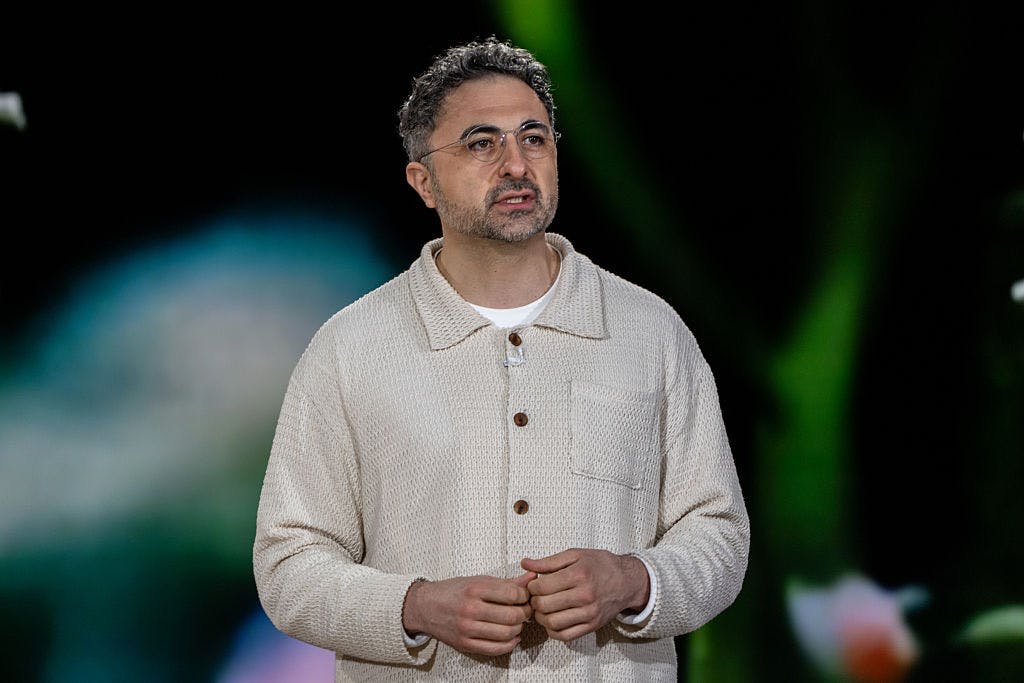
Microsoft AI CEO Mustafa Suleyman (Stephen Brashear/Getty Images)

Microsoft falls as it lays out plan for “Humanist Superintelligence” without OpenAI

Microsoft AI’s CEO explained its vision for superintelligence that prioritizes human control.

Rani Molla

Microsoft stock is down 2% after the company announced it is developing its own superintelligence team to pursue AI that surpasses humans, but also keeps humans in charge. The so-called “Humanist Superintelligence” (not to be confused with Meta’s regular superintelligence) will have “incredibly advanced AI capabilities that always work for, in service of, people and humanity more generally,” AI Chief Executive Mustafa Suleyman wrote.

It’s also Microsoft’s first attempt at achieving artificial general intelligence without OpenAI, which it’s now free to do after it renegotiated their partnership. In an interview with The Wall Street Journal, Suleyman praised the companies’ work together but also criticized chatbots that feel too human and trick people into thinking they’re sentient — a criticism others have leveled at OpenAI’s ChatGPT, which is widely considered to be leading the way with AI. While the two companies are continuing to work together, it’s also clear that Microsoft thinks it can make AI progress on its own.

AI is also very expensive — something that’s given investors pause lately as they wonder just how companies will pay for their giant capital outlays and how those will ultimately pay off. Meta last week took a big dive, partly because investors don’t see a clear route from the social media company’s massive AI infrastructure spending to revenue, since it’s not renting that infrastructure as a cloud business.

Even Microsoft, which has a robust cloud business, hasn’t escaped investor scrutiny over AI spending. Despite beating revenue and earnings expectations last week, the company’s stock fell in part because the company reversed its guidance on capital spending, now saying it would continue to rise instead of taper off.

Regardless of how humane it might be, the pursuit of superintelligence — and the talent and infrastructure it involves — will cost those who dare try it. And the payoffs are still unclear.

More Tech

See all Tech
tech

Two charts that show why Amazon is building a giant physical store

This week Amazon received approval to build a hybrid big-box store and fulfillment center outside Chicago that’s roughly twice the size of a typical Target. Why would the e-commerce giant want to wade into a costly and cumbersome physical store, especially after earlier brick-and-mortar iterations like Amazon Go have failed?

There are at least two reasons. First, despite e-commerce’s rapid growth, the vast majority of retail purchases still happen in physical stores, according to Census Bureau data:

Second, Amazon’s own customers regularly shop at competing big-box retailers. Consumer Intelligence Research Partners finds that 93% have also shopped at Walmart. And as Amazon pushes further into groceries — a category still dominated by in-person shopping — CIRP estimates that basically all Amazon customers buy groceries elsewhere.

tech

OpenAI rolls out age prediction system ahead of allowing adult content

OpenAI is rolling out a new “age prediction” feature for ChatGPT users.

The company will look at various signals from users to predict if a user is underage.

In a blog post, the company said:

“The model looks at a combination of behavioral and account-level signals, including how long an account has existed, typical times of day when someone is active, usage patterns over time, and a user’s stated age.”

If the system suspects the user is a minor, it will reduce content with graphic violence, harmful viral challenges, sexual or romantic role play, depictions of self-harm, and material promoting “extreme beauty standards, unhealthy dieting, or body shaming.”

If a user is incorrectly flagged as under 18, they will have to submit a selfie to an identity verification service to have the restrictions removed.

An age verification system is part of OpenAI’s plan to reduce harmful mental health encounters with the chatbot, while also allowing ChatGPT to generate “erotica” in the near future.

“The model looks at a combination of behavioral and account-level signals, including how long an account has existed, typical times of day when someone is active, usage patterns over time, and a user’s stated age.”

If the system suspects the user is a minor, it will reduce content with graphic violence, harmful viral challenges, sexual or romantic role play, depictions of self-harm, and material promoting “extreme beauty standards, unhealthy dieting, or body shaming.”

If a user is incorrectly flagged as under 18, they will have to submit a selfie to an identity verification service to have the restrictions removed.

An age verification system is part of OpenAI’s plan to reduce harmful mental health encounters with the chatbot, while also allowing ChatGPT to generate “erotica” in the near future.

tech

Google’s YouTube maintains its top spot as streaming accounts for nearly half of all TV-watching time

People spent a record 47.5% of their TV-watching time on streaming platforms in December, according to new data from Nielsen, up from the previous record of 47.3% in July. Google’s YouTube once again was the most popular streaming service by time spent, but Netflix’s share inched slightly upward to 9% from 8.8% in July, while YouTube’s fell to 12.7% from 13.4%. The jump was largely thanks to Stranger Things, which was the most watched streaming title last month.

tech

Amazon CEO says tariffs are inflating prices and buyers are looking for bargains

While the legality of President Trump’s tariffs winds its way through the courts, their effects are beginning to show up in prices.

During an interview at the World Economic Forum in Davos, Switzerland, Amazon CEO Andy Jassy said he is starting to see tariffs “creep into” pricing, as some sellers are “passing on those higher costs to consumers in the form of higher prices.”

Jassy said that while consumers are still spending, they are becoming more price conscious.

“I think that wherever they can, they are trying to trade down in price — they are looking for bargains wherever they can find bargains,” he said. “I see people a little more hesitant on higher-priced discretionary items.”

Trump has maintained that other countries are footing the bill for his tariffs. But new research suggests Americans will ultimately be the ones paying those higher prices.

Jassy said that while consumers are still spending, they are becoming more price conscious.

“I think that wherever they can, they are trying to trade down in price — they are looking for bargains wherever they can find bargains,” he said. “I see people a little more hesitant on higher-priced discretionary items.”

Trump has maintained that other countries are footing the bill for his tariffs. But new research suggests Americans will ultimately be the ones paying those higher prices.

Latest Stories

Sherwood Media, LLC produces fresh and unique perspectives on topical financial news and is a fully owned subsidiary of Robinhood Markets, Inc., and any views expressed here do not necessarily reflect the views of any other Robinhood affiliate, including Robinhood Markets, Inc., Robinhood Financial LLC, Robinhood Securities, LLC, Robinhood Crypto, LLC, or Robinhood Money, LLC.