
Tech
hyperion on manhattan
(Sherwood News)

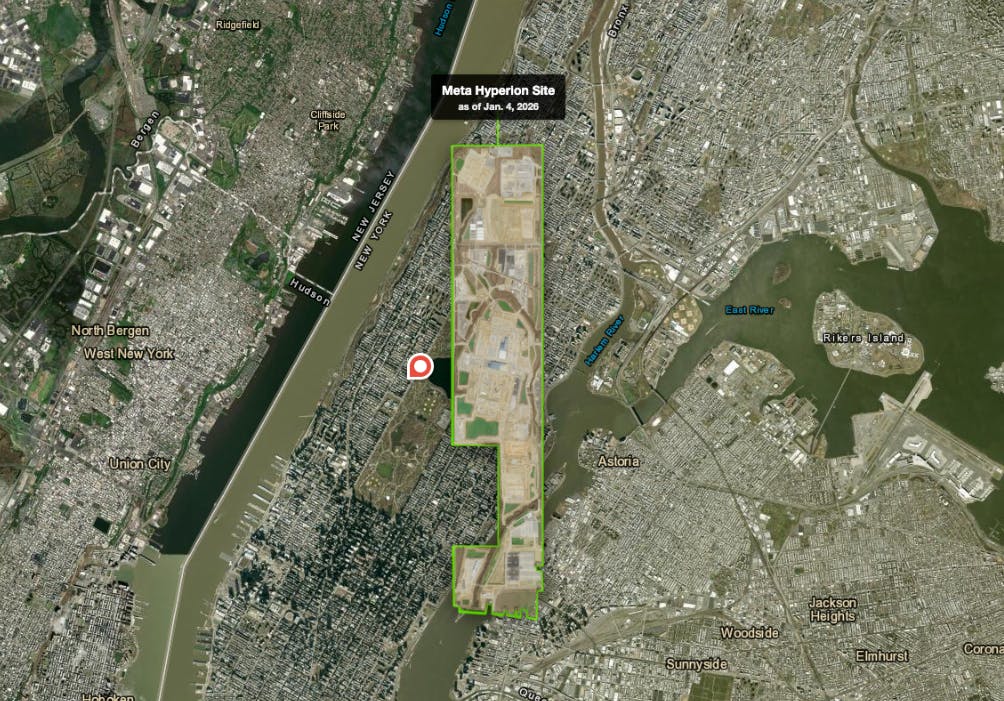
See for yourself just how massive Meta’s Hyperion data center is

It’s hard to overstate just how massive Meta’s Richland Parish, Louisiana, data center site is. Use this tool to compare it to where you live.

Jon Keegan

Massive. Titanic. Humongous. These words fail to capture the actual scale of Meta’s Hyperion data center, now well under construction in northeast Louisiana. The construction site is one of the largest such projects in the US.

Looking at a satellite image of the site, it’s hard to gauge its scale, surrounded by featureless farmland.

So we built an interactive map that lets you teleport the nearly 5-mile-long, 1-mile-wide Hyperion tract to some recognizable spots, like Manhattan, Washington, DC, and London.

And we even let you see how big this construction site would be if it were being built in your neighborhood. You can enter your address and imagine that Mark Zuckerberg’s mega data center is your new neighbor.

(Hyperion satellite photograph: Copernicus/ESA)

More Tech

See all Tech
tech

OpenAI’s models are officially coming to Amazon

Amazon is finally getting in on the hottest ticket in tech.

After Microsoft announced yesterday that it had agreed to give up its exclusive rights to sell OpenAI’s models, Amazon, as expected, will start offering them to customers — something AWS CEO Matt Garman says users have been asking for “for a really long time.” Some models are available now in preview, and the most powerful GPT versions will show up “in the coming weeks.”

This is a big shift in the AI cloud wars. Microsoft’s early bet on OpenAI gave Azure an edge by locking up the most in-demand models. Now that exclusivity is gone, Amazon and other competitors can finally offer them too, closing a key gap and competing more directly for AI customers.

This is a big shift in the AI cloud wars. Microsoft’s early bet on OpenAI gave Azure an edge by locking up the most in-demand models. Now that exclusivity is gone, Amazon and other competitors can finally offer them too, closing a key gap and competing more directly for AI customers.

tech

Ship-tracking app surges as Iran war continues

As Middle East peace talks stretch on, with Tehran reportedly offering to reopen the Strait of Hormuz if the US lifts its blockade and the war ends, the owner of shipping intelligence platform MarineTraffic revealed that the app has gained millions of new users since the conflict began.

MarineTraffic’s user count jumped to 8.5 million this April, up from 3.5 million a year ago, the cofounder of its parent company, Kpler, said in an interview with the Financial Times. Paid subscribers, often workers within companies and governments looking for more data on supply chains and commodities trading, rose 11,000 in the same period.

Kpler, which also owns shipping intelligence platform FleetMon, draws its data from a range of sources, including the Automatic Identification System, satellites, and more than 500 people on-site, like port terminal operators.

Per Appfigures data, MarineTraffic is estimated to have raked in almost $1 million across March and April in app revenue (through April 27), more than double the ~$346,500 from the same months last year. Across the full year, Kpler expects to earn between $300 million and $400 million in annual recurring revenues.

tech

Google will supply AI models to Pentagon in classified deal, per The Information

Google has become the latest tech company to ink an agreement to supply the Department of Defense (War) with AI, having reportedly closed a classified deal that allows the Pentagon to use its AI for “any lawful government purpose,” according to The Information.

The Information initially reported talks between the Alphabet-owned company and the US government around two weeks ago, following the messy breakdown of the relationship between Anthropic and the Trump administration — and the rushed OpenAI deal that took its place.

The move has reportedly sparked opposition among Google employees, with The Washington Post reporting that over 600 workers signed a letter to CEO Sundar Pichai to ask him to bar the Defense Department from using the company’s AI models for any classified work.

The Information initially reported talks between the Alphabet-owned company and the US government around two weeks ago, following the messy breakdown of the relationship between Anthropic and the Trump administration — and the rushed OpenAI deal that took its place.

The move has reportedly sparked opposition among Google employees, with The Washington Post reporting that over 600 workers signed a letter to CEO Sundar Pichai to ask him to bar the Defense Department from using the company’s AI models for any classified work.

Latest Stories

Sherwood Media, LLC produces fresh and unique perspectives on topical financial news and is a fully owned subsidiary of Robinhood Markets, Inc., and any views expressed here do not necessarily reflect the views of any other Robinhood affiliate, including Robinhood Markets, Inc., Robinhood Financial LLC, Robinhood Securities, LLC, Robinhood Crypto, LLC, Robinhood Derivatives, LLC, or Robinhood Money, LLC. Futures and event contracts are offered through Robinhood Derivatives, LLC.