Tech
World in hand
(Getty Images)
BIGGER NUMBER BETTER

Apple’s Services division and Meta’s Reality Labs are reminders of how dominant Big Tech really is

Both are mind-boggling, for different reasons.

This week, a number of Big Tech stocks reminded us just how dominant they really are. Yes, we used to balk at the thought of having a trillion-dollar company — now we have nine — but market valuations are only one way of contextualizing the sheer size of the BATMMAAN stocks.

Two divisions, both central to the future of their respective companies, Apple’s Services business and Meta’s Reality Labs division, offer another perspective.

Beyond the core

In its Q4 earnings, Apple revealed that, just as many reports had suggested, the latest AI-powered iPhone wasn’t proving as much of a pull for consumers as CEO Tim Cook would probably like, with sales down nearly 1% in its all-important holiday quarter. What is working at Apple, however, is its Services business, which clocked more than $26 billion in sales as the company topped 1 billion total subscriptions for things like Apple Music, TV+, iCloud, and more.
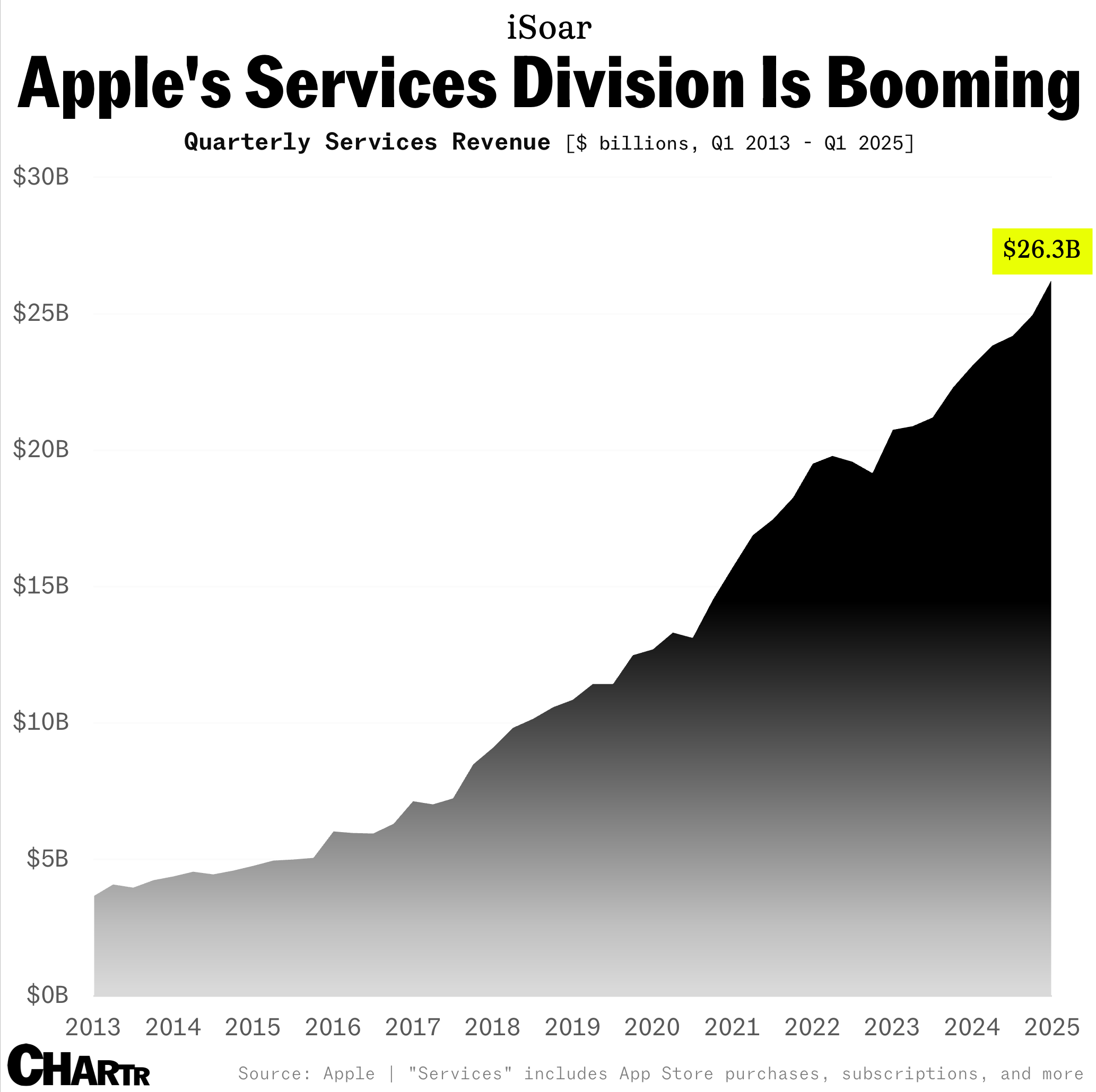
Apple Services
Sherwood News

To put that figure in context, if Apple’s Services division were a stand-alone business, let’s call it iServe, it would be the 37th-largest company in the S&P 500 Index by revenue. It would be more than double the size of Netflix or Uber. It would be more lucrative than consumer goods giant Procter & Gamble, larger than Disney, and would even outmatch Tesla in terms of pure revenue.
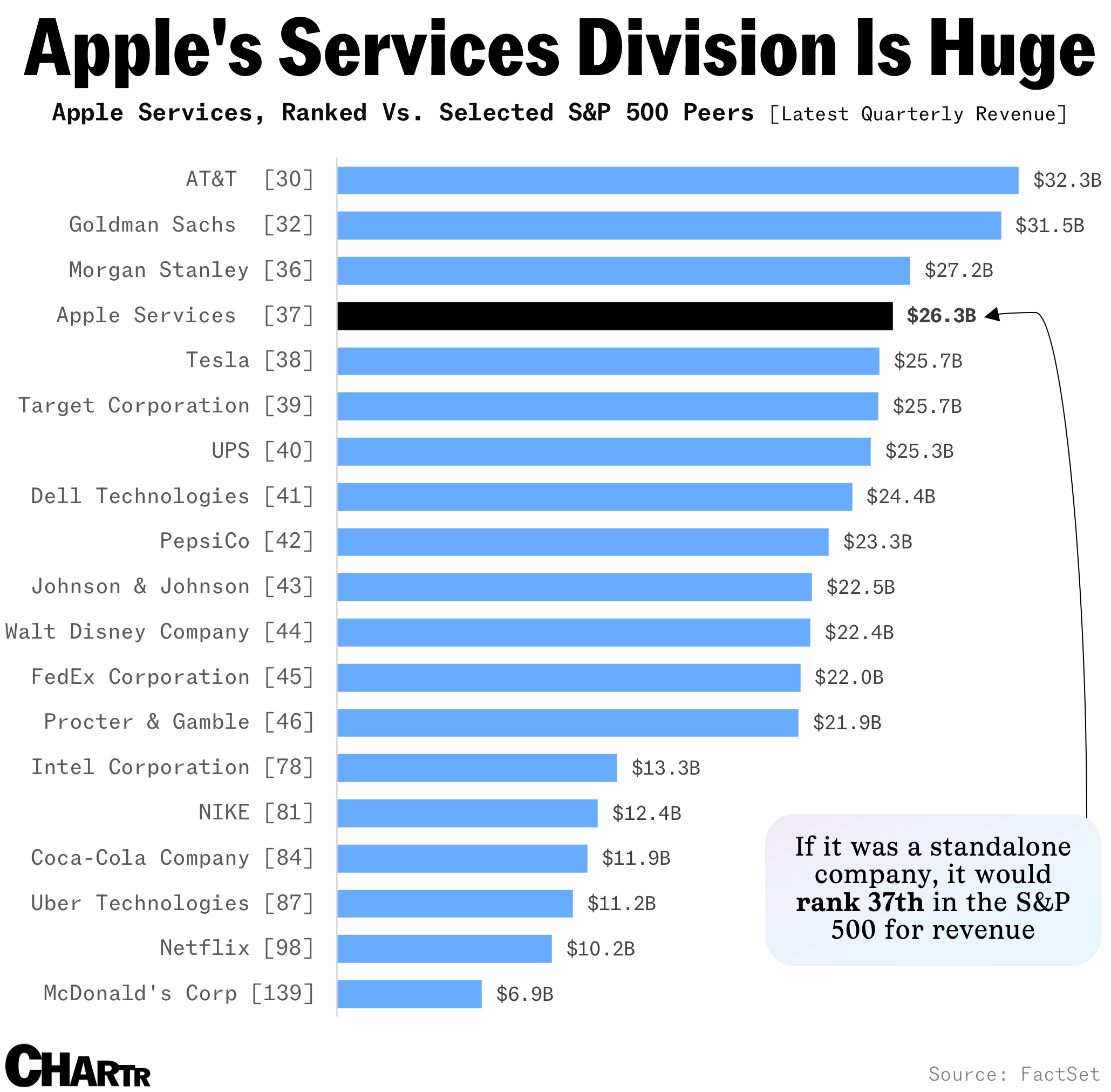
Perhaps most remarkable: it would be bigger than Coca-Cola and Nike combined.
Apple Services
Sherwood News

Now, moving on to Meta...

Reality check

Back in 2014, Facebook made its two largest acquisitions ever in just around a month’s time. The first was messaging giant WhatsApp, and the other was a small VR headset startup called Oculus. For the latter's potential to “create the most social platform ever,” CEO Mark Zuckerberg shelled out $2 billion.

That seemed like a lot of money at the time.

But since Facebook became Meta, Reality Labs, the augmented and virtual reality arm which expanded from Oculus, has lost the company a total of ~$60 billion since 2020.

To put that number in context, we’ll use Boeing, a company that’s been plagued by safety issues, union battles, scandals, and management change, and has reported six straight years of net losses. The sum total of those losses? A mere $35.7 billion — still 40% less cash than Reality Labs has burned through.
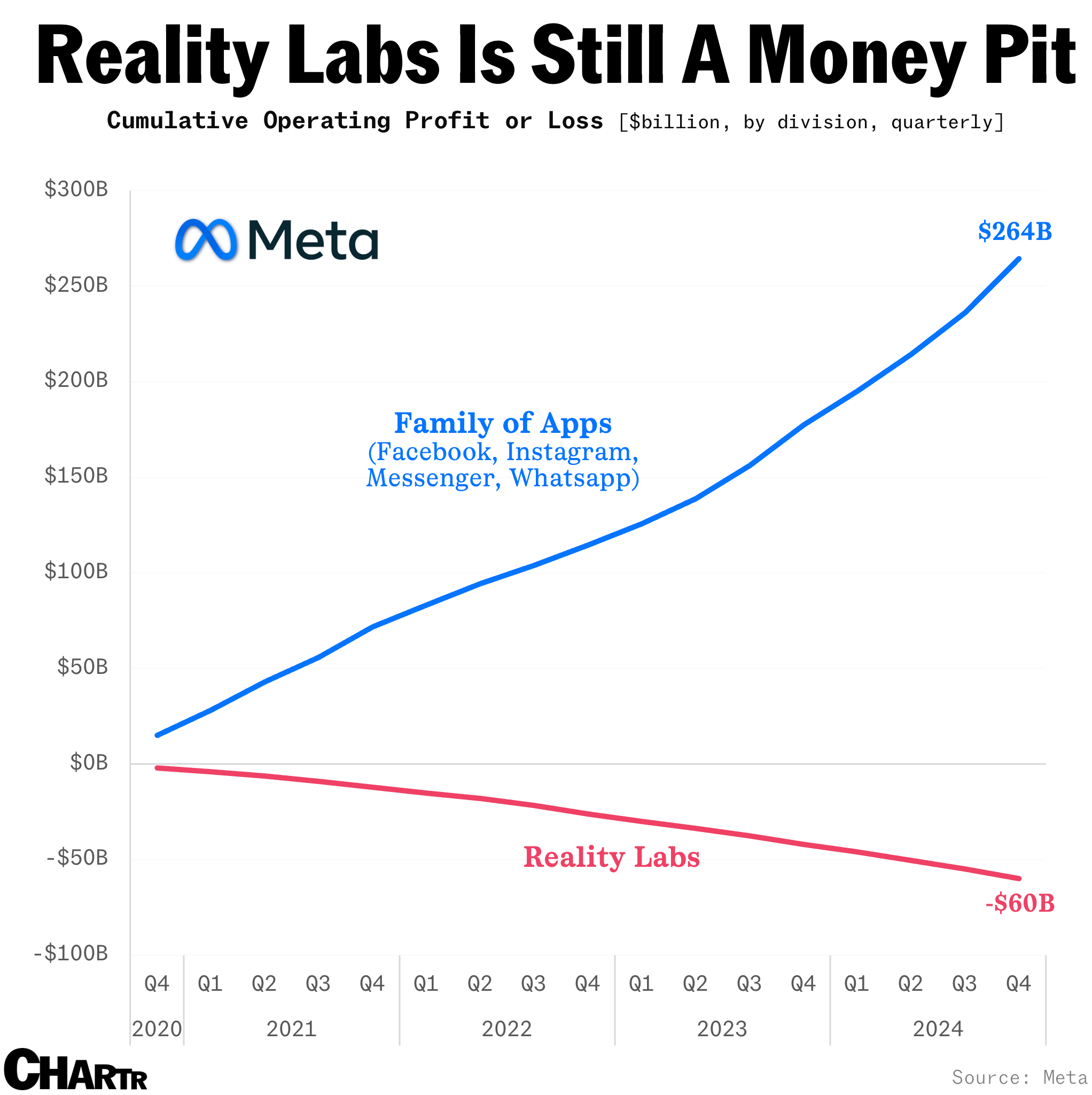
Reality Labs Losses
Sherwood News

Of course, Meta can afford to blow $60 billion on Reality Labs, as its “Family of Apps” division reported more than $260 billion in profit over the same period.

An obvious follow-up question: is Zuck’s “long-term investment” worth the burn? Well, on the plus side, Meta does continue to lead the VR/AR market with a 70% share, with the social media giant selling 3 million units of its latest Quest 3 through the first three quarters of the device’s launch, way ahead of Apple’s Vision Pro. 

Indeed, Meta’s leadership seems as keen as ever to pour cash into the business this year, with the company reportedly integrating Reality Labs more closely with its core functions and vowing 2025 will be “a pivotal year for the metaverse.” Meta is expected to spend $65 billion on capex in this year alone, thanks to the company’s cash-intensive AI ambitions.


More Tech

See all Tech
tech

Ship-tracking app surges as Iran war continues

As Middle East peace talks stretch on, with Tehran reportedly offering to reopen the Strait of Hormuz if the US lifts its blockade and the war ends, the owner of shipping intelligence platform MarineTraffic revealed that the app has gained millions of new users since the conflict began.

MarineTraffic’s user count jumped to 8.5 million this April, up from 3.5 million a year ago, the cofounder of its parent company, Kpler, said in an interview with the Financial Times. Paid subscribers, often workers within companies and governments looking for more data on supply chains and commodities trading, rose 11,000 in the same period.

Kpler, which also owns shipping intelligence platform FleetMon, draws its data from a range of sources, including the Automatic Identification System, satellites, and more than 500 people on-site, like port terminal operators.

Per Appfigures data, MarineTraffic is estimated to have raked in almost $1 million across March and April in app revenue (through April 27), more than double the ~$346,500 from the same months last year. Across the full year, Kpler expects to earn between $300 million and $400 million in annual recurring revenues.

tech

Google will supply AI models to Pentagon in classified deal, per The Information

Google has become the latest tech company to ink an agreement to supply the Department of Defense (War) with AI, having reportedly closed a classified deal that allows the Pentagon to use its AI for “any lawful government purpose,” according to The Information.

The Information initially reported talks between the Alphabet-owned company and the US government around two weeks ago, following the messy breakdown of the relationship between Anthropic and the Trump administration — and the rushed OpenAI deal that took its place.

The move has reportedly sparked opposition among Google employees, with The Washington Post reporting that over 600 workers signed a letter to CEO Sundar Pichai to ask him to bar the Defense Department from using the company’s AI models for any classified work.

The Information initially reported talks between the Alphabet-owned company and the US government around two weeks ago, following the messy breakdown of the relationship between Anthropic and the Trump administration — and the rushed OpenAI deal that took its place.

The move has reportedly sparked opposition among Google employees, with The Washington Post reporting that over 600 workers signed a letter to CEO Sundar Pichai to ask him to bar the Defense Department from using the company’s AI models for any classified work.

Latest Stories

Sherwood Media, LLC produces fresh and unique perspectives on topical financial news and is a fully owned subsidiary of Robinhood Markets, Inc., and any views expressed here do not necessarily reflect the views of any other Robinhood affiliate, including Robinhood Markets, Inc., Robinhood Financial LLC, Robinhood Securities, LLC, Robinhood Crypto, LLC, Robinhood Derivatives, LLC, or Robinhood Money, LLC. Futures and event contracts are offered through Robinhood Derivatives, LLC.