
Tech
Data tunnel
(Getty Images)

AI is eating the startup world

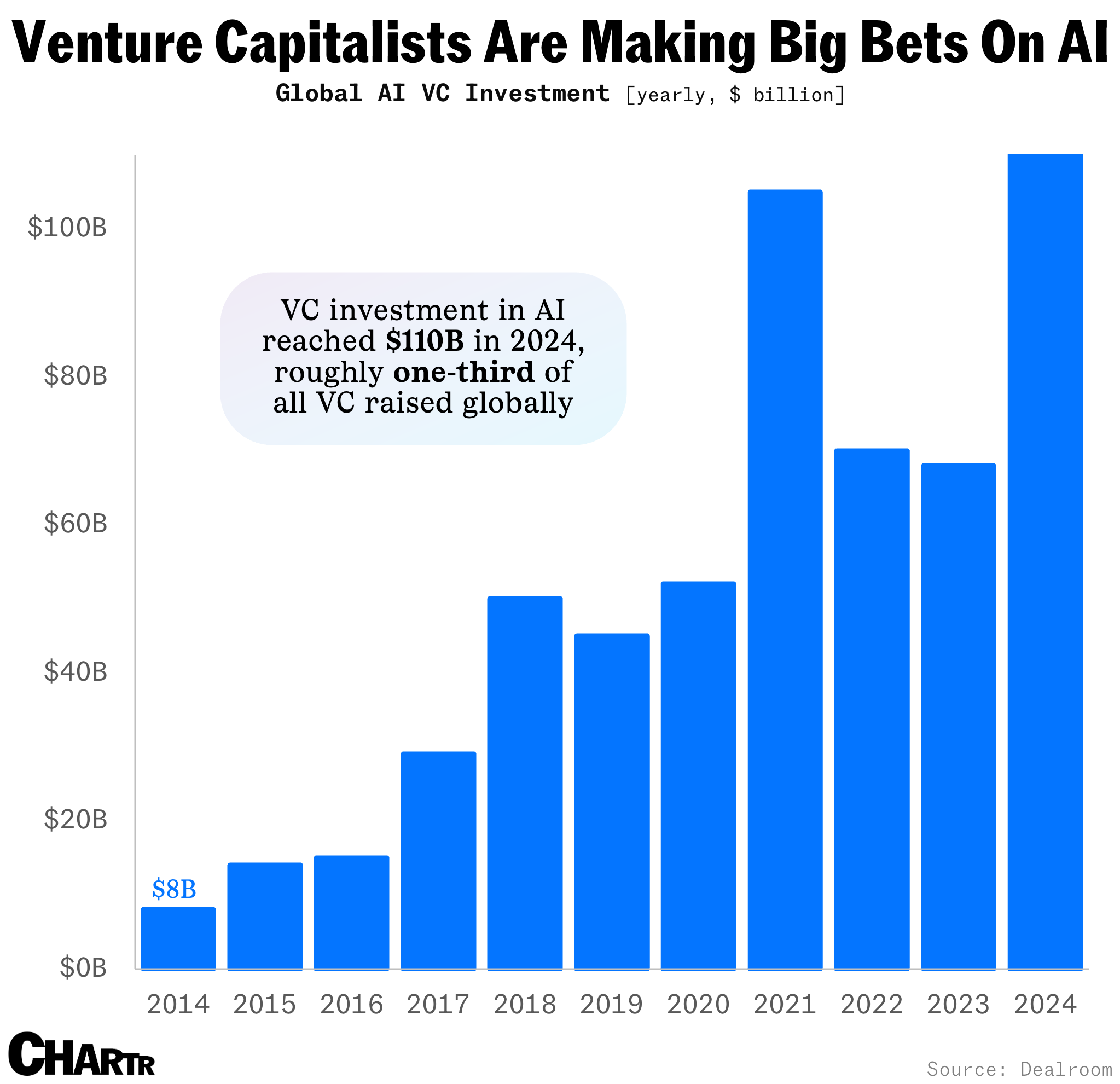
Venture capitalists splurged $110 billion on AI startups last year.

Increasingly, the due diligence for getting an ambitious world-changing technology business funded starts with a simple question: how does it use AI?

If the answer is it doesn’t, don’t expect the global gatekeepers of startup capital to go out of their way to write you a check. According to new data out this week from analytics firm Dealroom, the AI funding frenzy continued at pace last year with ~$110 billion pouring into the sector globally, about 33% of the total investment in the entire VC space.

This figure included outsized funding rounds like AI’s poster child OpenAI raking in $6.6 billion and AI data-processing platform Databricks with an even more staggering $10 billion.
AI VC investment
Sherwood News

But the boom isn’t just limited to more established, later-stage companies. Even at the very earliest stages of the venture capital funding ladder — seed and pre-seed stages — the omnipresence of AI is staggering.

AI: In everything, everywhere, all at once

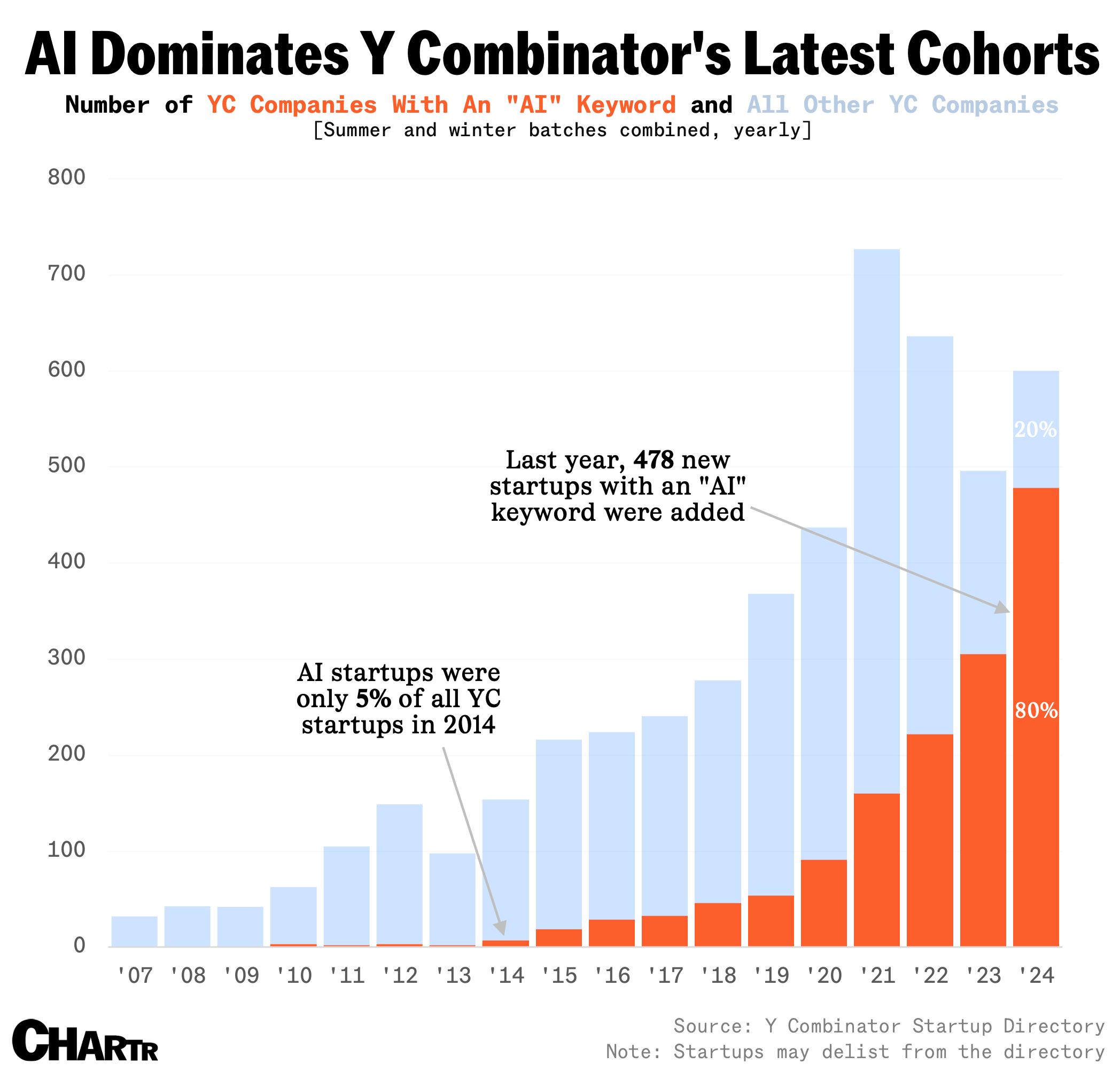
Last year we wrote about how Y Combinator — the world’s preeminent startup accelerator that has backed Airbnb, Reddit, and Stripe — was seeing an overwhelming influx of founders and startups working in AI.

Indeed, data from Y Combinator reveals that some 80% of the companies in its Startup Directory last year had “AI” in either the company name or description of what it does. Just five years ago, that proportion was only 15%.
Y Combinator proportion of startups with “AI” in name or description chart
Sherwood News

Clearly, there are multiple factors at play. Some are straightforward:

  • AI is progressing on a weekly or even daily basis, creating new opportunities for entrepreneurs to use AI as a tool in almost every industry.

Some are a bit more cynical, like FOMO, signaling, or playing the odds:

  • VC investors don’t want to miss out on the boom, with some blindly backing almost anything AI-adjacent.

  • Startup founders know that AI is the hot thing now, and are finding ways to incorporate it into their products... no matter what their original product idea was.

Winners and losers

Venture capital investing is inherently a high-risk endeavor. The typical model for a VC fund follows a power law and requires that one or two breakout mega-successes pay for the dozens of failures.

That law will undoubtedly play out again in the AI space. Most of the startups will fail as they scramble to figure out a viable business model. And raising billions isn’t always enough — Inflection AI, for one, made no money and had to fold its original generative-AI business even after raising $1.5 billion. Even the tech giants, like Meta, admitted earlier last year that the company is “scaling the product before it is making money,” pledging to spend up to $65 billion on AI this year.

Ultimately, it’s still unclear to almost everyone exactly where in the value chain the profit pools will finally accumulate. Will the infrastructure and chip providers like Nvidia be the ultimate winners? Or will it be the creators of the foundational models like OpenAI, Meta, or Alphabet? What about the downstream effects? Will Duolingo, a language-learning app, become completely obsolete because AI will provide perfect translation in real time? Or will AI enable Duolingo to build more powerful tools than ever before?

It’s still too early to tell, which is why the VC market has exploded in almost every vertical, even after the end of the global zero-interest rate era. After a record year in 2021, the VC world rightsized in 2022 and 2023 before a 30% jump in total capital raised last year, thanks primarily to a 62% growth in AI-related venture capital, while investments in the rest of tech fell 12%. VC investors can’t hang around on the sidelines.


More Tech

See all Tech
tech

Microsoft loses exclusive access to OpenAI’s models and tools while ending revenue-sharing deal with ChatGPT maker

Microsoft shares dropped as it announced a revised agreement with OpenAI.

The amended agreement ends revenue-sharing payments from Microsoft to OpenAI, and also ends Microsoft’s exclusive access to OpenAI’s intellectual property (i.e. models and products).

OpenAI’s revenue sharing with Microsoft will end in 2030, is subject to a total cap, and is no longer dependent on its achieving artificial general intelligence.

Amazon, a likely beneficiary of this lack of exclusivity, initially popped on the news but erased those gains.

This is a developing story.

tech

China just blew up one of Meta’s key AI bets

China has ordered Meta to unwind its $2 billion acquisition of Manus, a Chinese startup (since relocated to Singapore) that makes AI agents and was central to Meta’s push to turn its massive AI investments into a real business. The move is part of the Chinese government’s effort to stop US firms from gaining access to Chinese talent and intellectual property, as Washington continues to restrict sales of advanced AI chips to Chinese companies.

Unlike its tech peers, which can sell AI through cloud services, Meta mainly uses AI to improve its existing ad business rather than as a stand-alone revenue driver. The decision strips away one of Meta’s clearest paths to monetizing AI — leaving it spending like a hyperscaler, without a hyperscaler business model.

Unlike its tech peers, which can sell AI through cloud services, Meta mainly uses AI to improve its existing ad business rather than as a stand-alone revenue driver. The decision strips away one of Meta’s clearest paths to monetizing AI — leaving it spending like a hyperscaler, without a hyperscaler business model.

tech
Jon Keegan

DeepSeek releases new V4 series models highlighting efficiency and long context

Chinese AI lab DeepSeek has released a major new version of its eponymous open-source AI models that are nipping at the heels of leading frontier models in some areas.

The most significant DeepSeek-V4 Pro and DeepSeek-V4 Flash both have a 1 million-token context — the amount of information the model can actively work with in a single session — which is a crucial feature for complex, long-running coding tasks.

DeepSeek rebuilt how the models process information under the hood, making them substantially more efficient — and that efficiency is what makes the large context window actually usable.

Also, the new models’ coding skills have closed the gap with the major frontier models from Anthropic, OpenAI, and Google.

The authors of the model acknowledge some of V4’s shortcomings, such as its lower scores on reasoning benchmarks, saying that V4 “trails state-of-the-art frontier models by approximately 3 to 6 months.”

As open-weight models, V4 can be run on any user’s own hardware, making the V4 models among the top-performing open-source models out there. V4’s large context and token efficiency are especially significant among open-source models.

But like with earlier DeepSeek models, don’t ask it about Tiananmen Square.

DeepSeek rebuilt how the models process information under the hood, making them substantially more efficient — and that efficiency is what makes the large context window actually usable.

Also, the new models’ coding skills have closed the gap with the major frontier models from Anthropic, OpenAI, and Google.

The authors of the model acknowledge some of V4’s shortcomings, such as its lower scores on reasoning benchmarks, saying that V4 “trails state-of-the-art frontier models by approximately 3 to 6 months.”

As open-weight models, V4 can be run on any user’s own hardware, making the V4 models among the top-performing open-source models out there. V4’s large context and token efficiency are especially significant among open-source models.

But like with earlier DeepSeek models, don’t ask it about Tiananmen Square.

Latest Stories

Sherwood Media, LLC produces fresh and unique perspectives on topical financial news and is a fully owned subsidiary of Robinhood Markets, Inc., and any views expressed here do not necessarily reflect the views of any other Robinhood affiliate, including Robinhood Markets, Inc., Robinhood Financial LLC, Robinhood Securities, LLC, Robinhood Crypto, LLC, Robinhood Derivatives, LLC, or Robinhood Money, LLC. Futures and event contracts are offered through Robinhood Derivatives, LLC.
