
Tech
Data center vs office spending
Sherwood News

The AI infrastructure debate’s heating up, as spending on data centers set to outpace office construction

Multiple gargantuan data center projects got announced this week — some people see huge risks of fruitless spending, while others, like Sam Altman, think the build-out could be too slow.

Depending on who you ask, the AI data center boom is either an obscene waste or not fast enough.

Just yesterday, famed investor David Einhorn cautioned that there’s a “chance that a tremendous amount of capital destruction is going to come through this cycle.” Sam Altman, however, thinks that OpenAI’s hundreds of billions of dollars worth of spending will “look slow” in hindsight.

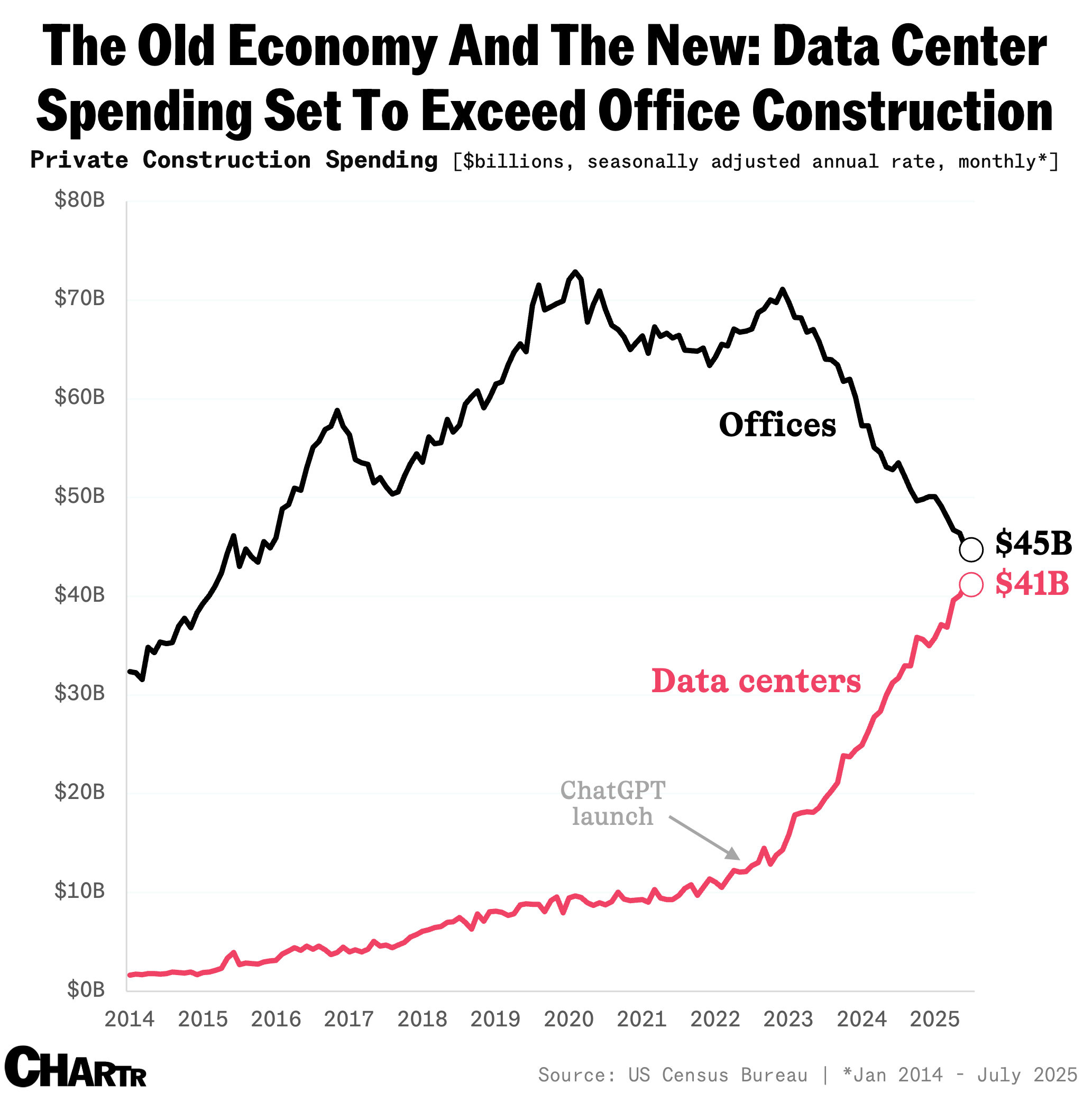
It’s hard to get your head around just how quickly the data center boom is taking off, but a viral chart from Joey Politano helps provide context. Indeed, according to Census Bureau data, construction spending for data centers in the year to July has reached an annualized rate of $41 billion — nearly exceeding the construction costs of all private offices in the US.
Data center vs office spending
Sherwood News

That’s a whopping 2,200% increase since July 2014.

With such an attractive alternative, investors are increasingly choosing to build data centers rather than offices, a trend accelerated by the shift toward remote work as many offices empty out postpandemic.

Data center construction spending accelerated after ChatGPT’s launch in late 2022, and the Census Bureau soon started to publish data center expenditure as a separate category. (Until then, data center was, ironically, lumped into the wider “Office” segment.)

Considering the Census Bureau’s annual spending data covers until the end of July, the data likely does not include the latest construction plans, such as the following, to name but a few, suggesting it’s only a matter of time before these two lines cross:

Related reading: Clash of the titans: Here are the biggest AI data center projects

More Tech

See all Tech
tech

Microsoft loses exclusive access to OpenAI’s models and tools while ending revenue-sharing deal with ChatGPT maker

Microsoft shares dropped as it announced a revised agreement with OpenAI.

The amended agreement ends revenue-sharing payments from Microsoft to OpenAI, and also ends Microsoft’s exclusive access to OpenAI’s intellectual property (i.e. models and products).

OpenAI’s revenue sharing with Microsoft will end in 2030, is subject to a total cap, and is no longer dependent on its achieving artificial general intelligence.

Amazon, a likely beneficiary of this lack of exclusivity, initially popped on the news but erased those gains.

This is a developing story.

tech

China just blew up one of Meta’s key AI bets

China has ordered Meta to unwind its $2 billion acquisition of Manus, a Chinese startup (since relocated to Singapore) that makes AI agents and was central to Meta’s push to turn its massive AI investments into a real business. The move is part of the Chinese government’s effort to stop US firms from gaining access to Chinese talent and intellectual property, as Washington continues to restrict sales of advanced AI chips to Chinese companies.

Unlike its tech peers, which can sell AI through cloud services, Meta mainly uses AI to improve its existing ad business rather than as a stand-alone revenue driver. The decision strips away one of Meta’s clearest paths to monetizing AI — leaving it spending like a hyperscaler, without a hyperscaler business model.

Unlike its tech peers, which can sell AI through cloud services, Meta mainly uses AI to improve its existing ad business rather than as a stand-alone revenue driver. The decision strips away one of Meta’s clearest paths to monetizing AI — leaving it spending like a hyperscaler, without a hyperscaler business model.

tech
Jon Keegan

DeepSeek releases new V4 series models highlighting efficiency and long context

Chinese AI lab DeepSeek has released a major new version of its eponymous open-source AI models that are nipping at the heels of leading frontier models in some areas.

The most significant DeepSeek-V4 Pro and DeepSeek-V4 Flash both have a 1 million-token context — the amount of information the model can actively work with in a single session — which is a crucial feature for complex, long-running coding tasks.

DeepSeek rebuilt how the models process information under the hood, making them substantially more efficient — and that efficiency is what makes the large context window actually usable.

Also, the new models’ coding skills have closed the gap with the major frontier models from Anthropic, OpenAI, and Google.

The authors of the model acknowledge some of V4’s shortcomings, such as its lower scores on reasoning benchmarks, saying that V4 “trails state-of-the-art frontier models by approximately 3 to 6 months.”

As open-weight models, V4 can be run on any user’s own hardware, making the V4 models among the top-performing open-source models out there. V4’s large context and token efficiency are especially significant among open-source models.

But like with earlier DeepSeek models, don’t ask it about Tiananmen Square.

DeepSeek rebuilt how the models process information under the hood, making them substantially more efficient — and that efficiency is what makes the large context window actually usable.

Also, the new models’ coding skills have closed the gap with the major frontier models from Anthropic, OpenAI, and Google.

The authors of the model acknowledge some of V4’s shortcomings, such as its lower scores on reasoning benchmarks, saying that V4 “trails state-of-the-art frontier models by approximately 3 to 6 months.”

As open-weight models, V4 can be run on any user’s own hardware, making the V4 models among the top-performing open-source models out there. V4’s large context and token efficiency are especially significant among open-source models.

But like with earlier DeepSeek models, don’t ask it about Tiananmen Square.

Latest Stories

Sherwood Media, LLC produces fresh and unique perspectives on topical financial news and is a fully owned subsidiary of Robinhood Markets, Inc., and any views expressed here do not necessarily reflect the views of any other Robinhood affiliate, including Robinhood Markets, Inc., Robinhood Financial LLC, Robinhood Securities, LLC, Robinhood Crypto, LLC, Robinhood Derivatives, LLC, or Robinhood Money, LLC. Futures and event contracts are offered through Robinhood Derivatives, LLC.

