
Tech
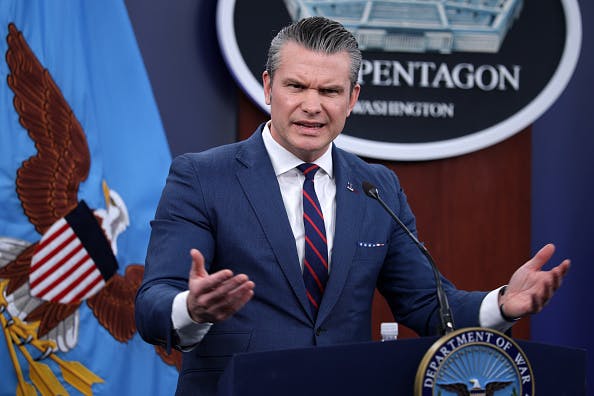
Secretary Hegseth And Chairman Caine Hold Pentagon Press Briefing On Iran Strikes
(Alex Wong/Getty Images)

A blow-by-blow catch-up on how Trump vs. Anthropic has unfolded

A consequential week punctuated by war highlights the deep rifts that exist between Silicon Valley and Washington.

Jon Keegan

Last week’s tense standoff between Anthropic and Defense Secretary Pete Hegseth focused on the issue of how the startup’s AI could be hypothetically used to surveil Americans or kill people. By the weekend, that hypothetical scenario became very real.

Tensions started after a tense meeting at the Pentagon, which resulted in Hegseth giving Anthropic CEO Dario Amodei an ultimatum: he had until Friday at 5:01 p.m. ET to get onboard with the Pentagon’s demands for full use of Claude for any legal purpose, or face the consequences. Here’s a quick timeline of how this fast-moving story unfolded:

  • Thursday 5:36 p.m. ET - Anthropic posted a statement from Amodei that the company will not acquiesce to Pentagon demands to allow the use of its Claude tool for any legal purpose.

  • Friday 3:47 p.m. ET - President Trump lashed out at the startup, calling it a “RADICAL LEFT, WOKE COMPANY,” and said he was directing all federal agencies to cease use of Anthropic’s software.

  • Friday 5:14 p.m. ET - In a post on X, Hegseth chided Anthropic’s refusal, and in an extraordinary move, said he would move to designate Anthropic “a Supply-Chain Risk to National Security,” effectively blacklisting the company’s tech from use by the US military or any contractors (like Palantir) working with the Pentagon on national security applications.

  • Friday 8:24 p.m. ET - In another blog post, Amodei defended Anthropic’s position and signaled that it may pursue legal action, calling the move “legally unsound.”

  • Friday 9:56 p.m. ET - OpenAI CEO Sam Altman posted on X that his company reached an agreement to deploy its models on the Pentagon’s classified network.

  • Saturday 1:15 a.m. ET - The American and Israeli attack on Iran commenced.

  • Saturday 8:21 p.m. ET - The Wall Street Journal reported that Anthropic’s Claude was used by the Pentagon to assess intelligence, identify targets, and simulate battle scenarios.

  • Sunday - Anthropic’s Claude app rose to the No. 1 spot on the iOS app store, dethroning ChatGPT.

The feud sent a chill through Silicon Valley, as companies wondered what control they would have going forward if the government decided it needed their tech.


More Tech

See all Tech
tech

Google will supply AI models to Pentagon in classified deal, per The Information

Google has become the latest tech company to ink an agreement to supply the Department of Defense (War) with AI, having reportedly closed a classified deal that allows the Pentagon to use its AI for “any lawful government purpose,” according to The Information.

The Information initially reported talks between the Alphabet-owned company and the US government around two weeks ago, following the messy breakdown of the relationship between Anthropic and the Trump administration — and the rushed OpenAI deal that took its place.

The move has reportedly sparked opposition among Google employees, with the Washington Post reporting that over 600 workers signed a letter to CEO Sundar Pichai to ask him to bar the Defense Department from using the company’s AI models for any classified work.

The Information initially reported talks between the Alphabet-owned company and the US government around two weeks ago, following the messy breakdown of the relationship between Anthropic and the Trump administration — and the rushed OpenAI deal that took its place.

The move has reportedly sparked opposition among Google employees, with the Washington Post reporting that over 600 workers signed a letter to CEO Sundar Pichai to ask him to bar the Defense Department from using the company’s AI models for any classified work.

tech

Microsoft loses exclusive access to OpenAI’s models and tools while ending revenue-sharing deal with ChatGPT maker

Microsoft shares dropped as it announced a revised agreement with OpenAI.

The amended agreement ends revenue-sharing payments from Microsoft to OpenAI, and also ends Microsoft’s exclusive access to OpenAI’s intellectual property (i.e. models and products).

OpenAI’s revenue sharing with Microsoft will end in 2030, is subject to a total cap, and is no longer dependent on its achieving artificial general intelligence.

Amazon, a likely beneficiary of this lack of exclusivity, initially popped on the news but erased those gains.

This is a developing story.

tech

China just blew up one of Meta’s key AI bets

China has ordered Meta to unwind its $2 billion acquisition of Manus, a Chinese startup (since relocated to Singapore) that makes AI agents and was central to Meta’s push to turn its massive AI investments into a real business. The move is part of the Chinese government’s effort to stop US firms from gaining access to Chinese talent and intellectual property, as Washington continues to restrict sales of advanced AI chips to Chinese companies.

Unlike its tech peers, which can sell AI through cloud services, Meta mainly uses AI to improve its existing ad business rather than as a stand-alone revenue driver. The decision strips away one of Meta’s clearest paths to monetizing AI — leaving it spending like a hyperscaler, without a hyperscaler business model.

Unlike its tech peers, which can sell AI through cloud services, Meta mainly uses AI to improve its existing ad business rather than as a stand-alone revenue driver. The decision strips away one of Meta’s clearest paths to monetizing AI — leaving it spending like a hyperscaler, without a hyperscaler business model.

Latest Stories

Sherwood Media, LLC produces fresh and unique perspectives on topical financial news and is a fully owned subsidiary of Robinhood Markets, Inc., and any views expressed here do not necessarily reflect the views of any other Robinhood affiliate, including Robinhood Markets, Inc., Robinhood Financial LLC, Robinhood Securities, LLC, Robinhood Crypto, LLC, Robinhood Derivatives, LLC, or Robinhood Money, LLC. Futures and event contracts are offered through Robinhood Derivatives, LLC.
