
Power
College closures
Sherwood News

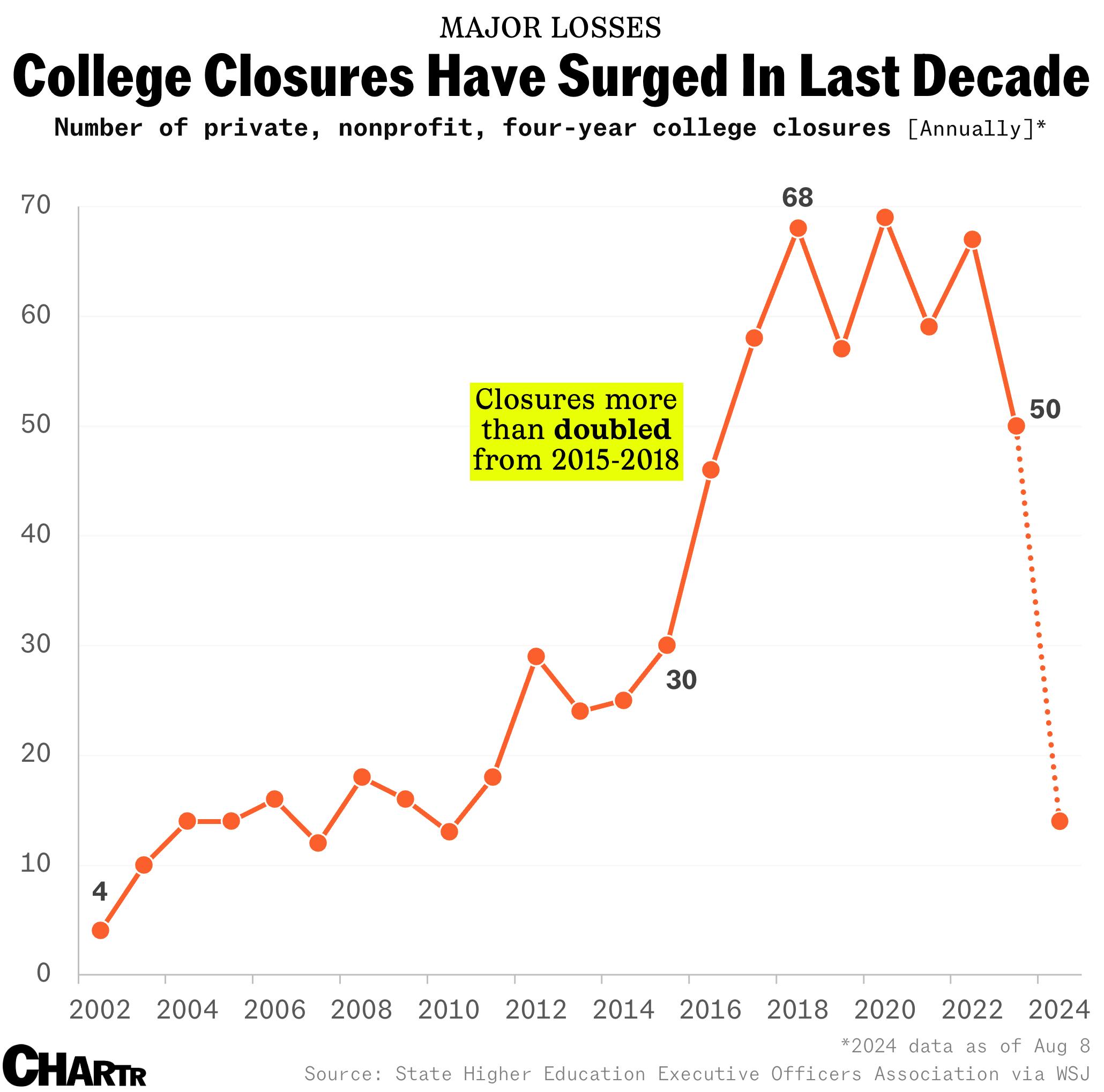
College closures in the US have risen sharply in the last 8 years

More than 500 private four-year universities have closed in the last 10 years alone

It’s an uncertain time to be a student in the US.

With sky-high tuition fees, a continued wave of university president resignations, and the effects of mass protests at the start of the summer now calcifying into harder restrictions on campuses, undergraduates are also facing sudden college closures that threaten the completion of their degrees altogether.

Indeed, a new report from the Wall Street Journal outlined a surge in traditional colleges shutting down across America. From 2014 to 2023, some 529 private, non-profit four-year institutions have shut down — 3x as many as in the previous decade — including renowned establishments like New York’s 156-year-old Wells College closing their doors.

Degrees of separation

While several factors are at play, the major driving force is simply the strain from tuition losses, as the number of people going to college continues to dwindle. According to the National Center for Education Statistics, enrollment in postsecondary institutions was down 12% in 2022 from its recent 2010 peak.

That’s partly due to longer-term demographic trends (America’s birthrate has been dropping for decades), but also because prospective students are doing napkin math and thinking: maybe the cost of a 4-year college degree just isn’t worth it.

Indeed, despite a number of measures to assuage student debt, which have waived more than $168 billion in loans for ~4.8 million eligible Americans since 2022, the cost of college remains formidable for many. A Pew Research Center poll published in May found that only 22% of American adults said that the cost of getting a college degree was worth it if someone has to take out loans; 47% said it was worth it only if you don’t need a loan, and 29% said it wasn’t worth it at all.

More Power

See all Power
power
Jake Lahut

Who’s next to leave the Trump admin following Chavez-DeRemer’s departure?

After a few abandoned nominations and the occasional lateral demotion during President Donald Trumps first year in office, turnover has accelerated dramatically.

Just in the past month, top officials such as Attorney General Pam Bondi, Homeland Security Secretary Kristi Noem, and Labor Secretary Lori Chavez-DeRemer have left their posts.

Following a report from The Atlantic alleging heavy drinking and absenteeism plaguing FBI Director Kash Patel, the odds of his departure from the Trump administration in 2026 shot up sharply, with traders now pricing in an 80% chance he won’t last the year.

(Event contracts are offered through Robinhood Derivatives, LLC — probabilities referenced or sourced from KalshiEx LLC or ForecastEx LLC.)

Loading...
 

Tulsi Gabbard, the director of national intelligence, is another official who could be on the ropes. Her deputy, Joe Kent, has already resigned over the Iran war. Gabbards 2020 presidential campaign — and appeal in broadening Trumps electorate in 2024 — heavily centered around ending perpetual regime change wars. The White House has indicated to Gabbard that they want her gone before the midterms, but the timing of her departure remains vague, according to two sources familiar with the discussions who spoke to Sherwood News in recent weeks.

As for who will replace the outgoing members, pay attention to who can be confirmed by the Senate. To replace Bondi, a Trump adviser told Sherwood the most likely replacements are acting Attorney General Todd Blanche, Trumps former personal attorney, as well as EPA Administrator Lee Zeldin.

Loading...
 

Following a report from The Atlantic alleging heavy drinking and absenteeism plaguing FBI Director Kash Patel, the odds of his departure from the Trump administration in 2026 shot up sharply, with traders now pricing in an 80% chance he won’t last the year.

(Event contracts are offered through Robinhood Derivatives, LLC — probabilities referenced or sourced from KalshiEx LLC or ForecastEx LLC.)

Loading...
 

Tulsi Gabbard, the director of national intelligence, is another official who could be on the ropes. Her deputy, Joe Kent, has already resigned over the Iran war. Gabbards 2020 presidential campaign — and appeal in broadening Trumps electorate in 2024 — heavily centered around ending perpetual regime change wars. The White House has indicated to Gabbard that they want her gone before the midterms, but the timing of her departure remains vague, according to two sources familiar with the discussions who spoke to Sherwood News in recent weeks.

As for who will replace the outgoing members, pay attention to who can be confirmed by the Senate. To replace Bondi, a Trump adviser told Sherwood the most likely replacements are acting Attorney General Todd Blanche, Trumps former personal attorney, as well as EPA Administrator Lee Zeldin.

Loading...
 
$1.4B
Rani Molla

In an effort to cement control ahead of SpaceX’s IPO, Tesla and SpaceX CEO Elon Musk bought $1.4 billion in shares of the rocket company from current and former employees last year, The Information reports, citing the confidential IPO prospectus.

The filing also revealed a moon shot incentive plan for the boss: Musk stands to gain 60 million more shares if SpaceX’s market cap increases to as high as $6.6 trillion and it completes a plan to build AI data centers in space. For its June IPO, the company is targeting a more than $2 trillion valuation.

power
Jake Lahut

Lori Chavez-DeRemer out at Department of Labor

Lori Chavez-DeRemer resigned as President Donald Trumps labor secretary on Monday, sources familiar with the matter told NOTUS.

Her tenure at the department was mired in scandal, including her husband being barred from headquarters after women employees reported he had touched them inappropriately. Chavez-DeRemer and a top aide reportedly texted women on staff to pay attention to the secretarys husband and her father around the office, according to The New York Times.

The departments inspector general had been investigating those messages and personal requests made of staff members.

power
Jon Keegan

Report: Anthropic’s Amodei headed to White House to settle dispute

In February, President Trump called Anthropic “A RADICAL LEFT, WOKE COMPANY,” and said of the company’s Claude AI technology: “We don’t need it, we don’t want it, and will not do business with them again!”

Now, less than two months later, Anthropic CEO Dario Amodei is scheduled to meet with White House Chief of Staff Susie Wiles today, according to a report from Axios.

After being declared a supply chain risk to national security by the Pentagon, and then suing the government to block the action, Anthropic finds itself in a powerful position: it has announced that its new Mythos AI model is capable of planning and executing offensive cyberattacks, and therefore would be shared only with a close group of trusted partners for testing before wider release, leading the US Treasury to try to get its hands on the new model.

The White House meeting is expected to result in some sort of deal that settles the dispute with the company, per the report.

After being declared a supply chain risk to national security by the Pentagon, and then suing the government to block the action, Anthropic finds itself in a powerful position: it has announced that its new Mythos AI model is capable of planning and executing offensive cyberattacks, and therefore would be shared only with a close group of trusted partners for testing before wider release, leading the US Treasury to try to get its hands on the new model.

The White House meeting is expected to result in some sort of deal that settles the dispute with the company, per the report.

power
Jon Keegan

Maine is the first to pass a statewide ban on large data centers

The tide is turning against big AI data centers.

In addition to many cities and towns that have passed outright bans on data centers, lawmakers in at least 11 states have introduced legislation to pause their construction, citing the need to carefully study power and water usage of the facilities.

But Maine just became the first state to successfully pass a ban on large data centers. If Maine Governor Janet Mills signs the bill into law, new data centers that draw more than 20 gigawatts of power would be banned until late 2027, and the state would set up a mechanism to study the impact of data center energy usage.

Last month, a federal bill was introduced to block new data centers until AI regulation has been passed. The issue has been getting more attention in this election year, as voters in data center hubs like Virginia have soured on the facilities.

Look at the crumbling support among Virginians (America's first data center hot spot) for data centers:

But Maine just became the first state to successfully pass a ban on large data centers. If Maine Governor Janet Mills signs the bill into law, new data centers that draw more than 20 gigawatts of power would be banned until late 2027, and the state would set up a mechanism to study the impact of data center energy usage.

Last month, a federal bill was introduced to block new data centers until AI regulation has been passed. The issue has been getting more attention in this election year, as voters in data center hubs like Virginia have soured on the facilities.

Look at the crumbling support among Virginians (America's first data center hot spot) for data centers:

Latest Stories

Sherwood Media, LLC produces fresh and unique perspectives on topical financial news and is a fully owned subsidiary of Robinhood Markets, Inc., and any views expressed here do not necessarily reflect the views of any other Robinhood affiliate, including Robinhood Markets, Inc., Robinhood Financial LLC, Robinhood Securities, LLC, Robinhood Crypto, LLC, Robinhood Derivatives, LLC, or Robinhood Money, LLC. Futures and event contracts are offered through Robinhood Derivatives, LLC.