

Markets
markets

Latest rally takes Tesla’s price-to-earnings ratio over 130x

The world’s most valuable automaker has been riding a postelection wave unlike almost any other company. Since the start of November, Tesla’s stock has risen 75%, taking the company’s market cap north of $1.37 trillion at the time of writing — and making Elon Musk richer than any human being has ever been, with his own personal net worth topping $400 billion.

The enthusiasm among investors to own Tesla, which has seen vehicle-delivery growth grind to a halt this year, has stretched the company’s valuation once again. Per data from FactSet, the company’s price-to-earnings ratio (looking at earnings forecasted over the next 12 months) has hit 131x, the highest figure since late 2021, when the company was just beginning to rack up consistent profits quarter after quarter.
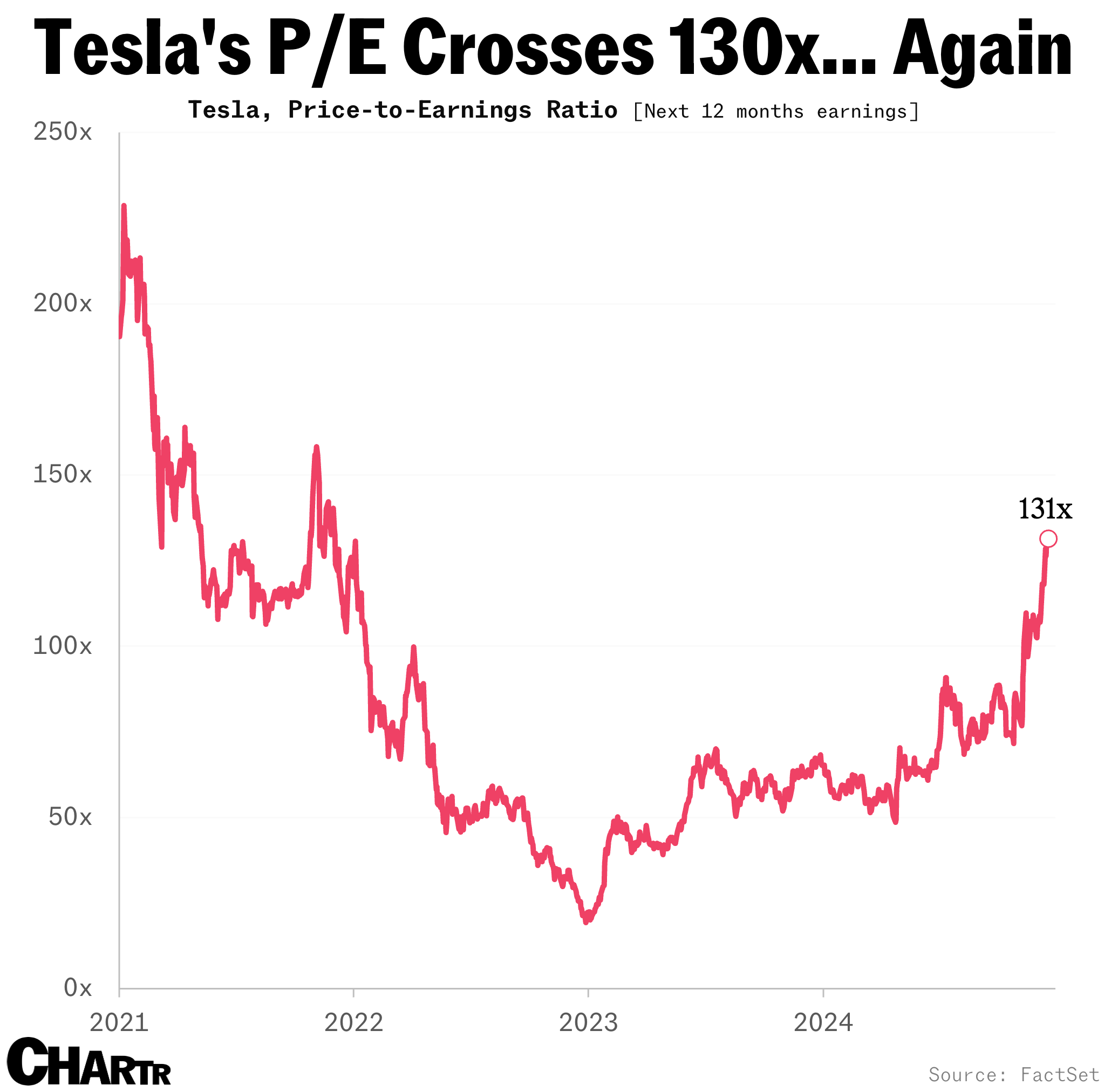
Tesla price-to-earnings ratio
Sherwood News

With equity valuations more of an art than a science, Tesla’s valuation has been hotly debated on Wall Street for more than a decade. Those arguing that Tesla is overvalued tend to point to the rest of the automotive industry, which can often trade on single-digit price-to-earnings ratios. Ford, for example, is trading on 6x P/E, and General Motors is on 5x, per FactSet. The counterargument often made is that given its leadership in electric vehicles and investment in autonomous-driving technology, Tesla shouldn’t be valued like a car company, but a tech company — a sector where investors are often happy to invest at triple-digit P/E ratios or in completely unprofitable companies, expecting innovation to drive serious profits in the future.

As we stated earlier this year, the fastest-growing part of Tesla’s business in its latest quarter was its energy-generation and storage division, where revenues rose to nearly $2.4 billion, up 52% year on year.

More Markets

See all Markets
The Future of the AI boom is coming into view

GE Vernova and Vertiv are giving us a glimpse into the future of the AI boom

GEV’s backlogs are bursting at the seams. One analyst told us he thinks that by the end of this year, GEV could be completely sold out of production capacity for heavy-duty turbines until 2029 or 2030.

markets

Low-cost airlines plunge on report Trump administration is close to $500 million rescue deal for Spirit

Low-budget US airlines are sinking on Wednesday morning following a Wall Street Journal report that the Trump administration is close to making a rescue deal for Spirit Airlines, which is said to be nearing liquidation amid high fuel costs.

Shares of Frontier, Allegiant, JetBlue, and Southwest Airlines all dropped notably.

Per the WSJ, the US government could soon loan Spirit up to $500 million in return for warrants to take a sizable stake in the airline, which has filed for bankruptcy twice since late 2024. Those warrants could give the US government the ability to purchase as much as 90% ownership of Spirit, Bloomberg reports. The carrier has made efforts to emerge from its latest bankruptcy, filed in August, but fuel costs amid the war in Iran have upset the math.

On Tuesday, President Trump told CNBC he would “love somebody to buy Spirit.”

Per the WSJ, the US government could soon loan Spirit up to $500 million in return for warrants to take a sizable stake in the airline, which has filed for bankruptcy twice since late 2024. Those warrants could give the US government the ability to purchase as much as 90% ownership of Spirit, Bloomberg reports. The carrier has made efforts to emerge from its latest bankruptcy, filed in August, but fuel costs amid the war in Iran have upset the math.

On Tuesday, President Trump told CNBC he would “love somebody to buy Spirit.”

markets

Boeing reports better-than-expected Q1 earnings, revenue

Plane maker Boeing reported its first-quarter earnings before the market opened on Wednesday. Its shares climbed more than 3% in premarket trading.

For Q1, Boeing reported:

  • An adjusted loss of $0.20 per share, compared to the loss of $0.68 per share expected by Wall Street analysts polled by FactSet.

  • Revenue of $22.22 billion, compared to estimates of $21.85 billion.

Boeing reported -$1.45 billion in free cash flow in Q1, compared to the -$2.34 billion expected by Wall Street. Prior to Wednesday, Boeing had reported two consecutive quarters of positive FCF following six straight quarters of negative results. The company is still guiding for full-year FCF of between $1 billion and $3 billion.

Earlier this month, Boeing announced it had delivered 143 commercial jets in Q1, up 10% from the same period last year and ahead of rival Airbus, which delivered 114. This was Boeing’s first time outdelivering Airbus since 2018.

markets

GE Vernova, top AI energy play, rises after Q1 report

GE Vernova, a maker of power plant equipment that’s seen orders tied to data centers surge, rose early Wednesday after posting strong Q1 results and lifting full-year sales guidance. The GE spin-off reported:

  • Adjusted EBITDA of $896 million vs. the $772 million estimate from analysts polled by FactSet.

  • Total revenue of $9.34 billion vs. the $9.25 billion consensus expectation from analysts polled by FactSet.

  • Full-year 2026 sales guidance that was lifted to between $44.5 billion and $45.5 billion from prior guidance of between $44 billion and $45 billion, vs. the consensus estimate of $44.64 billion.

“In the quarter, our electrification segment booked $2.4 billion in equipment orders to support data centers, more than all of last year,” said CEO Scott Strazik.

GE Vernova is up some 600% over the last two years through Tuesday’s close, but the majority of those gains were booked by August 2025. After being largely range-bound for months, the stock busted out following the company’s last earnings report, lifting the shares up nearly 50% in 2026.

Latest Stories

Sherwood Media, LLC produces fresh and unique perspectives on topical financial news and is a fully owned subsidiary of Robinhood Markets, Inc., and any views expressed here do not necessarily reflect the views of any other Robinhood affiliate, including Robinhood Markets, Inc., Robinhood Financial LLC, Robinhood Securities, LLC, Robinhood Crypto, LLC, Robinhood Derivatives, LLC, or Robinhood Money, LLC. Futures and event contracts are offered through Robinhood Derivatives, LLC.
