
Markets
WNBA: JUN 23 Indiana Fever at Chicago Sky
(Melissa Tamez/Getty Images)
AIudiophile

Morgan Stanley: Most Gen Zers and millennials in the US listen to about three hours of AI music a week

That’s enough AI music to last the run time of “Avatar.”

Luke Kawa

Video may have killed the radio star, but AI is starting to dance on its grave.

Morgan Stanley’s annual survey of audio habits revealed that younger Americans are listening to an amount of AI-generated music each week that’s roughly on par with the run time of “Avatar.”

“This is the first year we included any AI music questions in our survey,” wrote a team led by analyst Benjamin Swinburne. “What we found surprised us, with 50-60% of listeners 18- 44 reporting 2.5-3 hours per week of AI music listening.”
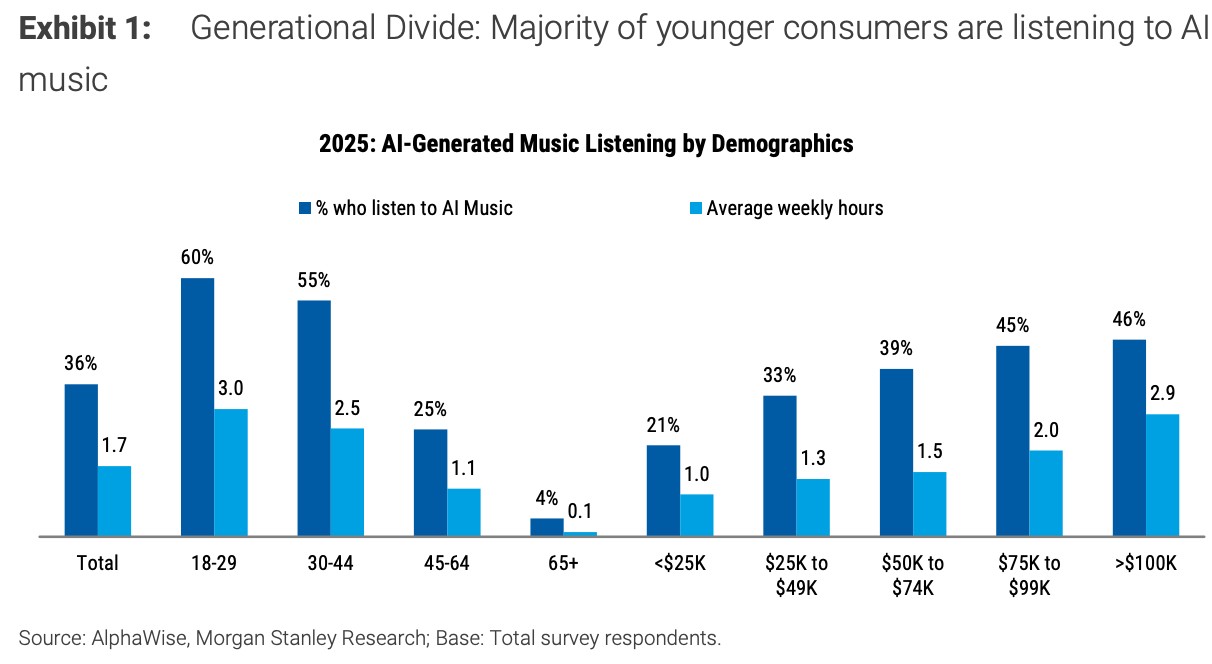
Morgan Stanley AI listening

The most common sources from which AI music is being ingested are YouTube and TikTok, per Morgan Stanley’s survey. Even so, their analysts remain bullish on Spotify and Warner Music Group, writing:

“As a distribution platform with leading global scale, a history of product innovation, and leveraging machine learning, we see AI as a tailwind to Spotify in 2026 and beyond. Specifically, we expect AI to prove foundational to Spotifys personalization 2.0 efforts. For OW WMG, we expect the rise of AI music to increase the value of scarce catalog assets while potentially creating new competition for front line content. However, we see WMGs recently announced Suno partnership as an important step toward AI music monetization. We believe the multiple compression absorbed by WMG shares in 2025 suggests a lot of AI risk is already priced in.”


More Markets

See all Markets
markets

The slow-motion private credit crunch continues

You may have missed it, what with the Iran war, the price of oil spiking, or the ongoing questions about the durability — and future profitability — of the AI capex boom.

But there are clear signs of malaise in private credit markets — the massive corporate bond and loan markets that typically burble away quietly in the background while the stock markets garner the headlines.

The Financial Times reported on Friday:

BlackRock has limited withdrawals from one of its flagship private credit funds following a surge in redemption requests, as investors retreat from the asset class and questions about credit quality intensify...

The decision to cap withdrawals at 5 per cent will be closely scrutinised by the industry as outflows climb across semi-liquid private credit funds. The vehicles have drawn in hundreds of billions of dollars from retail investors and wealthy individuals who were enticed by the high returns on offer but have started to bolt at the first signs of stress.”

That news follows an unsettling recent pattern of private credit firms telling investors they cannot have their money back on demand, most notably Blue Owl last month, which also limited redemptions.

Normally the goings-on of the credit markets are of little interest to stock jockeys. But the concerns about credit have started to bleed into the stock market, too.

Of the S&P 500’s 11 industry groups — known as sectors — the financial sector (Financial Select Sector SPDR Fund) is by far the year’s worst performer, down more than 9% in 2026, with firms with links to private credit such as Ares Management, Blackstone, KKR & Co., and Apollo Global Management some of the worst performers. They’re all down more than 20% since the start of the year.

If investors were looking for another thing to worry about, this would likely be a good one to add to the list.

But there are clear signs of malaise in private credit markets — the massive corporate bond and loan markets that typically burble away quietly in the background while the stock markets garner the headlines.

The Financial Times reported on Friday:

BlackRock has limited withdrawals from one of its flagship private credit funds following a surge in redemption requests, as investors retreat from the asset class and questions about credit quality intensify...

The decision to cap withdrawals at 5 per cent will be closely scrutinised by the industry as outflows climb across semi-liquid private credit funds. The vehicles have drawn in hundreds of billions of dollars from retail investors and wealthy individuals who were enticed by the high returns on offer but have started to bolt at the first signs of stress.”

That news follows an unsettling recent pattern of private credit firms telling investors they cannot have their money back on demand, most notably Blue Owl last month, which also limited redemptions.

Normally the goings-on of the credit markets are of little interest to stock jockeys. But the concerns about credit have started to bleed into the stock market, too.

Of the S&P 500’s 11 industry groups — known as sectors — the financial sector (Financial Select Sector SPDR Fund) is by far the year’s worst performer, down more than 9% in 2026, with firms with links to private credit such as Ares Management, Blackstone, KKR & Co., and Apollo Global Management some of the worst performers. They’re all down more than 20% since the start of the year.

If investors were looking for another thing to worry about, this would likely be a good one to add to the list.

LNG terminal in Wilhelmshaven

Qatar energy minister warns of potential oil spike to $150 within weeks

“Most of the folks who appreciate just how bullish the US-Israel-Iran war is for oil markets think it’s SO WILDLY BULLISH that they can’t imagine this lasting much longer,” wrote Rory Johnston, founder of Commodity Context.

Latest Stories

Sherwood Media, LLC produces fresh and unique perspectives on topical financial news and is a fully owned subsidiary of Robinhood Markets, Inc., and any views expressed here do not necessarily reflect the views of any other Robinhood affiliate, including Robinhood Markets, Inc., Robinhood Financial LLC, Robinhood Securities, LLC, Robinhood Crypto, LLC, or Robinhood Money, LLC.