
Markets
Nikkei 225 worst day since 1987
Sherwood News

Global stock sell-off: The Nikkei 225 just had its worst day since 1987

Japan’s flagship index shed more than 12%, its worst performance since Black Monday

After last week’s disappointing jobs report, in which US unemployment hit its highest level in more than two years, investors are once again dumping stocks, as a flurry of “risk off” trading activity reverberates around global markets.

Most notable of this morning’s flashing red charts is that of the Nikkei 225, Japan’s flagship index, which has closed down 12.4%, its worst one-day showing since 1987. That’s a remarkable decline when you consider all that has happened in that time: Japan’s asset bubble bursting in the early 1990s, the dot-com crash, earthquakes, the global financial crisis, nuclear meltdowns, and COVID-19. It builds on the nearly 6% decline seen on Friday, which means that those two days have now wiped out all of the gains — and then some — that the index had notched in 2024.
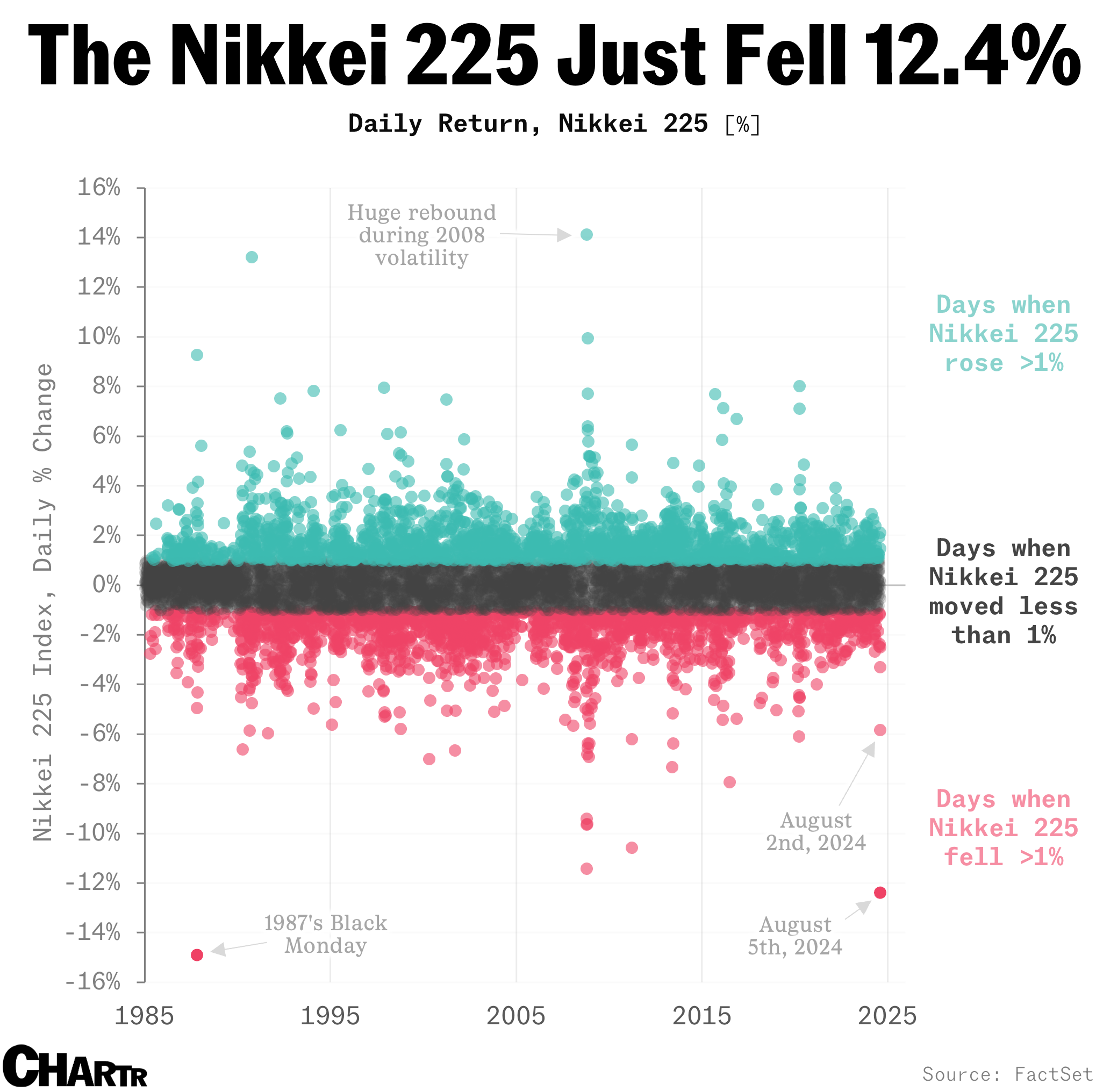
Nikkei 225 worst day since 1987
Sherwood News

A rapid appreciation in the Japanese Yen against the US Dollar appears partly to blame for the Nikkei 225’s outsized decline, as investors unwind the “carry trade” which had seen investors borrow in Japan, where interest rates have been very low, and re-invest elsewhere. Last week’s rate hike from the Bank of Japan turned that trade on its head.

When America sneezes...

Although Friday’s jobs report came with a large weather-related asterisk, the fundamental deterioration appears to have been enough to spook investors, with many of the more successful trades this year unwound quickly in the last two trading days. European stocks are also down, with the STOXX 600 off 2.3% at the time of writing, while shares of big US tech stocks are changing hands at significantly cheaper prices in pre-market trading, with AI darling Nvidia currently down more than 9%.

Today’s sharp sell-off follows the most volatile day of the year last week, as the stock market’s “fear gauge” (the VIX) rose to its highest level since the pandemic at 47 on Monday.

More Markets

See all Markets
markets

Brent crude futures break through $126 per barrel as fears of a prolonged supply crunch intensify

Brent crude prices jumped to a four-year high on Thursday after reports that President Trump is set to receive a briefing on potential military action against Iran, raising concerns that oil supply disruptions in the Middle East could extend further.

Citing sources with knowledge, Axios reported late on Wednesday that the US Central Command (CENTCOM) will brief a plan for a “short and powerful” wave of strikes on Iran, in a bid to accelerate negotiations and weaken Iran's position. A ceasefire has held since early April but talks to resolve the conflict have been deadlocked in recent days, with Iran's leadership — a group that seems scattered and fractured — wanting some control over the Strait of Hormuz, with reparations for war damages also brought up two weeks ago. Yesterday, reports emerged that President Trump had rejected Iran's latest offer, maintaining the naval blockade in the region until an agreement about Iran's nuclear program is reached.

Brent crude futures jumped more than 7%, briefly touching $126 per barrel before retreating slightly — the highest price since Russia’s invasion of Ukraine in 2022. US West Texas Intermediate futures also extended its 7% gain in the previous session, reaching past $108 a barrel.

Trump discussed ways to mitigate the impact of a prolonged blockade on American consumers with oil companies on Tuesday, the White House said.

US equity futures, meanwhile, have broadly shrugged off the news. Contracts on the S&P 500 point to a broadly unchanged open, as traders digest the bevy of mega tech earnings last night.

markets

Ford raises its full-year guidance, receives $1.3 billion tariff refund

Ford reported its first-quarter results after markets closed on Wednesday. The automaker’s shares climbed roughly 7% in after-hours trading on the news.

For Q1, Ford reported:

  • Adjusted earnings of $0.66 per share, compared to the $0.18 per share expected by Wall Street analysts polled by FactSet. The figure includes Ford’s tariff reimbursement.

  • $43.25 in total revenue, vs. the $42.66 billion consensus forecast. Automotive revenue came in at $39.8 billion, compared to estimates of $38.9 billion.

  • A $1.3 billion tariff refund.

Ford boosted its full-year guidance for adjusted earnings before interest and taxes to between $8.5 billion and $10.5 billion, up from between $8 billion and $10 billion.

Late last year, Ford announced it would take $19.5 billion in charges — one of the largest write-downs ever — relating mostly to its EV business. Of those charges, $7 billion will be spread across this year and next, the company said.

Earlier this month, Ford recorded an 8.8% drop in Q1 sales from the same period last year, a similar result to Detroit rival GM, which posted a 9.7% sales drop.

markets

Microsoft beats on revenue and earnings in Q3, but only meets expectations for cloud growth

Microsoft shares dipped after the company reported strong Q3 earnings postmarket Wednesday, posting ​​sales of $82.9 billion for the quarter, beating FactSet analyst estimates of $81.4 billion. Earnings per share were $4.27, handily beating estimates of $4.05. 

In a closely watched number, Microsoft’s Azure cloud business increased 40% year on year, just above the 39.7% estimated. The metric technically beat expectations, but may not be the beat investors were looking for.

Total capital expenditure for the quarter was $31.9 billion, up 49% year on year, above estimates of $27.5 billion and down from Q2’s $37.5 billion.

One thing investors were eager to find out: how is the company doing in its effort to fulfill the billions in backlogged commercial bookings? Last quarter, the company reported a staggering $625 billion in remaining performance obligations, and 45% of that was for just one customer — OpenAI.

For the third quarter, Microsoft reported a backlog of $627 billion, up 99% year on year. The company said the RPO increase was 26% — in line with “historical seasonality” — when excluding OpenAI.

Breaking down the results by the company’s business lines:

  • ☁️ 🤖 Intelligent Cloud (Azure, server products): $34.7 billion in revenue, up 30% year on year.

  • 📝 📊 Productivity and Business Processes (Microsoft 365, LinkedIn, Dynamics): $35 billion in revenue, up 17% year on year.

  • 💻 🎮 More Personal Computing (Windows, Xbox, Bing): $13.2 billion in revenue, down 1% year on year.

Microsoft CFO Amy Hood said in the earnings release:

“We delivered results that exceeded expectations across revenue, operating income, and earnings per share, reflecting strong execution and growing demand for the Microsoft Cloud.”

Latest Stories

Sherwood Media, LLC produces fresh and unique perspectives on topical financial news and is a fully owned subsidiary of Robinhood Markets, Inc., and any views expressed here do not necessarily reflect the views of any other Robinhood affiliate, including Robinhood Markets, Inc., Robinhood Financial LLC, Robinhood Securities, LLC, Robinhood Crypto, LLC, Robinhood Derivatives, LLC, or Robinhood Money, LLC. Futures and event contracts are offered through Robinhood Derivatives, LLC.

