
Markets
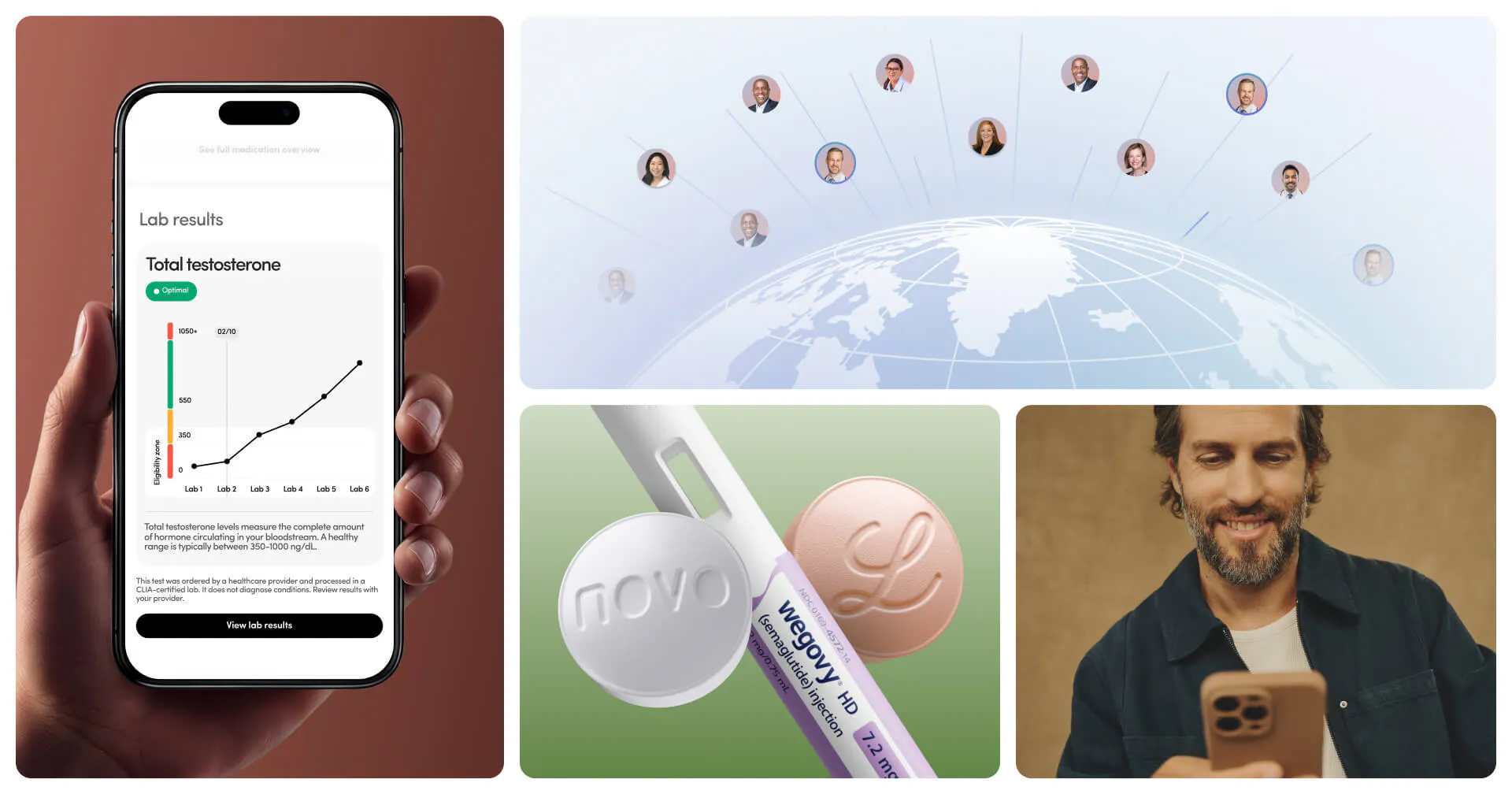
Hims & Hers graphic. (Hims & Hers)
Hims & Hers graphic (Hims & Hers)

Hims enters a “strategic pivot” following blowback from its copycat Wegovy pill

After selling compounded GLP-1 drugs for two years, Hims is launching an expensive shift to branded treatments.

Hims & Hers, which made a fortune selling compounded GLP-1s for the past two years, now says it has turned a new chapter.

The company reported first-quarter earnings on Monday that missed expectations, taking a big hit from costs associated with moving away from its own compounded weight-loss products and toward branded treatments sold by Novo Nordisk and Eli Lilly

Traders smashed the sell button, sending the stock down 12% in early trading on Tuesday. That nearly doubled the stock’s year-to-date decline to 23%.

The company began selling knockoff Wegovy in May 2024, when it was allowed to because the drug was in a shortage. But it continued to do so after the drug was taken off the shortage list, saying it was offering a “personalized” version of the drug that met a clinical need that Novo couldn’t with its prefilled pens. The compounded vials appeared in Hims’ 2025 Super Bowl commercial.

In January, Novo’s Wegovy pill came to market and immediately showed signs that it was expanding the GLP-1 market. Weeks later, Hims rolled out a copy of the pill.

That would become the straw that broke the camel’s back: Novo sued Hims for patent infringement; the Securities and Exchange Commission opened an inquiry into Hims’ compounding practices; the Department of Health and Human Services said it had referred Hims to the Justice Department. 

Eventually, Novo dropped the lawsuit and Hims agreed to no longer market its own knockoff products, instead offering Novo’s branded products on its platform. (The SEC proceedings are ongoing and the DOJ has not launched a formal proceeding, Hims said Monday.) 

The pivot cost Hims $33 million in the first quarter, primarily consisting of “write-downs related to our compounded GLP-1 supply chain that now face risk of obsolescence,” Hims CFO Yemi Okupe told analysts. The company had invested heavily in those compounding operations, only to abandon them as it pivots toward branded drugs.

Hims also reported its least profitable quarter in years on a gross margin basis, in large part because it is shipping branded products every month as opposed to multi-month batches, as it did with its compounded products.

It was likely not a surprise to Hims that selling Novo’s products would have worse unit economics, but Okupe said selling branded products has the potential to bring more people onto the platform who may purchase other products as well. Hims is on track to add more than 100,000 new subscribers per month to its weight-loss segment since adding branded Wegovy, Okupe said. 

The company is now looking beyond GLP-1s to fuel growth. In the past year, it launched hormone treatments and a lab product, and has expanded to international markets.

The company has signaled that it will sell peptides once the Food and Drug Administration lifts restrictions on them. Hims CEO Andrew Dudum teased potentially making its own wearable device. 

“The focus right now for the company is to become the default health and wellness provider in the US and establish a leadership position,” Okupe said. 

Hims did not immediately respond to a request for comment.

More Markets

See all Markets
markets

Tower Semiconductor soars on solid sales guidance with $1.3 billion in silicon photonics sales contracts

Tower Semiconductor is surging in early trading after the company released solid Q1 results and announced $1.3 billion in silicon photonics contract wins for 2027.

Q1 revenues of $413.6 million came in slightly better than Wall Street’s call, with adjusted diluted earnings per share of $0.65 well ahead of the $0.56 estimate.

Looking forward, the company projects Q2 2026 revenue to reach an all-time record of $455 million (plus or minus 5%), above analysts’ expectations for $436.6 million.

Tower Semiconductor is benefiting from a surge in demand for AI infrastructure and is committed to its multiyear growth target in its silicon photonics business. Tower has already received $290 million in customer cash prepayments to reserve this capacity. Management said it has “an even larger contractual wafer commitment for 2028 for which additional associated prepayments are due by January 2027.”

“We are confident in our path toward achieving our model targets of $2.8 billion in annual revenue and $750 million in net profit in 2028,” said Russell Ellwanger, CEO of Tower Semiconductor.

Shares of Tower Semiconductor are up more than 80% year to date.

markets

Nebius soars on strong Q1 results, boost to full-year contracted power guidance

Nebius is soaring in early trading after reporting robust Q1 results and boosting its outlook for how much power it expects to have secured by year-end, a necessary ingredient for AI compute.

For the three months ended March 31, the neocloud reported:

  • Revenue of $399 million (compared to analyst estimates of $391.6 million).

  • Adjusted EBITDA of $129.5 million (estimate: $87.2 million).

Management raised their guidance for contracted power, or energy supply, to more than 4 gigawatts by year-end 2026 from a prior view in February of more than 3 gigawatts.

These results “strengthen the case for scaled AI infrastructure, in our view,” wrote Bloomberg Intelligence senior technology analyst Vasu Kasibhotla. “The 3.5x quarter-over-quarter pipeline increase in 1Q, a new 1.2 GW Pennsylvania facility and $6.3 billion raised in the quarter improve funding and capacity to execute.”

markets

Eos Energy Enterprises soars on joint venture with Cerberus for energy storage and Q1 revenue beat

Eos Energy Enterprises is surging in premarket trading after the company reported better-than-expected Q1 sales and unveiled a joint venture with a major alternative investment firm for battery energy storage projects.

The key Q1 numbers:

  • Revenue of $57 million (compared to analyst estimates of $54.27 million).

  • Adjusted earnings per share of $0.12 (estimate: a $0.20 loss), which was juiced by a noncash change in fair value based on the change in EOSE’s share price.

Concurrently with earnings, Eos and Cerberus Capital Management announced the formation of a joint venture called Frontier Power USA, which will be a stand-alone, purpose-built Independent Power Producer to be supplied through a 2-gigawatt-hour capacity reservation agreement with Eos.

“Frontier Power USA is expected to deploy this capacity across commercial and industrial applications, AI data centers, and utility-scale projects, drawing from a multi GWh project pipeline which is under active development,” per the press release.

To support the platforms launch, Cerberus has committed $100 million in equity, and, to underscore its confidence in Eos, extended its stock lockup agreement through the end of 2026. Eos plans to launch a rights offering to raise $150 million to support this JV.

“The market is telling us what it needs: long-duration storage that is safe, American-made, and financeable at scale,” said Joe Mastrangelo, CEO of Eos. “We have the technology, the manufacturing, the controls, and now, with Frontier Power USA, the planned capital to accelerate project deployment.”

Last month, Eos also announced a joint development agreement with Turbine-X Energy. The partnership focuses on deploying zinc-based battery storage solutions for AI hyperscale data centers, with a target capacity of up to 2 gigawatt-hours beginning in 2027.

For the full year in 2026, Eos expects to achieve revenue between $300 million and $400 million, in line with its previously provided guidance.

markets

EchoStar rises as FCC approves $40 billion wireless spectrum sale to SpaceX and AT&T

EchoStar is up more than 7% in premarket trading Wednesday after the FCC said on Tuesday that it had approved the telecommunications company’s roughly $40 billion spectrum sale to SpaceX and AT&T, saying the two deals would “accelerate Internet speeds, strengthen competition, and bolster rural service.”

According to the FCC’s two separate orders, AT&T is buying about 50 megahertz of EchoStar’s nationwide spectrum for roughly $23 billion to expand its 5G network, while SpaceX is buying about 65 megahertz of EchoStar’s spectrum for around $17 billion to support Starlink’s next-generation direct-to-device service.

The approval caps a yearlong FCC review of EchoStar’s wireless spectrum licenses, which drew intervention from President Trump, who encouraged the company and FCC Chair Brendan Carr to reach an “amicable resolution.”

Still, the approval comes with a major condition: the FCC requires EchoStar to set up a $2.4 billion escrow account to cover potential obligations tied to disputes over work under its spectrum licenses — a requirement EchoStar called “unprecedented,” adding that it’s “evaluating next steps.”

Latest Stories

Sherwood Media, LLC and Chartr Limited produce fresh and unique perspectives on topical financial news and are fully owned subsidiaries of Robinhood Markets, Inc., and any views expressed here do not necessarily reflect the views of any other Robinhood affiliate, including Robinhood Markets, Inc., Robinhood Financial LLC, Robinhood Securities, LLC, Robinhood Crypto, LLC, Robinhood Money, LLC, Robinhood U.K. Ltd, Robinhood Derivatives, LLC, Robinhood Gold, LLC, Robinhood Asset Management, LLC, Robinhood Credit, Inc., Robinhood Ventures DE, LLC and, where applicable, its managed investment vehicles.

