
Markets
Electronic Arts Photo Illustrations
(Jakub Porzycki/Getty Images)
ANOTHER ONE BITES THE DUST

Electronic Arts set to go private in $55 billion deal — the latest in a long line of disappearing stocks

The “Madden” maker is set to join a growing group of listed companies that are deciding to drop out of exchanges.

Claire Yubin Oh

This morning, video game maker Electronic Arts confirmed that it will be taken private by a consortium including Saudi Arabia’s wealth fund, along with private equity firms Silver Lake and Affinity Partners, in a deal that would value the company at some $55 billion, roughly 25% more than what the company was worth before deal rumors started circling last week.

The deal marks the largest take-private transaction in US history, topping the $45 billion buyout of Texas utility group TXU in 2007. That’s quite a record considering the rise of take-private deals more generally — a trend that’s exploded since 2012 in both count and volume. Per data from Bloomberg, last year saw a whopping 173 deals take stocks off the market, transactions worth some ~$289 billion and change.
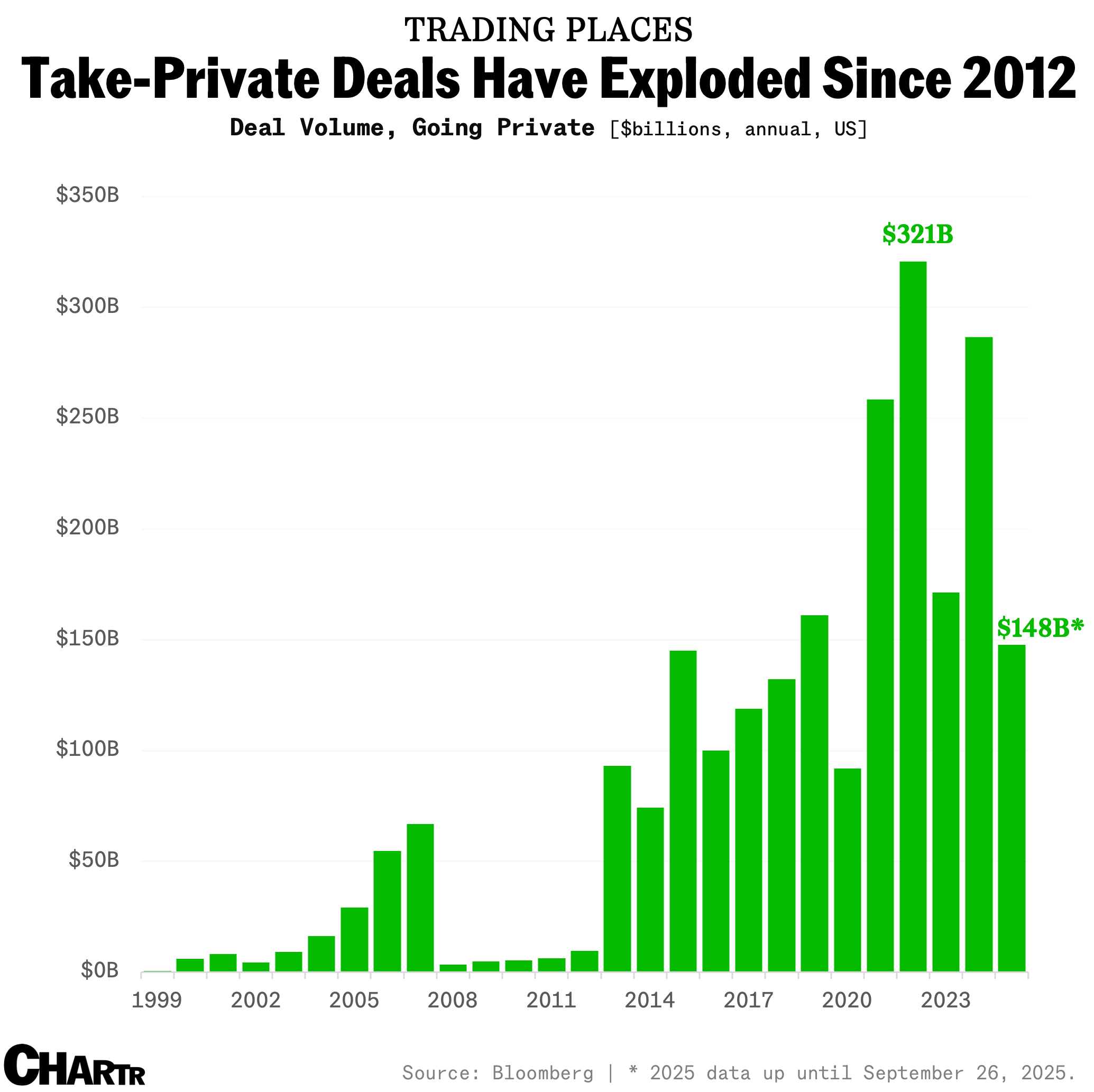
More companies are going private
Sherwood News

Private party

Aided by a private markets capital pool that increasingly rivals its public cousin, the swelling dealmaking market is contributing to a broader trend: the slow decline of public markets.

Indeed, many high-profile startups like SpaceX and OpenAI have completely bypassed the hassle of public markets (like quarterly reporting, *cough*), finding no problem raising tens of billions of dollars for their cash-hungry operations.

The combined effect of fewer IPOs and a rise in take-private deals: there are now only half the number of public companies that were listed in the US in 1996, with just 4,010 public equities as of last year.
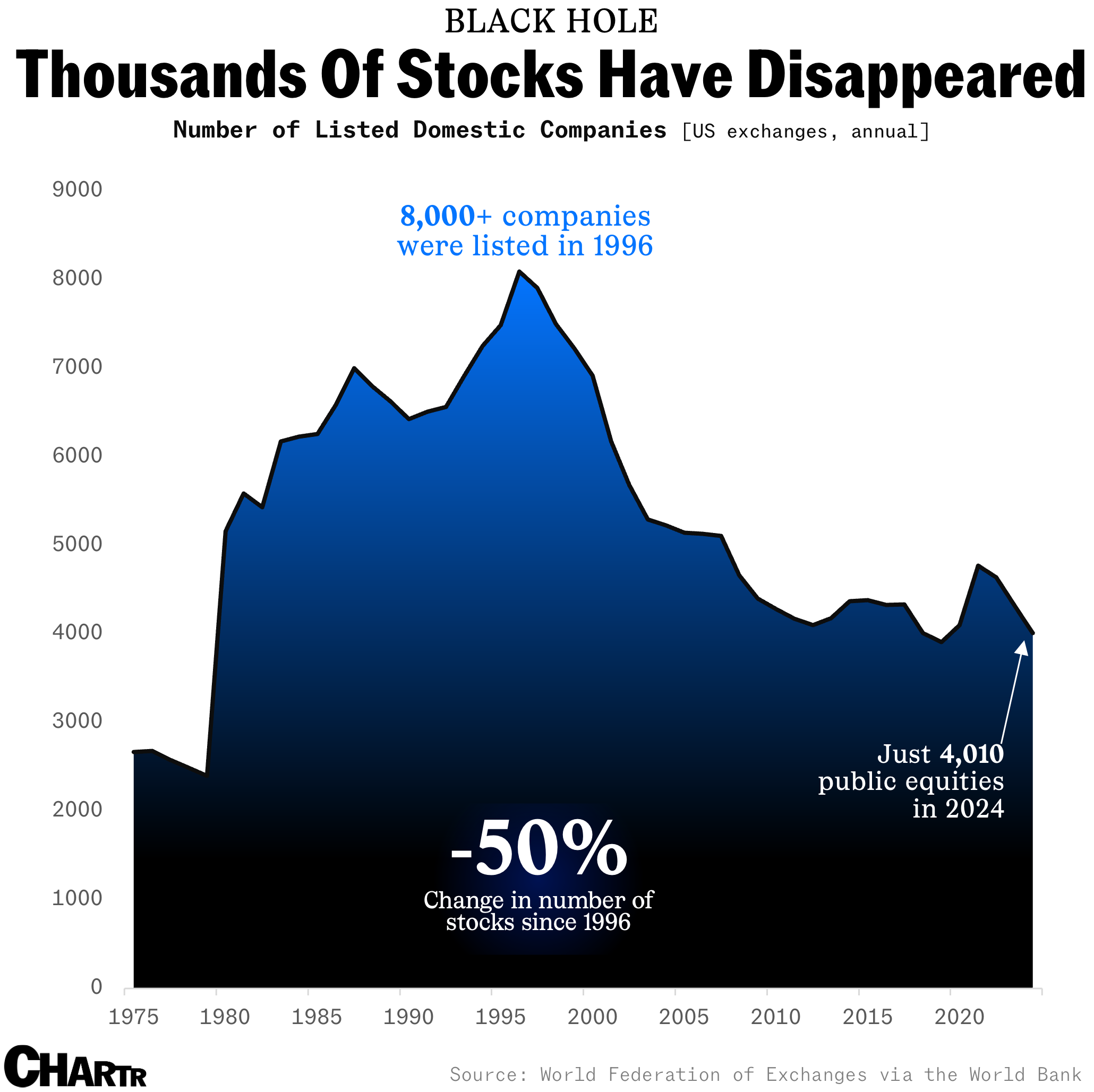
Thousands of stocks have disappeared
Sherwood News

Related reading: Where did all the stocks go?

More Markets

See all Markets
markets

Memory stocks shine in messy day for markets

Micron and Sandisk shook off an otherwise “meh” tech sector performance Monday after the two memory bellwethers received an analyst initiation.

It was a “buy” on both counts from Melius Research, adding to the growing consensus view that there’s no end in sight for data center-related storage demand as the AI capital-spending boom continues.

The newly minted Sandisk watchers at Melius slapped a target price of $1,350 on the stock — a 36% premium to Friday’s close. Their target for memory chip maker Micron was $700, a 40% premium to Friday’s close.

The reason? (At this point do we even have to ask?)

Obviously it’s optimism that the parabolic surge in pricing power for memory products amid the AI boom can last.

Analyst Ben Reitzes argues that memory sellers may effectively offer “subscriptions” — aping the software business model that they’re helping to displace — in a way that protects their margins over time.

Other AI memory plays had something of a mediocre day: hard disk drive maker Seagate Technology Holdings was up, while its arch rival, Western Digital, was down. But the optimistic tone of the note was enough to send Micron and Sandisk to new record highs on an intraday basis. (Sandisk has to close above Friday’s $2,965.66 and Micron has to close above Friday’s $541.59 for the records to stick.)

Obviously, new records are an old hat for both companies. Micron and Sandisk have been on a romp for much of the past 12 months, in which they’re up a cool 550% and 3,100%, respectively.

The newly minted Sandisk watchers at Melius slapped a target price of $1,350 on the stock — a 36% premium to Friday’s close. Their target for memory chip maker Micron was $700, a 40% premium to Friday’s close.

The reason? (At this point do we even have to ask?)

Obviously it’s optimism that the parabolic surge in pricing power for memory products amid the AI boom can last.

Analyst Ben Reitzes argues that memory sellers may effectively offer “subscriptions” — aping the software business model that they’re helping to displace — in a way that protects their margins over time.

Other AI memory plays had something of a mediocre day: hard disk drive maker Seagate Technology Holdings was up, while its arch rival, Western Digital, was down. But the optimistic tone of the note was enough to send Micron and Sandisk to new record highs on an intraday basis. (Sandisk has to close above Friday’s $2,965.66 and Micron has to close above Friday’s $541.59 for the records to stick.)

Obviously, new records are an old hat for both companies. Micron and Sandisk have been on a romp for much of the past 12 months, in which they’re up a cool 550% and 3,100%, respectively.

markets

AI data center and networking stocks take a breather after parabolic run

AI infrastructure and data center stocks are swooning on Monday after an exceptionally hot run, with the likes of Applied Optoelectronics, Lumentum, Astera Labs, Coherent, Marvell Technology, Nebius, IREN, and Applied Digital all off at least 3% as of 1:08 p.m. ET.

Most of these names didn’t fall in tandem on news of the amended agreement between Microsoft and OpenAI, but rather began to sharply extend losses shortly ahead of the open (by which time the Copilot creator was already well off its lows).

So it’s tough to cite that as a catalyst for the group. If you wanted to try to pigeonhole that as a cause of the decline: Microsoft and OpenAI’s simplified relationship points to a world where AI spend is increasingly rationalized by the underlying economics, with cash-burning behemoths forced to stand on their own two feet. That may ultimately restrain what appears to be the present eye-popping demand for AI infrastructure.

On the other hand, there have been myriad signs in recent weeks of just how intense supply crunches are across networking, CPUs, and AI accelerator chips as well as elevated end user appetite, so it’s difficult to suggest this is something fundamental as opposed to the space taking a breather ahead of hyperscalers’ earnings reports on Wednesday.

The capex budgets for Meta, Amazon, Microsoft, and Google effectively serve as sales guidance for the rest of the AI ecosystem.

For some parts of the AI trade, Monday’s tape may be a reminder that parabolic moves don’t end by going sideways. For other core contributors to the 2025-26 advance, the skyward marches are still intact: Sandisk and Micron are zooming higher.

markets

Marvell cancels order with POET, citing breach of confidentiality

This is an own goal for the ages.

POET Technologies is cratering on Monday after announcing “the cancellation of all purchase orders received by the Company from Celestial AI, including the ones for initial production units first disclosed (the ‘Purchase Orders’) by the Company in a press release on April 25, 2023.”

Marvell Technology, which acquired Celestial AI, provided written notice of the cancellation on Thursday, citing “disclosures of information related to the Purchase Order and shipping information in contravention of its confidentiality obligations.”

We can zero in on the likely cause here — the interview that CFO Thomas Mika did with Stocktwits TV last week:

“We’re a supplier to Marvell now that they’ve acquired Celestial AI, who has been a customer of ours for a couple of years. And what we supply to Celestial AI are light sources — high-bandwidth, multi-frequency, high-power light sources that light up the photonic fabric that Celestial AI talks about as being the communication device between GPUs and one GPU and another GPU, a GPU and a memory device.”

Now, it’s likely that Mika provided a useful excuse for Marvell to cancel a contract it may not have wanted, thanks to its own in-house capabilities.

The worst part is: any reasonable person would have assumed that Marvell, through Celestial AI, was a customer of POET! The stock surged when Marvell acquired Celestial in December for that very reason!

On Friday, the day after POET received notice of the cancellation and one trading day before that information became public, a record $1.1 billion changed hands trading the stock. That high-water mark lasted only one session, with more than $1.3 billion in dollar volumes through 12:30 p.m. ET.

“The Company remains focused on executing its strategic priorities and advancing product development within the AI and optical networking markets to meet increasing demand,” per POET’s press release on Monday. “This effort also involves fulfilling product deliveries for other customers, including a recently disclosed purchase order with another technology company with a value of approximately $5 million.”

markets

Analyst reports that OpenAI is partnering with Qualcomm for custom processors for an AI smartphone chip

Qualcomm, the worst-performing member of the Philadelphia Semiconductor Index this year which finally got its day in the spotlight on Friday, is basking in the sunshine once again. The San Diego-based firm is up 12% in early trading on Monday after an analyst said that the smartphone chip maker is partnering with OpenAI to build new custom processors for smartphones.

Per an X post from TF Securities analyst Ming-Chi Kuo late last night, OpenAI is working with Qualcomm, as well as MediaTek and Luxshare, to develop an AI agent phone, with plans for mass production to start in 2028.

Per Kuo, processors for the AI phone, which Qualcomm and MediaTek will partner to codevelop, will prioritize “power consumption, memory hierarchy management, and basic small-model execution,” in an effort to continuously understand the user’s context, while more complex or compute-intensive tasks will be handled by cloud AI. Specifications and suppliers for the processors are expected to be finalized by late 2026 or Q1 of 2027.

The reported partnership continues OpenAI’s ambitions to get into agentic AI hardware, after it announced in July 2025 that its building an AI device with Broadcom under the watch of Jony Ives, the former chief design officer at Apple.

Latest Stories

Sherwood Media, LLC produces fresh and unique perspectives on topical financial news and is a fully owned subsidiary of Robinhood Markets, Inc., and any views expressed here do not necessarily reflect the views of any other Robinhood affiliate, including Robinhood Markets, Inc., Robinhood Financial LLC, Robinhood Securities, LLC, Robinhood Crypto, LLC, Robinhood Derivatives, LLC, or Robinhood Money, LLC. Futures and event contracts are offered through Robinhood Derivatives, LLC.

