Business
Wheels Up business model

Why is Wheels Up stock so volatile?

The company has laid off pilots, after racking up major losses in 2023

In the last month, the second most volatile US stock worth more than $2 billion has been the headline-hogging meme stock GameStop. The most volatile, per data from FinViz, is "on-demand" private aviation company Wheels Up, which has seen its share price move: +36%, +7%, +23%, -24%, and +11% in the last 5 days alone, with the stock having doubled since June 21st.

Part of the reason for that volatility is that only a small portion of its shares are available for public trading (what’s known as a low float). Another is that the company’s business model remains unproven at scale.

The 30,000 foot view

The first rule of business is that you usually shouldn’t sell a product for less than it costs to produce.

Restaurants, for example, make healthy profits — or specifically gross profits — on their sales. Salad chain Sweetgreen only spends about $4.15 out of a $15 salad on the ingredients and packaging of the food. Nike makes a ~45% gross margin, leaving itself a healthy buffer to cover marketing, admin expenses, and other overheads.

Now, the premise gets a little bit more complicated when you’re trying to be “Uber for the sky”, as you juggle planes, pilots, software, and fuel, but the fundamental rule remains: try not to lose money on each flight. Wheels Up, which opens up access to private jets not just to the super-wealthy but to the moderately super-wealthy, doesn’t make the math work.
Wheels Up

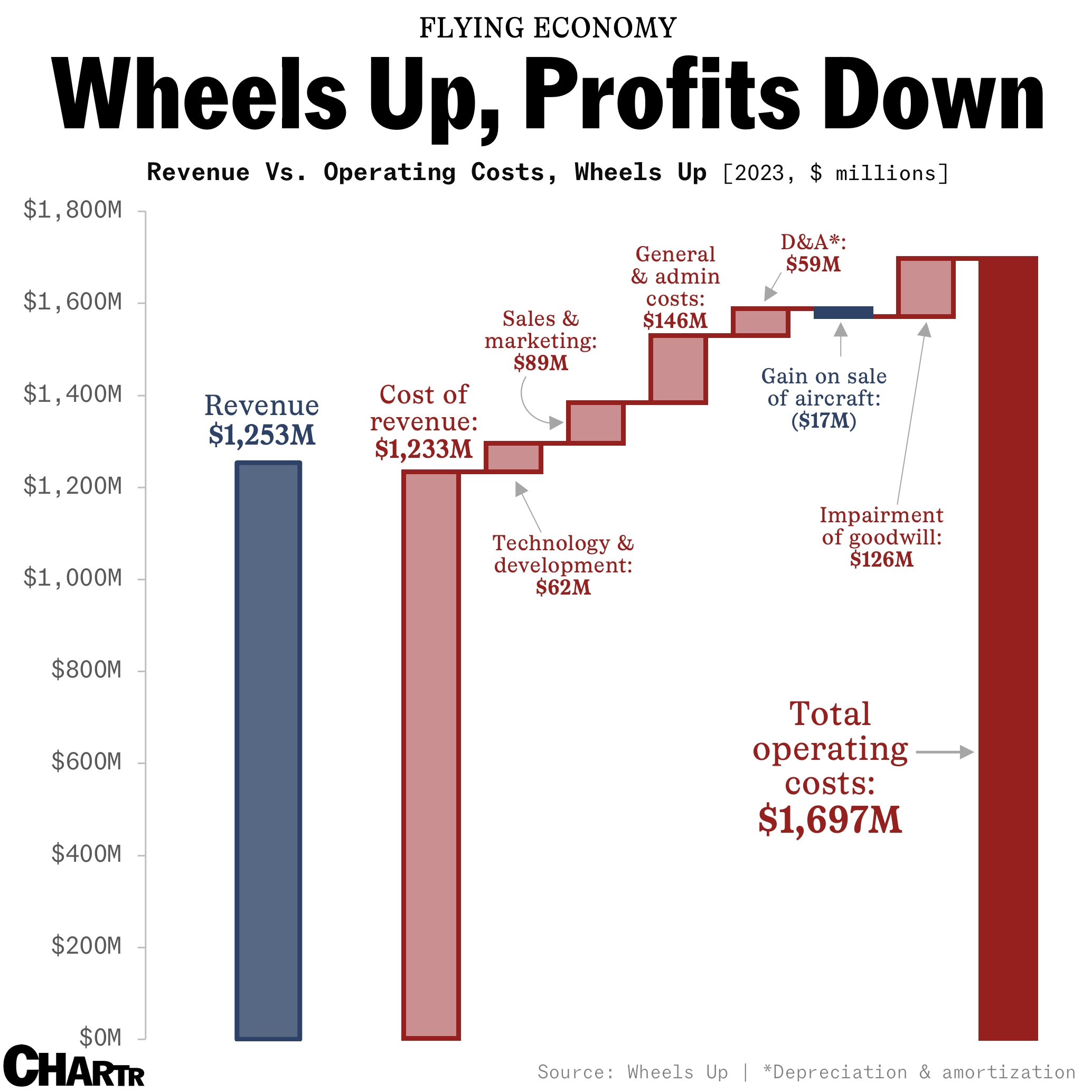
Last year, the company reported $1,253 million in revenue. However, just delivering on its service cost it almost its entire takings, with aircraft leases, fuel, maintenance, fees, cabin crew labor, plane parking, and more setting it back $1,233 million. Once other overheads were accounted for, that left the company deeply in the red.

Turbulent times

Wheels Up landed on the public markets in 2021 as part of a wave of SPACs during the pandemic. It’s time as a public company has not been smooth — despite the recent uptick, the stock is down more than 96% from its peak. Last year, Delta and a group of investors stepped in with a $500 million lifeline for the company, but UP’s woes have continued. Revenue dropped 44% year-on-year in Q1, and the company reportedly laid off around 11% of its pilots as it moves to reduce its fleet size.

More Business

See all Business
business
Tom Jones

Demis Hassabis, Google DeepMind’s CEO and founder, was also an early Anthropic investor

A chess prodigy and an actual a knight of the realm in the UK, it’s perhaps no surprise that Demis Hassabis has made some strategic moves about his exposure to AI upside. According to people familiar with the matter, the influential AI architect became an angel investor in Anthropic, currently behind many of the leading AI models, per Arena AI leaderboards.

The Nobel Prize winner’s position in the Claude creator was previously undisclosed and, per the Financial Times, highlights Hassabis’ “growing influence across the AI industry.”

Google, which bought DeepMind, the company that Hassabis cofounded and heads to this day, for a reported ~$400 million in 2014, is also a key Anthropic investor. The tech giant reportedly plans to invest up to $40 billion in the AI company as part of the mutually beneficial relationship the pair have forged, with reports that Anthropic has committed to spending $200 billion in the other direction on Google’s cloud services over the next five years.

Im playing all sides, so I always come out on top

In addition to his financial support for Anthropic, Hassabis has also invested in a range of AI startups launched by colleagues, such as Inflection AI, a company set up by DeepMind cofounder Mustafa Suleyman (who is now CEO of Microsoft AI), as well as efforts from other collaborators, like David Silver’s Ineffable Intelligence.

Hassabis also emerged as a recurring figure on the fringes of the recent Elon Musk v. Sam Altman trial, cropping up repeatedly in testimonies and court documents and appearing to live, as The Verge put it, “rent-free” in Musk’s head.

Founded in 2021, Anthropic has recently raised funding at a reported $900 billion valuation, sending it soaring ahead of competitor OpenAI.

The Nobel Prize winner’s position in the Claude creator was previously undisclosed and, per the Financial Times, highlights Hassabis’ “growing influence across the AI industry.”

Google, which bought DeepMind, the company that Hassabis cofounded and heads to this day, for a reported ~$400 million in 2014, is also a key Anthropic investor. The tech giant reportedly plans to invest up to $40 billion in the AI company as part of the mutually beneficial relationship the pair have forged, with reports that Anthropic has committed to spending $200 billion in the other direction on Google’s cloud services over the next five years.

Im playing all sides, so I always come out on top

In addition to his financial support for Anthropic, Hassabis has also invested in a range of AI startups launched by colleagues, such as Inflection AI, a company set up by DeepMind cofounder Mustafa Suleyman (who is now CEO of Microsoft AI), as well as efforts from other collaborators, like David Silver’s Ineffable Intelligence.

Hassabis also emerged as a recurring figure on the fringes of the recent Elon Musk v. Sam Altman trial, cropping up repeatedly in testimonies and court documents and appearing to live, as The Verge put it, “rent-free” in Musk’s head.

Founded in 2021, Anthropic has recently raised funding at a reported $900 billion valuation, sending it soaring ahead of competitor OpenAI.

business

Jury rules against Musk in lawsuit against OpenAI and Altman

Jurors in Tesla CEO Elon Musk’s lawsuit against Sam Altman, Greg Brockman, and OpenAI found the defendants not liable on all claims on Monday.

In a unanimous verdict reached after less than two hours of deliberation, the Oakland jury found that Musk had waited too long to bring his case forward, exceeding the statute of limitations.

Musk had alleged that OpenAI abandoned its founding mission as a nonprofit dedicated to developing AI for humanity and instead became a profit-driven company closely tied to Microsoft.

The verdict caps off a three-week blockbuster tech trial that could have seen Altman and Brockman removed from OpenAI leadership.

Musk had alleged that OpenAI abandoned its founding mission as a nonprofit dedicated to developing AI for humanity and instead became a profit-driven company closely tied to Microsoft.

The verdict caps off a three-week blockbuster tech trial that could have seen Altman and Brockman removed from OpenAI leadership.

Latest Stories

Sherwood Media, LLC and Chartr Limited produce fresh and unique perspectives on topical financial news and are fully owned subsidiaries of Robinhood Markets, Inc., and any views expressed here do not necessarily reflect the views of any other Robinhood affiliate, including Robinhood Markets, Inc., Robinhood Financial LLC, Robinhood Securities, LLC, Robinhood Crypto, LLC, Robinhood Money, LLC, Robinhood U.K. Ltd, Robinhood Derivatives, LLC, Robinhood Gold, LLC, Robinhood Asset Management, LLC, Robinhood Credit, Inc., Robinhood Ventures DE, LLC and, where applicable, its managed investment vehicles.