
Business
Rubles: Checking in on Russia's economy

Rubles: Checking in on Russia's economy

Landslide

Vladimir Putin has — somewhat inevitably — secured another 6 years as president of Russia after apparently taking 87% of the vote, according to exit polls from the weekend’s "sham" election. Candidates were reportedly vetted by the Kremlin, campaign financing and fundraising was limited by the state, and voting was enforced by gunpoint in some parts of occupied Ukraine, leading to protests breaking out within Russia and around the world.

Russia’s ruble

Putin’s rule in one form or another has been steady for 25 years now, having served as president or prime minister ever since 1999 — making him the longest-serving leader since Joseph Stalin. But, with Russia increasingly sealed off from the rest of the world, how is the country’s economy faring?

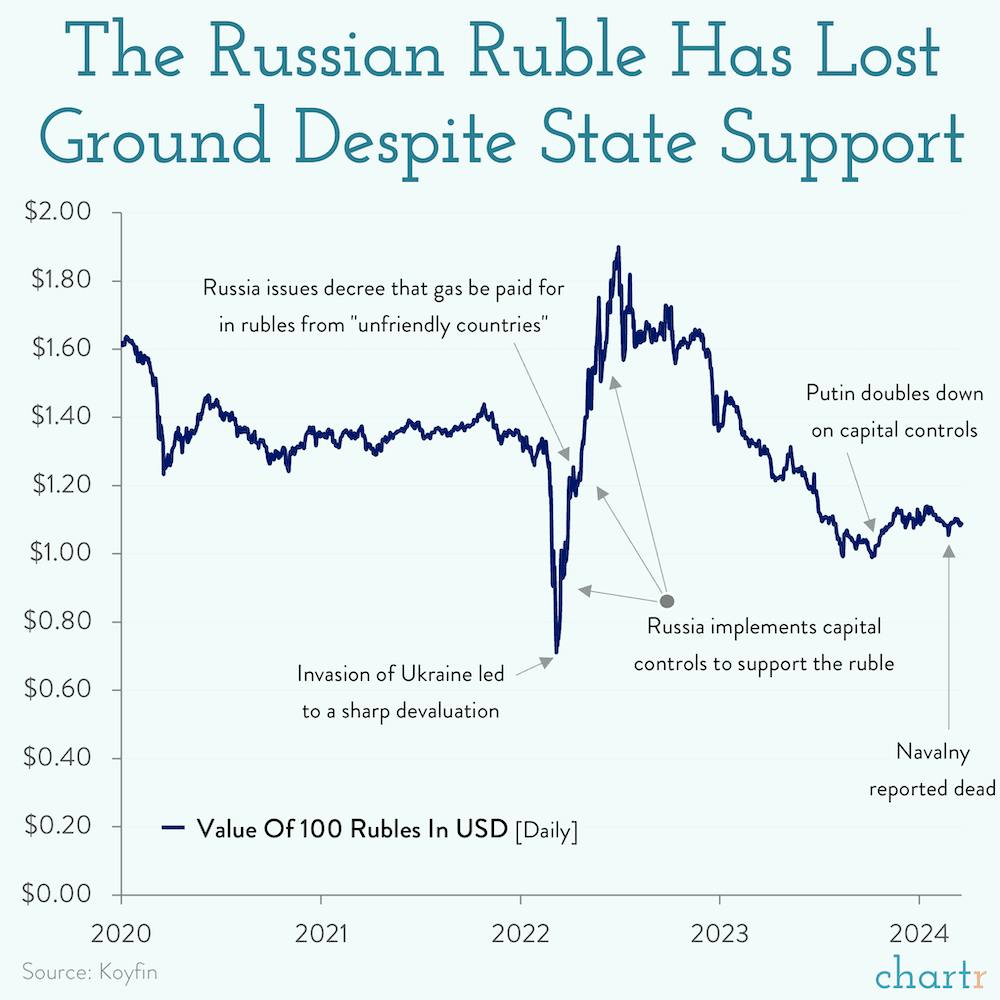
The ruble, Russia's national currency, has seen some extreme fluctuations for an economy of its size since the invasion of Ukraine in February 2022. From 2020-2021, 100 rubles would typically buy somewhere between $1.25 and $1.60 — an exchange rate that, in the wake of the invasion, reached as low ~$0.72. Since then, the Kremlin has made concerted efforts to prop up its currency, implementing extended capital controls, ordering Russian companies to sell off other countries’ cash, and decreeing that “unfriendly” foreign entities must pay for gas in rubles.

Other measures of Russia’s economic wellbeing are equally distorted, with GDP seemingly holding up well... in part because it measures every new tank, bomb, and weapon produced by the country.

Like so many other questions surrounding modern Russia, the answer to “how is the country’s economy doing” is shrouded in some deliberate, and some unintended, obfuscation.

More Business

See all Business
Luigi Mangione And His Lawyers Attends Hearing In Manhattan Court

Health giants and other S&P 500 companies spent big on executive security in 2025

Major health insurers spent over $3 million on protecting executives last year, as security budgets at S&P 500 companies across various sectors hit new highs.

business

Lucid climbs after Uber revealed to be its second-largest shareholder following recent investment

Shares of luxury EV maker Lucid are up more than 7% in premarket trading on Tuesday, following the release of a regulatory filing that revealed Uber is now its second-largest shareholder, trailing only Saudi Arabia’s PIF sovereign wealth fund.

The news follows an announcement earlier this month that Uber and Lucid would expand their robotaxi partnership from 20,000 planned vehicles to 35,000. Along with the expansion, Uber also said it would invest an additional $200 million into the EV maker.

Per Monday afternoon’s filing, it seems that investment pushed Uber’s ownership stake in Lucid to 11.52%.

Lucid’s stock is down 29% in April. It hit an all-time low of $6.75 on Monday ahead of the regulatory filing becoming public.

In a mark of just how painful the slide has been for Lucid shareholders, as of Monday, the company’s market cap had dropped to a quarter of the approximately $9.5 billion that Saudi Arabia’s PIF has sunk into it.

Latest Stories

Sherwood Media, LLC produces fresh and unique perspectives on topical financial news and is a fully owned subsidiary of Robinhood Markets, Inc., and any views expressed here do not necessarily reflect the views of any other Robinhood affiliate, including Robinhood Markets, Inc., Robinhood Financial LLC, Robinhood Securities, LLC, Robinhood Crypto, LLC, Robinhood Derivatives, LLC, or Robinhood Money, LLC. Futures and event contracts are offered through Robinhood Derivatives, LLC.
