Health giants and other S&P 500 companies spent big on executive security in 2025
Major health insurers spent over $3 million on protecting executives last year, as security budgets at S&P 500 companies across various sectors hit new highs.
Healthcare companies continued to spend large sums on security to protect their executives in 2025 — a trend that ramped up at the very end of 2024 after Brian Thompson, the former CEO of UnitedHealth Group’s insurance arm, was shot dead in Manhattan in December that year.
Prior to Thompson’s death, major health insurers weren’t known to spend much on security for their executives; most didn’t even mention or account for it in public filings. Now, each is spending hundreds of thousands of dollars on bodyguards, home security systems, and increased use of company aircraft, according to their most recent batch of proxy filings.
Luigi Mangione, the man accused of killing Thompson, is still being met with a deluge of support from some Americans frustrated and angry with the for-profit healthcare industry. With his trial set to begin in October, companies across various sectors are clearly worried about potential copycat assailants.
Often citing a “heightened risk environment,” major health insurers spent at least $3.1 million on protecting their executives in 2025, only slightly less than the $3.3 million spent for 2024, when industry titans rushed to bolster chief security in the wake of Thompson’s death.
UnitedHealth, for one, spent $1.7 million protecting its C-suite, roughly the same as it did in 2024. That includes “the costs of personal and home security services provided for our named executive officers,” the company said in its proxy materials. Tim Noel, who replaced Thompson as head of UnitedHealth’s insurance business, received $448,276 alone in security benefits.
Molina Healthcare, which is a major provider of Affordable Care Act plans, spent $456,000 protecting its executives in 2025. Before 2024, it did not report spending any amount on executive security.
CVS, which owns the insurer Aetna, requires that its CEO, J. David Joyner, accept a personal security benefit, which was $297,540 in 2025.
Cigna, one of the country’s largest insurers, does not break out how much it spends on personal security for its executives. The company said it does not consider it compensation, but instead views the “costs associated with their safety and security as being integrally and directly related to the performance of their executive duties.”
My boss’s boss’s keeper
Beyond the health industry, fears that stirred in boardrooms nationwide following Thompson’s death are continuing to drive security spending at some of America’s most valuable companies across all sectors.
A new study from data firm Equilar, featured in The New York Times earlier this month, examined S&P 500 proxy filings through April 7, 2026, and found that over a third of companies in the index provided security services to at least some of their executives in 2025, up from 24% only four years before. The analysis cited Walmart among companies that adopted security perks “for the first time in recent years.”
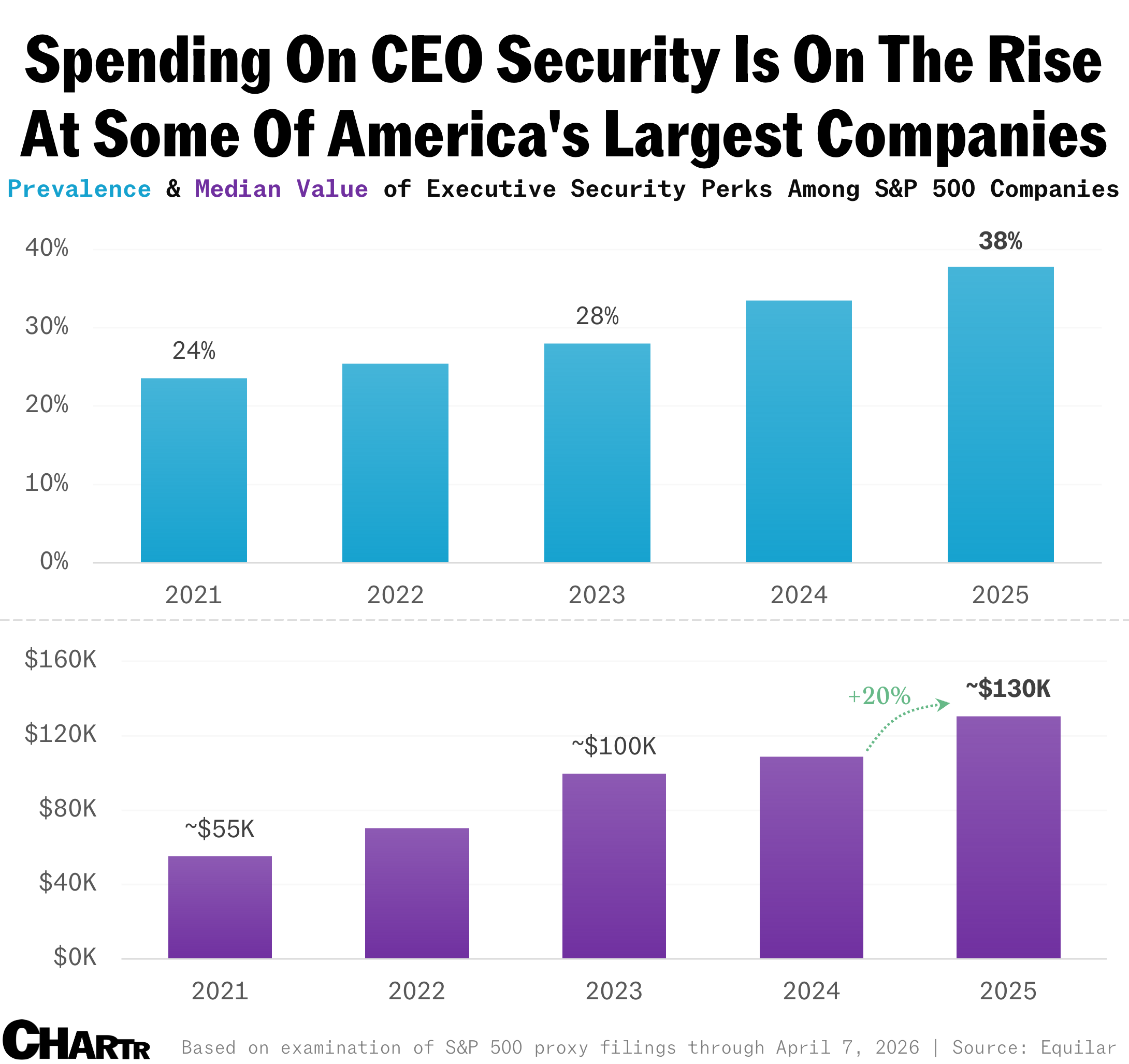
Not only is the share of companies that spend on exec security going up, but the amount those businesses are shelling out is, too. Among the S&P 500 companies that provided executive security services, the median value of spending increased ~136% from 2021 to $130,468 last year.
JPMorgan Chase, for example, detailed in its proxy this month that it spent $1.2 million in 2025 on protecting CEO Jamie Dimon — a 36% increase from the $882,000 that it reported for 2024.
But this figure isn’t even close to what Meta disclosed spending on security for Mark Zuckerberg in its 2025 proxy, released last Thursday. While slightly less than the $27.2 million it had spent in 2024, the tech giant still forked out $25.1 million on Zuck protection last year.
With an attack on OpenAI CEO Sam Altman’s home taking place less than two weeks ago, it’s unlikely that executives’ anxieties will cool down any time soon.