Business
Stars and Stripes on back of pickup truck, USA
Getty Images

Has America finally hit “peak truck”?

A new report suggests customer tastes are changing, after decades of booming truck sales.

America’s love affair with hulking trucks may be coming to an end. According to a US auto market report out last week from dealership merger specialists Dave Cantin Group and Kaiser Associates, America has reached “peak truck,” with the economic evidence “mounting” that consumer preferences are changing.

At the core of the new trend? Cost.

The survey in the report found that the number of people who believe their next vehicle will be a truck or SUV fell 3% compared to last year, noting that “consumer preferences are finally moving away from trucks and SUVs toward more affordable sedans, driven by concerns over vehicle affordability.”

Keep on truckin’

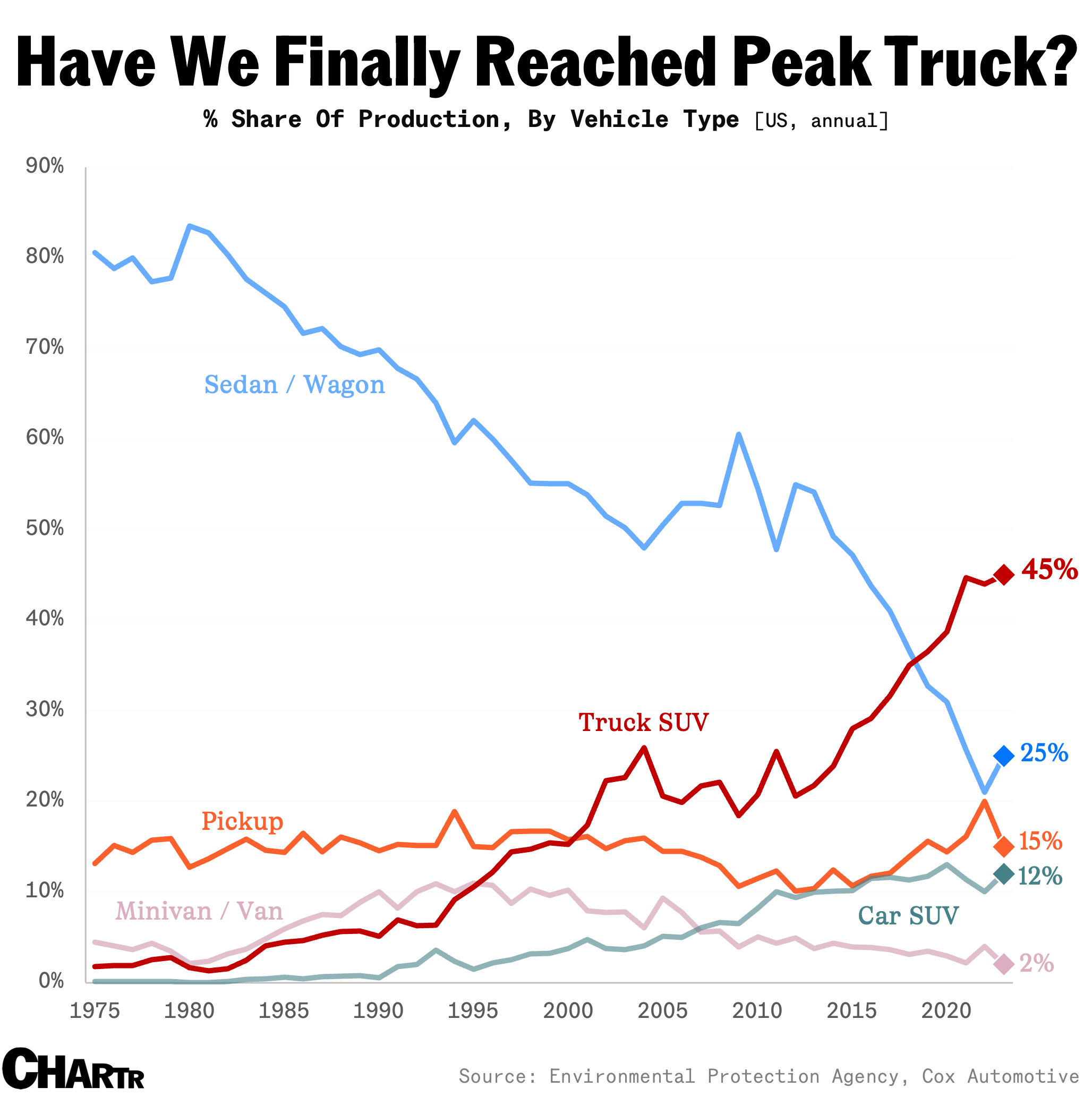
With the average price of a new truck hovering around ~$60,000, compared to $39,233 for cars, the bang for your truck buck just doesn’t quite cut it like it used to for inflation-weary consumers. If the report’s prediction does come true, it will be calling time on a trend that has dominated America’s streets for decades. As the world’s wealthiest country fell in love with the space, comfort, and utility of bigger vehicles, the share of truck SUVs in the market raced up from 24% in 2014 to 45% a decade later, per data from the Environmental Protection Agency.
Peak truck
Sherwood News

That came at the expense of sedans and wagons, which used to dominate the market but now make up only one-quarter of production.

With vehicles like the Ford F-150 dominating sales — Ford says it’s been the bestselling truck for 48 years in America — some American manufacturers have de-prioritized the smaller, typically less profitable car segment. Japanese brands like Toyota and Honda are now producing America’s bestselling sedans.


More Business

See all Business
business

How Tesla quietly wound up owning a small piece of SpaceX

Tesla is converting its recent $2 billion investment in Elon Musk’s AI company, xAI, into a small ownership stake in SpaceX — just months before the rocket maker’s highly anticipated IPO.

Here’s what happened: Tesla announced its xAI investment in late January, after a shareholder proposal to invest fell short last year. Several days later, xAI merged with SpaceX. All three companies are headed by Musk.

Now, regulatory filings with the Federal Trade Commission show Tesla converting that investment into a small stake in SpaceX, formalizing the financial link between the companies ahead of the rocket maker’s IPO. SpaceX is expected to go public this year at a valuation some speculate could top $1.75 trillion, potentially making it the biggest company to ever go public. (The current record holder, Saudi Aramco, went public at a more than $1.7 trillion valuation in 2020.)

While the size of Tesla’s stake wasn’t available, Bloomberg reports that the investment would equate to ownership of less than 1%.

While SpaceX and Tesla have engaged in related-party transactions over the years, Tesla had not previously disclosed an equity investment in SpaceX.

Now, regulatory filings with the Federal Trade Commission show Tesla converting that investment into a small stake in SpaceX, formalizing the financial link between the companies ahead of the rocket maker’s IPO. SpaceX is expected to go public this year at a valuation some speculate could top $1.75 trillion, potentially making it the biggest company to ever go public. (The current record holder, Saudi Aramco, went public at a more than $1.7 trillion valuation in 2020.)

While the size of Tesla’s stake wasn’t available, Bloomberg reports that the investment would equate to ownership of less than 1%.

While SpaceX and Tesla have engaged in related-party transactions over the years, Tesla had not previously disclosed an equity investment in SpaceX.

Southwest Airlines At San Diego International Airport

Southwest stopped fuel hedging a year ago. Whoops.

It’s been a year since Southwest said it would end its fuel-hedging program. Oil’s moves this year make that decision look like a mistake.

Latest Stories

Sherwood Media, LLC produces fresh and unique perspectives on topical financial news and is a fully owned subsidiary of Robinhood Markets, Inc., and any views expressed here do not necessarily reflect the views of any other Robinhood affiliate, including Robinhood Markets, Inc., Robinhood Financial LLC, Robinhood Securities, LLC, Robinhood Crypto, LLC, or Robinhood Money, LLC.