Business
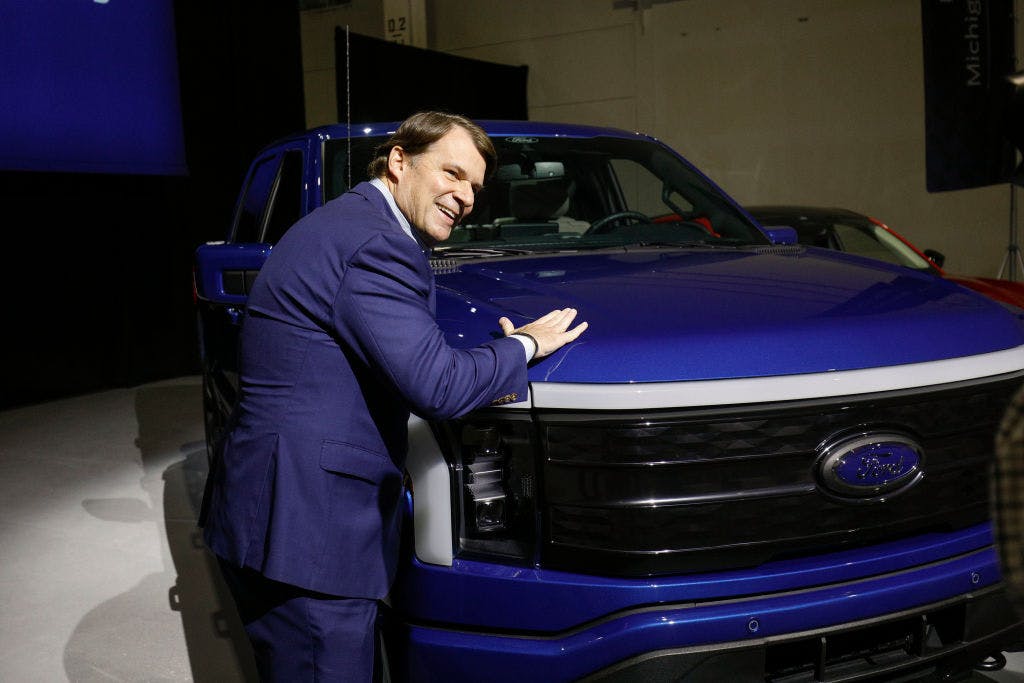
Ford CEO Jim Farley touching an F-150 Lightning
Ford CEO Jim Farley isn’t feeling so close to the F-150 Lightning these days (Bill Pugliano/Getty Images)

Ford’s EV biz lost the value of about 100,000 new F-150s last year

Electric vehicles still arent providing the spark Fords looking for.

In its latest earnings report, released Wednesday, Ford announced another quarter in the red for its EV division, as expected. Broader results and 2025 guidance also disappointed investors, who sent the stock 4.5% lower after hours.

With its Q4 loss of $1.4 billion, Fords total EV loss climbed to $5.1 billion in 2024. Thats up from 2023s loss of $4.7 billion, and more than double 2022s loss of $2.1 billion. Put another way, Fords EV biz lost about the value of 100,000 new F-150s last year.

Measured against those losses: the 98,000 electric vehicles Ford sold in 2024 (a 35% increase from 2023). The carmaker also sold 187,000 hybrids and about 1.8 million gas-powered vehicles — all increases, though just barely for combustion vehicles.

The automaker is planning lower-cost EVs and extended range EVs, but both lines are reportedly still two years away. In the meantime, the electric F-150 Lightning was outsold in Q4 by Tesla’s Cybertruck (which itself has stalled out).

Overall, Fords revenue climbed to $48.2 billion on the quarter, capping the automakers highest revenue year ever. Profit grew to $1.8 billion in the three-month period.

Ford’s been toughing it through a bumpy start to the year, with its stock (along with other major auto stocks) dropping and then making a U-turn as President Trump’s planned tariffs on Canada and Mexico were announced and then delayed. The auto industry could be the hardest hit by the proposed levies.

82% of Fords North American vehicles are made in the US, so its less exposed to tariffs than archrival General Motors, which built around 900,000 vehicles in Mexico last year. Still, Fords not fully in the clear: key components for some of its most popular vehicles (including F-series pickups) are imported from across America’s northern and southern borders. Additionally, Fords Lincoln Nautilus is built in China, and will be impacted by Trumps new 10% tariff on goods from that country.

If Trump’s planned 25% tariffs do ultimately get tagged onto vehicles, some analysts believe the average price of a car could rise by $3,000. That would be added on top of Ford’s $57,000 average transaction price, which is already about $2,000 above the average prices for rivals GM, Stellantis, and Tesla.

More Business

See all Business
Capsule Pill and Dots

Justice Department accuses telehealth Zealthy of fraud, says remedy may bankrupt it

The feds say they don’t think Zealthy has the liquidity to pay what it owes customers.

Netflix playground

Will investing in kids games finally make Netflix Games “the Netflix of games”?

Netflix is launching a game for preschoolers, its latest foray into stuff-you-play instead of stuff-you-watch.

business

American Airlines joins the flock, hiking bag fees amid higher jet fuel prices

American Airlines on Thursday announced that it, too, will be hiking the fees it charges customers to check luggage.

With the move, all four of the major US airlines, which together control about 80% of the US market, have now hiked their baggage fees in recent days amid surging jet fuel prices.

The change will go into effect on tickets bought on or after Thursday, the same day Southwest’s hike begins.

Since late March, JetBlue, Delta Air Lines, United Airlines, Canada’s WestJet, and Southwest have hiked their fees. Experts expect more major carriers to follow, and to potentially tweak the pricing of other ancillary revenue sources like seat assignments and carry-on luggage.

The change will go into effect on tickets bought on or after Thursday, the same day Southwest’s hike begins.

Since late March, JetBlue, Delta Air Lines, United Airlines, Canada’s WestJet, and Southwest have hiked their fees. Experts expect more major carriers to follow, and to potentially tweak the pricing of other ancillary revenue sources like seat assignments and carry-on luggage.

business

Less than a year after implementing them, Southwest is also hiking its bag fees

Southwest Airlines has joined the growing list of airlines opting to hike their bag fees amid sustained higher jet fuel costs.

Starting today, the first checked bag at the carrier — which implemented bag fees less than a year ago — will jump from $35 to $45, and the second from $45 to $55. Southwest quietly disclosed the change Tuesday.

Southwest assigned the decision to “part of an ongoing analysis of the business and against the evolving global backdrop.”

As of Wednesday, jet fuel prices dropped to $4.16 a gallon, per the Argus US Jet Fuel Index, down from $4.81 on Tuesday following President Trump’s ceasefire announcement, which sent travel stocks soaring. Major airlines have shed some of those gains in premarket trading Thursday.

With the move to hike bag fees, Southwest joins JetBlue, United Airlines, Delta Air Lines, and Canada’s WestJet, all of which also boosted fees this month. Experts expect more major carriers to follow, and to potentially tweak the pricing of other ancillary revenue sources like seat assignments and carry-on luggage.

Southwest assigned the decision to “part of an ongoing analysis of the business and against the evolving global backdrop.”

As of Wednesday, jet fuel prices dropped to $4.16 a gallon, per the Argus US Jet Fuel Index, down from $4.81 on Tuesday following President Trump’s ceasefire announcement, which sent travel stocks soaring. Major airlines have shed some of those gains in premarket trading Thursday.

With the move to hike bag fees, Southwest joins JetBlue, United Airlines, Delta Air Lines, and Canada’s WestJet, all of which also boosted fees this month. Experts expect more major carriers to follow, and to potentially tweak the pricing of other ancillary revenue sources like seat assignments and carry-on luggage.

Latest Stories

Sherwood Media, LLC produces fresh and unique perspectives on topical financial news and is a fully owned subsidiary of Robinhood Markets, Inc., and any views expressed here do not necessarily reflect the views of any other Robinhood affiliate, including Robinhood Markets, Inc., Robinhood Financial LLC, Robinhood Securities, LLC, Robinhood Crypto, LLC, Robinhood Derivatives, LLC, or Robinhood Money, LLC. Futures and event contracts are offered through Robinhood Derivatives, LLC.