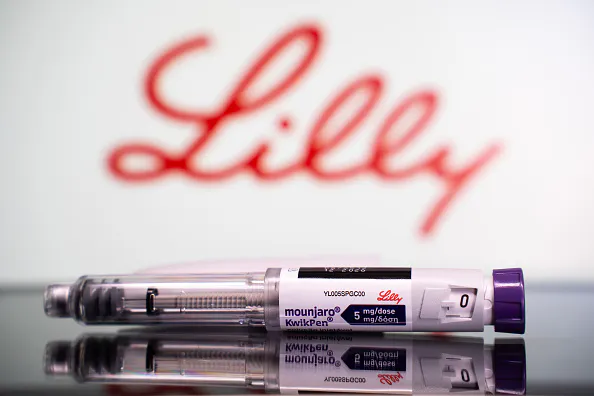
Eli Lilly makes the world’s bestselling drug. Can it keep the party going?
Some are starting to worry that Lilly, which for a short time vaulted into the trillion-dollar market cap club, may have hit a plateau.
Eli Lilly, the most valuable pharmaceutical company in the world, has made a killing selling diabetes and weight-loss drugs that are widely viewed as the most effective in the market.
But as the GLP-1 market matures, with more treatments becoming available and prices falling, Eli Lilly has attracted some bears. Last month, the company received a rare “sell” rating from analysts at HSBC, who said the stock was “priced to perfection” — or in other words, may have hit a ceiling.
The stock has more than tripled since Mounjaro, its blockbuster diabetes drug, was approved by the Food and Drug Administration in May 2022. The company hit a $1 trillion valuation in November, but has since taken a hit, and now sits at nearly $900 billion.
The company has consistently reported clinical trial results that show its products are more effective than the competition and has reported sales numbers to match. It just got approval for a new pill that’s expected to contribute $1.45 billion in revenue this year and $4.2 billion in 2027.
“Lily is among the best-positioned pharmaceutical companies in the world right now and there’s a lot of very good news that is priced in,” Allen Bond, managing director at Jensen Investment Management, said in an interview.
Bond, however, said his firm continues to own the stock because they see continued upside. “They’ve built themselves a very strong lead, and they’ve got the pieces in place to continue that lead,” he said.
Next phase of the GLP-1 market
The HSBC analysts argued that the GLP-1 market may be smaller than what Wall Street has priced in. Meanwhile, as competition ramps up, prices are coming down. Earlier this week, Novo Nordisk rolled out its higher-dose Wegovy shot, which has a monthly cash-pay price that’s $50 cheaper than the top 3 doses of Lilly’s Zepbound.
The analysts also noted that reliance on out-of-pocket cash payments leaves Lilly highly vulnerable to economic downturns and seasonality, forces that drugmakers are often insulated from when they rely more on insurance coverage. Lilly, however, pushes back against the narrative that the obesity market is turning into a race to the bottom on price.
“We don’t see this as a price-driven market; it’s an innovation-driven market still in its early innings,” Ashley Hennessey, a spokesperson for the company, told Sherwood News. “More than a billion people globally could benefit from these medicines, and our focus is on expanding that market, not just competing for a fixed share of it.”
Last week, the FDA approved Foundayo, Lilly’s new weight-loss pill. Novo Nordisk, Lilly’s rival in the GLP-1 market, released its GLP-1 pill earlier this year, and early signs show that it’s expanding the market, inviting patients who were turned off by weekly injections.
Lilly’s pill has an advantage over Novo’s, which is that it can be taken at any time of day, with or without food. Lilly disclosed in a February regulatory filing that it had $1.5 billion worth of prelaunch inventory ready ahead of the FDA approval — which is about as much as analysts polled by FactSet expect it to sell this year.
When these drugs were first launched, demand was insatiable but limited by capacity constraints, which led to shortages. According to Bond, manufacturing capacity — specifically the scaling of complex peptide production — is now the real gating factor and primary operational constraint in the GLP-1 market, rather than clinical drug discovery.
Lilly has committed capital expenditure to build manufacturing muscle.
This has become especially important as the administration has threatened tariffs on drugmakers that don’t onshore their manufacturing. Recent company filings outline a massive operational scaling effort, including plans for a $6.5 billion facility in Texas, a $5 billion plant in Virginia, and a $1.2 billion investment in Puerto Rico.
“We think that that puts them in good stead with the powers that be in terms of tariffs,” Bond said.
Lilly’s “next chapter”
As the GLP-1 market matures, Lilly is also deploying its windfall to secure its next chapter beyond weight loss and diabetes.
The company has announced three acquisitions so far this year, including narcolepsy drugmaker Centessa for up to $7.8 billion. It is also spending upward of $14 billion on research and development this year.
To accelerate drug discovery, Lilly recently partnered with Nvidia to build an “AI Factory,” bringing its new AI supercomputer, LillyPod, fully online alongside a joint AI co-innovation lab.
“We’re reinvesting some of the proceeds from the obesity opportunity to make sure we can further accelerate growth in those promising areas,” Daniel M. Skovronsky, Lilly’s chief product officer, told analysts in the company’s most recent earnings call.