Business
Birthday Green apple
(Getty Images)
appy birthday

Apple is turning 50 today and it doesn’t look a thing like its younger self

From Macs to iPods, iPhones, and now services, here’s how Apple’s business has looked every 10 years.

Around half of startups in the US disappear within five years, just a third survive a full decade, and only about 13% make it past 30 years — with new tech companies faring even worse on average. One name in the space, however, has made it to its 50th birthday today, growing from a scrappy computer maker run out of a garage in California to a $3.7 trillion behemoth.

For its first ~20 years, Apple was essentially a one-product company, with its annual reports through the mid-1990s and into the early 2000s consistently stating that “substantially all” of its net sales had been derived from personal computers and their related software and peripherals.

It wasn’t until a few years after the turn of the century that Apple, barely recovered from near bankruptcy, started making money from things that weren’t the Mac. Following the launch of the iPod in 2001 and its iTunes Music Store in 2003, Apple’s music business generated $9.6 billion in sales by 2006, or roughly half of the company’s total revenue.

Apple through years
Sherwood News

The era of the iPod didn’t last all that long though, as the iPhone’s debut in the summer of 2007 quickly rendered the music player obsolete. By 2016, the iPhone alone made up nearly two-thirds (63%) of total company sales, while the Mac, iPod, and other products that once defined Apple contributed just ~15%.

iVolution

Fast-forward another decade, and Apple remains an iPhone company… at least in most people’s minds. In reality, the company has been slowly trying to reduce its reliance on physical devices in favor of recurring revenue streams, with its Services segment — the non-product side that includes the App Store, advertising, iCloud, AppleCare, and Apple TV+ — generating over a quarter of total revenue and running at a roughly 75% gross margin. That’s more than double the 37% margin that the iPhone and other physical products deliver.

At a time when Big Tech names are racing to outspend each other on chips and data centers, Apple hasn’t been riding the AI wave in quite the same way, nor splurging nearly as aggressively. Still, the iPhone maker has seen its best-ever year and a record quarter for smartphone sales, even as its AI system, Apple Intelligence, has yet to prove itself in earnest. Whether that changes by Apple’s 60th birthday, or what the company will look like more broadly by then, is anyone’s guess.


More Business

See all Business
The entrance of Allbirds seen from Hayes St. in San Francisco, Calif.

Allbirds, the once buzzy multibillion-dollar sneaker startup, is selling up for $39 million

That’s less than 1% of its peak market cap about four years ago.

Tom Jones3/31/26
business

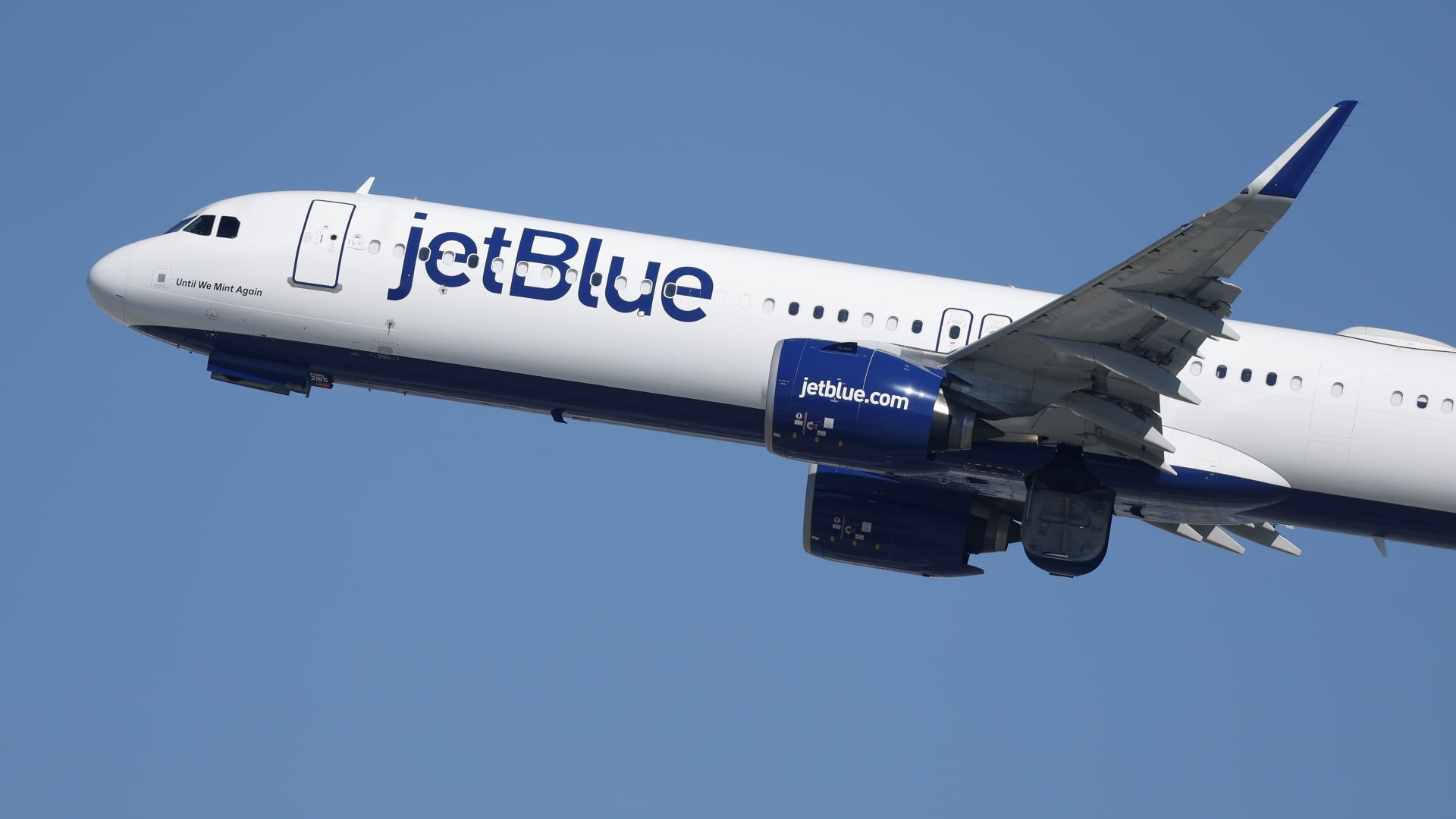
JetBlue is raising its bag fees as fuel costs squeeze airlines

JetBlue will reportedly hike its bag fees, as the cost of jet fuel continues to climb amid the war in Iran. It’s the latest example of carriers finding ways to push rising costs onto travelers.

Last week, United Airlines CEO Scott Kirby said that if fuel prices remain elevated, fares would need to rise another 20% for his airline to break even this year.

As CNBC reported, when one airline raises fees, others tend to follow.

Earlier this month, JetBlue hiked its first-quarter outlook for operating revenue per seat mile to between 5% and 7%, saying that strong Q1 demand helped “partially offset additional expenses realized from operational disruptions and rising fuel costs.” Now, the carrier appears to be making moves to further boost revenue to offset those costs.

Earlier on Monday, JetBlue rival Alaska Air lowered its Q1 profit forecast. The refining margins for the carrier’s cheapest fuel option — sourced from Singapore and representing about 20% of Alaska’s overall supply — have spiked 400% since February.

JetBlue did not immediately respond to a request for comment.

As CNBC reported, when one airline raises fees, others tend to follow.

Earlier this month, JetBlue hiked its first-quarter outlook for operating revenue per seat mile to between 5% and 7%, saying that strong Q1 demand helped “partially offset additional expenses realized from operational disruptions and rising fuel costs.” Now, the carrier appears to be making moves to further boost revenue to offset those costs.

Earlier on Monday, JetBlue rival Alaska Air lowered its Q1 profit forecast. The refining margins for the carrier’s cheapest fuel option — sourced from Singapore and representing about 20% of Alaska’s overall supply — have spiked 400% since February.

JetBlue did not immediately respond to a request for comment.

business

Netflix is hiking its prices again

Netflix is raising its subscription prices for the fourth time in four years, a move first spotted by Android Authority.

Per Netflix’s US pricing page, the cost of an ad-supported plan is climbing $1 to $8.99 per month, while the cost of a standard ad-free plan is going up $2 to $19.99 per month. The premium tier has also risen $2 to $26.99 per month.

The streamer last raised its subscription costs more than a year ago in January 2025. It also hiked prices in 2023, 2022, 2020, and 2019. Netflix shares climbed about 2% on the news.

“Our approach remains the same: we continue offering a range of prices and plans to meet a variety of needs, and as we deliver more value to our members we are updating our prices to enable us to reinvest in quality entertainment and improve their experience by updating our prices,” said a Netflix spokesperson, in a statement to Sherwood News.

The streamer last raised its subscription costs more than a year ago in January 2025. It also hiked prices in 2023, 2022, 2020, and 2019. Netflix shares climbed about 2% on the news.

“Our approach remains the same: we continue offering a range of prices and plans to meet a variety of needs, and as we deliver more value to our members we are updating our prices to enable us to reinvest in quality entertainment and improve their experience by updating our prices,” said a Netflix spokesperson, in a statement to Sherwood News.

Latest Stories

Sherwood Media, LLC produces fresh and unique perspectives on topical financial news and is a fully owned subsidiary of Robinhood Markets, Inc., and any views expressed here do not necessarily reflect the views of any other Robinhood affiliate, including Robinhood Markets, Inc., Robinhood Financial LLC, Robinhood Securities, LLC, Robinhood Crypto, LLC, Robinhood Derivatives, LLC, or Robinhood Money, LLC. Futures and event contracts are offered through Robinhood Derivatives, LLC.