
AI wrecked Big Tech’s climate goals. Now it’s spinning a new “climate stock” story.
Google's and Microsoft's emissions continue to soar as they double down on AI, and it could impact their standing with BlackRock
In 2021, Google set a goal to reach net-zero emissions across all of its operations and value chain by 2030. In order to meet this goal, the company aimed to reduce its total emissions by 50% compared to its 2019 emissions level.
However, in 2023, Google’s emissions had increased by 48% from 2019. The cause of Google’s emissions jump? AI. From Google’s 2024 environmental report:
In 2023, our total GHG emissions were 14.3 million tCO2e, representing a 13% year-over-year increase and a 48% increase compared to our 2019 target base year. This result was primarily due to increases in data center energy consumption and supply chain emissions. As we further integrate AI into our products, reducing emissions may be challenging due to increasing energy demands from the greater intensity of AI compute, and the emissions associated with the expected increases in our technical infrastructure investment.
One of the funnier parts of this report is that on page three, before any mention of the 48% jump in emissions, Google’s Chief Sustainability Officer noted that AI “has the potential to help mitigate 5-10% of global greenhouse gas emissions by 2030.”
How can Google claim that AI could reduce global emissions by 5-10% in a report that blames its own 48% emissions increase on AI? Because that “5-10%” statistic came from a 2021 Boston Consulting Group blog post that had little to do with Google’s own AI-driven emissions increase. To quote the BCG piece:
In our experience with clients, using AI can achieve overall emissions reductions of 5% to 10%—the equivalent of 2.6 to 5.3 gigatons of CO2e if AI were applied to all emissions…
Monitoring Emissions. Companies can use AI-powered data engineering to automatically track emissions throughout their carbon footprint. They can arrange to collect data from operations, from activities such as corporate travel and IT equipment, and from every part of the value chain, including materials and components suppliers, transporters, and even downstream users of their products. AI can exploit data from new sources such as satellites. And by layering intelligence onto the data, AI can generate approximations of missing data and estimate the level of certainty of the results.
Reducing Emissions. By providing detailed insight into every aspect of the value chain, prescriptive AI and optimization can improve efficiency in production, transportation, and elsewhere, thereby reducing carbon emissions and cutting costs.
A couple of things to note here. First, BCG’s “analysis” was published in January 2021, more than 18 months before the launch of ChatGPT kicked off an AI arms race, so I find it tough to believe that whatever data BCG used is especially relevant to Google three and a half years later. Second, the paper gave a generalized overview of how data-driven AI insights can help companies better track emissions, but it said nothing about the environmental impact of the compute power behind the AI itself, which is, as we now know, a lot!
Back to Google.
Big tech companies want to win the AI arms race, but AI is an energy-intensive pursuit. As we’ve seen with Google (as well as Microsoft) the cost of investing in AI is an emissions increase. The solution to reconcile the contradiction between Google’s business ambitions with its environmental goals is, I guess, to publish an 86-page sustainability report that highlights how AI in the abstract will help with the climate crisis as well as Google’s progress on its other sustainability initiatives to help downplay its AI-driven emissions jump.
This led me to another question: Why do big tech companies feel the need to justify the environmental impact of their AI investments? Why couldn’t they just say, “You know, we set these targets in 2019, but now AI is a big thing, and we want to win it, so our emissions are going to increase for a few years.”
Here’s one reason: BlackRock funds with specific climate change mandates will soon allow clients to take an activist position on shareholder proposals about decarbonisation. From The Financial Times:
“The world’s largest asset manager said on Tuesday that its new policy would allow clients in climate-focused funds to take an activist position on shareholder proposals about decarbonisation.
All BlackRock funds consider climate as a risk factor affecting financial performance. But those funds that follow its new “climate & decarbonisation stewardship guidelines” will consider whether companies are actively trying to limit the average global temperature rise to 1.5C above pre-industrial levels, set down as an ideal threshold in the Paris Agreement between almost 200 countries…
The policy will start applying to 83 funds, all domiciled in Europe, with $150bn in assets, in the fourth quarter, Joud Abdel Majeid, BlackRock’s global head of stewardship, wrote in a letter to clients…
The boards of US and Asian funds that have a specific climate change mandate will be asked if they want to adopt the policy later this year. BlackRock also plans to offer the climate-related option to clients who invest through separately managed accounts.”
One of BlackRock’s savvier tricks is calling a fund “Paris-Aligned Climate MSCI USA ETF,” filling it with the same companies as its “Core S&P 500 ETF,” and charging 3x higher fees on the former because, climate. The top five companies in the US, by market cap, are Apple, Microsoft, Nvidia, Alphabet, and Amazon. Guess what the top five holdings in the above-mentioned Paris-Aligned Climate fund are:
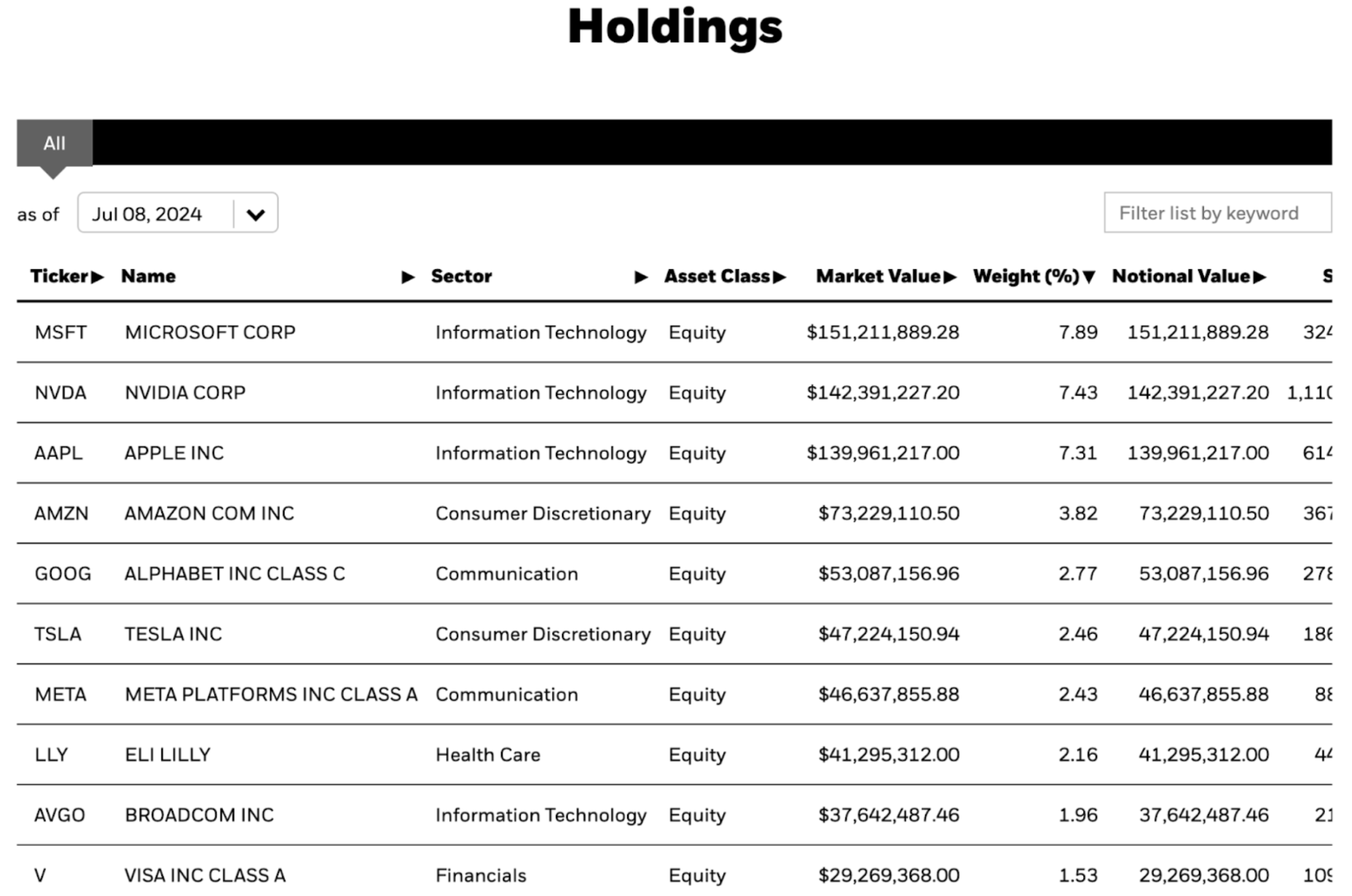
This fund’s objective is “to track the investment results of an index composed of US large-and mid-capitalization stocks that is designed to be compatible with the objectives of the Paris Agreement by, in aggregate, following a decarbonization trajectory…” so I imagine that shareholders in this fund won’t be happy that the emissions of two of their largest holdings have increased by 49% and 30% (Microsoft) in the last few years!
If you’re a big tech company looking to double down on AI, and your company’s stock is also one of the top five positions in BlackRock’s climate funds, one solution would be to simply embrace your emissions increase and tell BlackRock to omit you from its climate-focused funds. However, that obviously won’t happen, so it’s in your best interest to convince shareholders that, while AI is increasing your emissions now, AI will eventually reduce global emissions later, and your net sustainability impact, despite the increase in emissions, is somehow positive. Otherwise, you might have to deal with shareholders looking to take an activist position on shareholder proposals about decarbonisation.