
Business
Bronzed: Germany overtakes Japan to become the 3rd largest global economy

Bronzed: Germany overtakes Japan to become the 3rd largest global economy

Pay a visit

Following the devastating wildfires seen across Hawaii last August, the island state is considering a new tourist tax to fund conservation and restoration projects in hard-hit regions such as Maui.

Gov. Josh Green proposed a $25 “climate impact fee” for vacationers in his second State of the State Address. The tariff is projected to bring in tens of millions a year — with half earmarked for disaster insurance to encourage investment in high-risk areas, as well as fire breaks to shield vulnerable communities.

Paradise lost

This isn’t the first time Hawaii has attempted to pass a similar bill: in April, lawmakers debated a $50 annual green fee that would grant visitors access to parks and beaches; however, that proposal failed in the final hours of a legislative session. Since then, last summer’s wildfires — the worst disaster in Hawaii state history — have caused an estimated $4-6 billion in economic losses, burning thousands of acres of land.

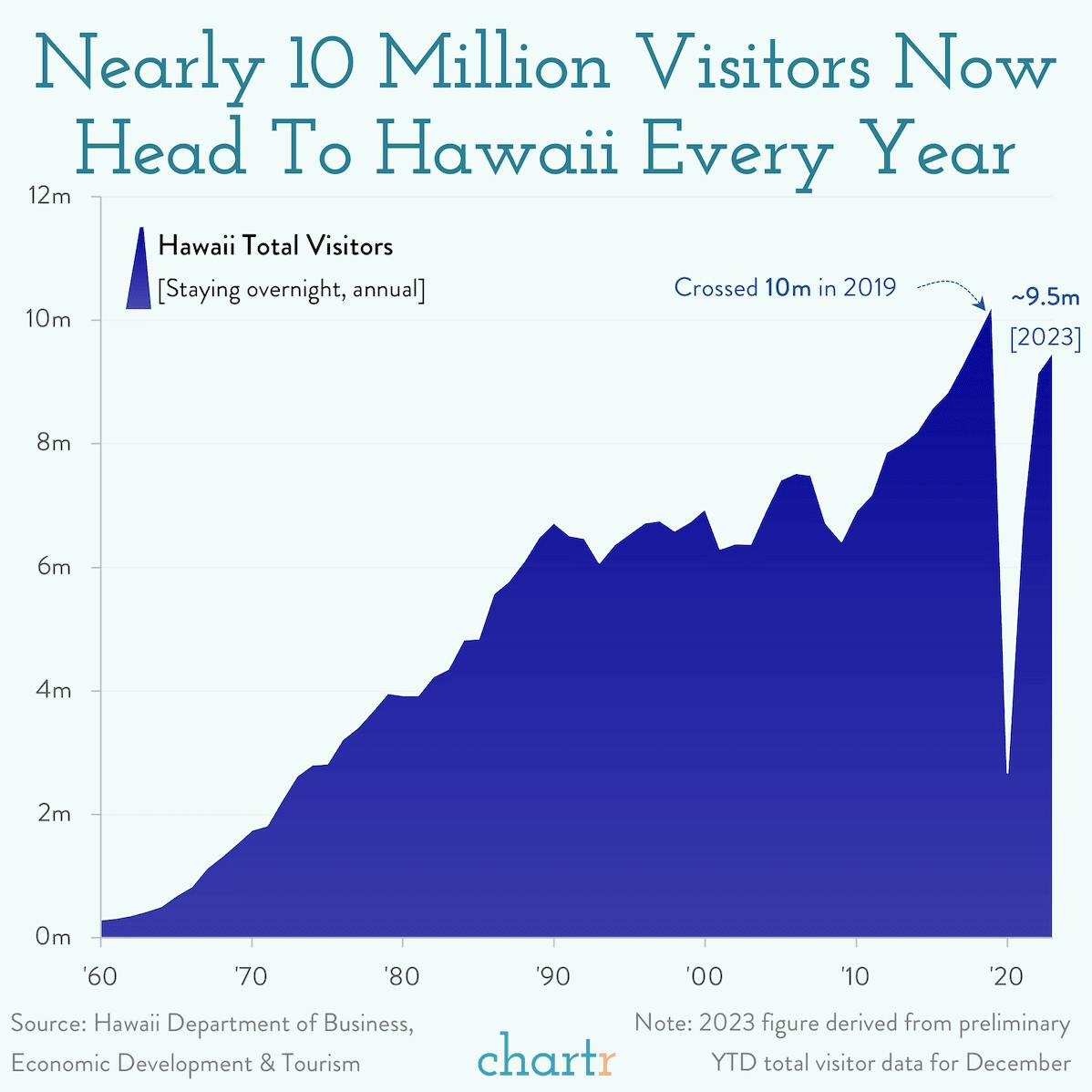
The urgency to protect Hawaii’s natural assets comes as tourist numbers have soared, recording around 10 million visitors in 2019, roughly 7x the state’s ~1.4 million residents. Although the vacationer count hasn’t quite recovered since the pandemic, the state’s reliance on tourism means that the loss of its renowned scenery comes with both ecological and economic consequences — in 2022, tourism was estimated to make up ~18% of Hawaii’s GDP.

Zooming out: Many tourist hotspots are enacting similar legislation: from this spring, Venice is charging a €5 day rate to mitigate damage; Bali recently introduced a $10 sustainability fee; and in Greece, which was also ravaged by wildfires in 2023, a “climate resilience fee” is now added onto lodging bills.

More Business

See all Business
Luigi Mangione And His Lawyers Attends Hearing In Manhattan Court

Health giants and other S&P 500 companies spent big on executive security in 2025

Major health insurers spent over $3 million on protecting executives last year, as security budgets at S&P 500 companies across various sectors hit new highs.

business

Lucid climbs after Uber revealed to be its second-largest shareholder following recent investment

Shares of luxury EV maker Lucid are up more than 7% in premarket trading on Tuesday, following the release of a regulatory filing that revealed Uber is now its second-largest shareholder, trailing only Saudi Arabia’s PIF sovereign wealth fund.

The news follows an announcement earlier this month that Uber and Lucid would expand their robotaxi partnership from 20,000 planned vehicles to 35,000. Along with the expansion, Uber also said it would invest an additional $200 million into the EV maker.

Per Monday afternoon’s filing, it seems that investment pushed Uber’s ownership stake in Lucid to 11.52%.

Lucid’s stock is down 29% in April. It hit an all-time low of $6.75 on Monday ahead of the regulatory filing becoming public.

In a mark of just how painful the slide has been for Lucid shareholders, as of Monday, the company’s market cap had dropped to a quarter of the approximately $9.5 billion that Saudi Arabia’s PIF has sunk into it.

Latest Stories

Sherwood Media, LLC produces fresh and unique perspectives on topical financial news and is a fully owned subsidiary of Robinhood Markets, Inc., and any views expressed here do not necessarily reflect the views of any other Robinhood affiliate, including Robinhood Markets, Inc., Robinhood Financial LLC, Robinhood Securities, LLC, Robinhood Crypto, LLC, Robinhood Derivatives, LLC, or Robinhood Money, LLC. Futures and event contracts are offered through Robinhood Derivatives, LLC.
