

Why were 125 million people just added to last year’s extreme poverty estimates?
The goalposts are moving. That’s a good thing — but 1 in 10 people are still living on less than $3 a day.
In 2015, the United Nations outlined the goal of eradicating extreme poverty for all people everywhere by 2030.
Back then, the threshold for extreme poverty — defined by the International Poverty Line (IPL) — was people living on less than $1.25 a day, estimates for which were measured by the World Bank. With inflation biting globally, the IPL was updated to $2.15 at the end of 2022.
Now, the IPL has been raised significantly again, as outlined in this fascinating deep dive from Our World in Data released Monday. As of June, the threshold for extreme poverty was hiked to $3 per day, a ~40% increase; with it, 125 million additional people have now been categorized by the UN as “extremely poor” at last year’s count, up to 817 million people worldwide.
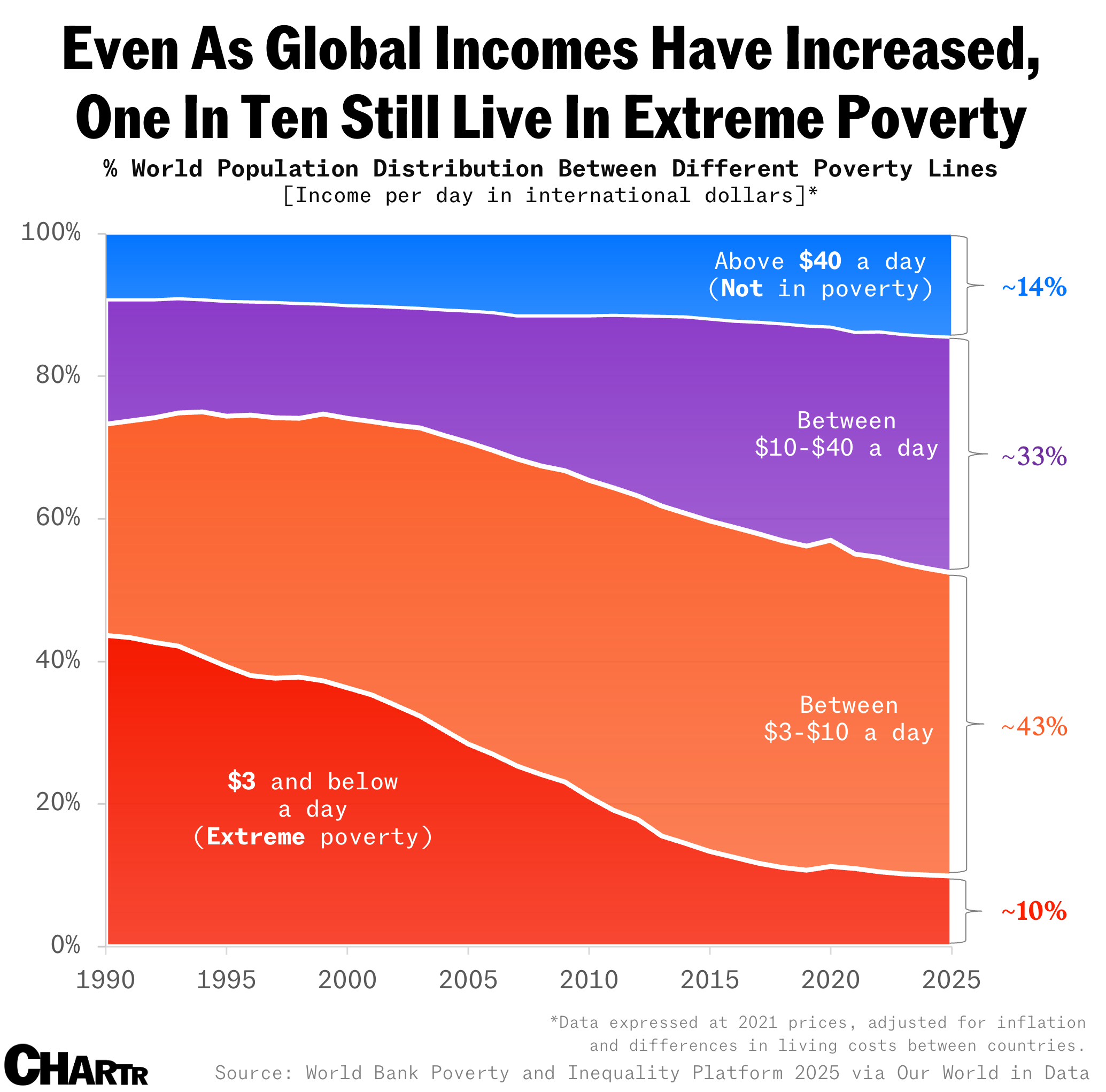
Of course, a large part of the IPL adjustment reflects inflation. However, the poverty line has also increased in real terms as global incomes have risen. The new data shows that the bottom tenth of the global wealth distribution can now buy about 16% more than the old data showed, per the report. So, even though more people are falling below a raised IPL, this doesn’t mean that the world is necessarily poorer.
Despite all the remarkable progress that’s been made, the original goal of eradicating extreme poverty by 2030 now looks almost impossible — the number of people below the new IPL shrunk by just over 1% from 2024 to 2025, compared with the average 3% annual decline seen from 1990 to 2020.
Wherever the goalposts, though, 808 million people — more than the combined populations of the US and the EU — living on less than $3 a day in 2025 remains hard to fathom.
Quantity and inequality
A large part of the IPL change reflects higher prices, since the UN has started using 2021 prices rather than 2017 prices for international dollars — a hypothetical currency, equivalent to USD, that adjusts for purchasing power differences between countries.
But another important variable affecting the revised IPL is its “raw ingredient,” national poverty lines, which have increased with countries’ average incomes going up — essentially reflecting a rise in relative poverty, but a drop in absolute poverty.
Per the report, the World Bank’s “consistently applied methodology” for calculating the IPL means that the value has been raised even more than proportionate increases in inflation and income growth. After collecting a set of national poverty lines and making them comparable, the World Bank “anchors” the IPL to the thresholds adopted by low-income countries. Since several low-income countries have recently elevated their poverty lines in accordance with higher national costs of living, this has had a large impact on the IPL.