World
Global Price of Uranium

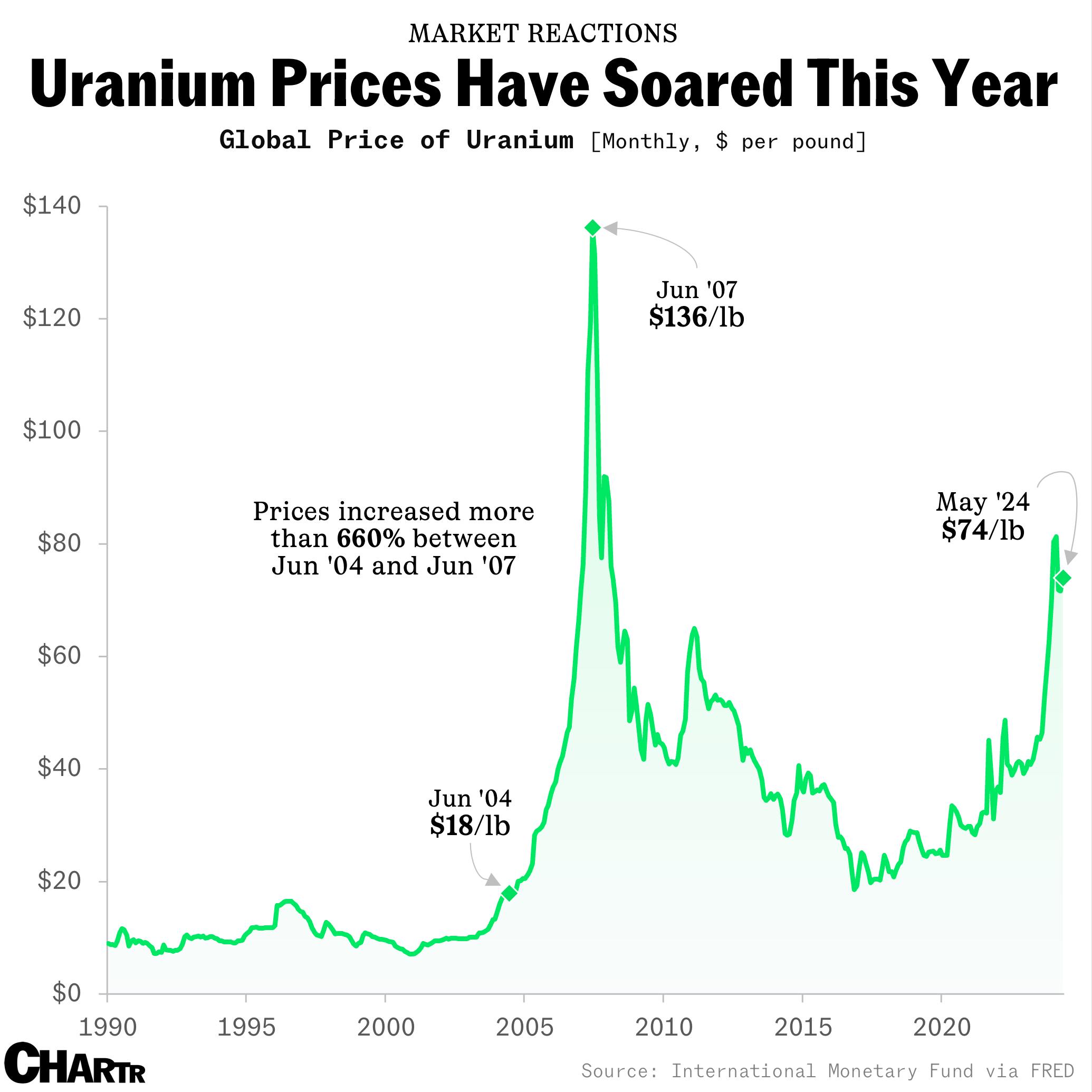
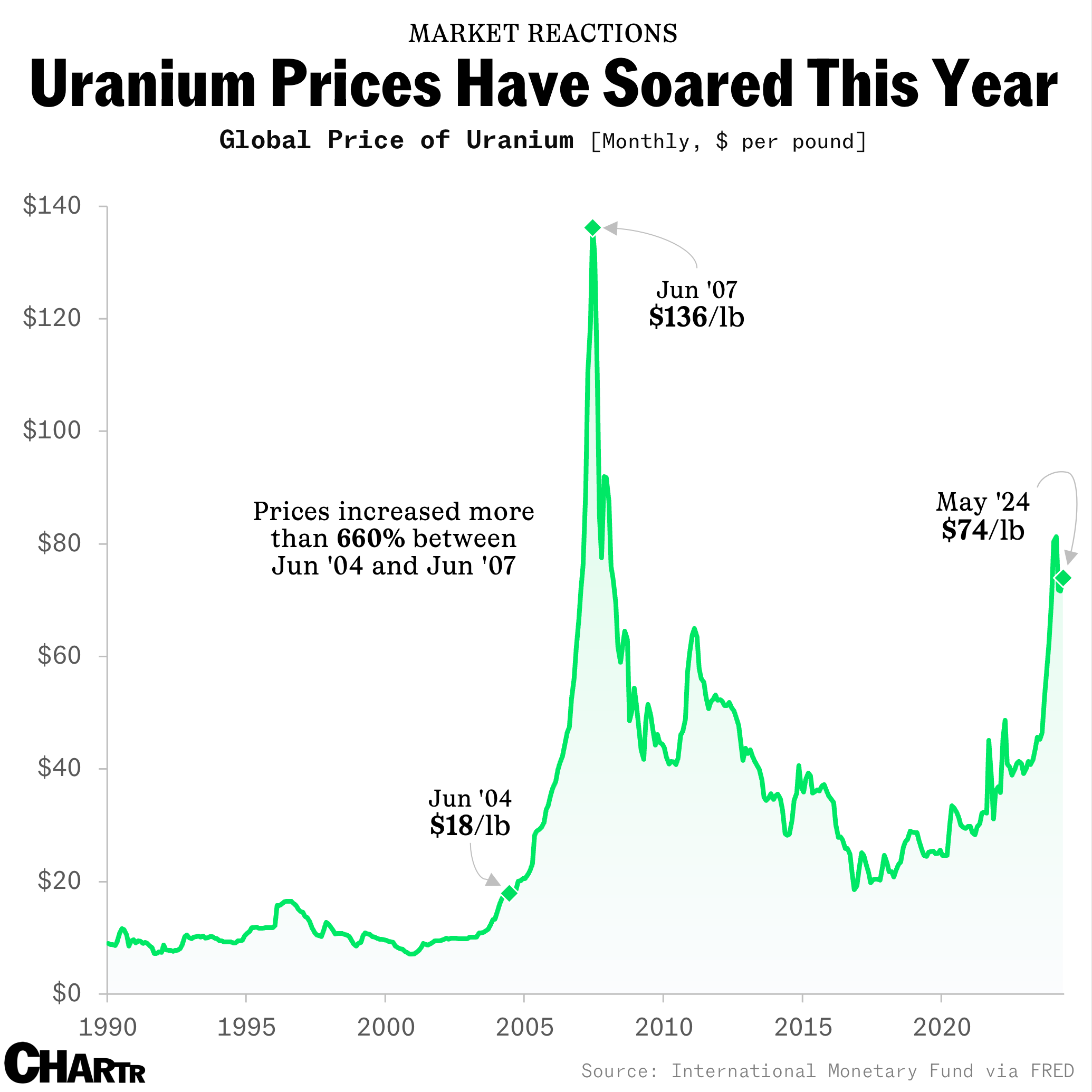
Uranium prices are up 70% in the last 12 months

Production is stirring in some of the most remote places on Earth

Gone fission

After a decade of underinvestment, global superpowers such as China and India are doubling down on nuclear output. That appears to be setting off a chain reaction that’s boosted the price of uranium and incentivized major suppliers to join forces in a bid to meet soaring demand, as Australian uranium giant Paladin Energy announced today its acquisition of Canada’s Fission Uranium in a deal worth some $833M.

The combined company would position itself as a leader in the nuclear fuel space — an industry that, in remote parts of frozen Canada, Kazakhstan, and Australia, is booming. In fact, per Bloomberg, the soaring price of uranium (+233% in the last 5 years) has surpassed the increases seen for silver (+99%), gold (+75%), copper (+66%), and the all-important battery-powering lithium (+17%) in the same period.
2024-06-24-uranium-prices-site

As a vital component of the power-generating fission reactions harnessed by nuclear plants, the price of uranium gives some indication of the incremental demand for nuclear projects — and right now, it’s signaling a serious resurgence. The recent market reaction echoes the 2004 - 2007 period: a 3-year stretch when prices rose more than 650%. That previous bubble was in part due to the flooding of major mines restricting supply, but it was also generally a more “nuclear-optimistic” time, before the high-profile Fukushima disaster of 2011 tempered public appetite for nuclear energy.

Recently, though, prices have boomed as an atomic-gold-rush has spurred a surge in reactor infrastructure, driven by new projects in China and India. Indeed, Bloomberg reports that, globally, 61 new plants are currently under construction, 90+ are in planning, and an additional 300+ are being proposed.

Related chart: America’s nuclear output.

More World

See all World
world

The UAE’s OPEC exit will hit the group in the barrels

After just shy of 60 years in OPEC, its membership even predating its status as a nation-state, the United Arab Emirates yesterday announced its shocking departure from the oil production group, effective May 1, as the knock-on effects of the Iran war continue to play out across the Middle East and the energy landscape.

For context, the UAE produces the third-highest amount of oil in the group, per April data and OPEC’s latest set of annual statistics.

According to the cartel’s 2025 Annual Statistical Bulletin, the OPEC group was collectively exporting some 19 million barrels of crude oil a day last year, with the United Arab Emirates accounting for some 14% of that daily output.

UAExit means UAExit

The nation, whose energy minister told Reuters yesterday that the decision was taken “after a careful look at current and future policies related to level of production” and wasn’t made following discussions with any other country, made up a healthy share of the group’s total confirmed crude oil reserves, as well.

OPEC exports chart
Sherwood News

Of the 12 nations in the core group, which was founded by just five oil superpowers back in September 1960, only two (Iraq and Saudi Arabia) exported more barrels of crude oil daily, pumping out 3.36 million and 6.05 million barrels, respectively, each day to nations around the world.

For its part, the UAE said it will “continue its responsible role by gradually and thoughtfully increasing production, in line with demand and market conditions,” per the official state news agency. Clearly, the nation now wants a little more control of just how much oil it can pump around the world, with the UAE having to eat a large proportion of lost revenues due to its healthy abundance and OPEC restrictions.

According to the cartel’s 2025 Annual Statistical Bulletin, the OPEC group was collectively exporting some 19 million barrels of crude oil a day last year, with the United Arab Emirates accounting for some 14% of that daily output.

UAExit means UAExit

The nation, whose energy minister told Reuters yesterday that the decision was taken “after a careful look at current and future policies related to level of production” and wasn’t made following discussions with any other country, made up a healthy share of the group’s total confirmed crude oil reserves, as well.

OPEC exports chart
Sherwood News

Of the 12 nations in the core group, which was founded by just five oil superpowers back in September 1960, only two (Iraq and Saudi Arabia) exported more barrels of crude oil daily, pumping out 3.36 million and 6.05 million barrels, respectively, each day to nations around the world.

For its part, the UAE said it will “continue its responsible role by gradually and thoughtfully increasing production, in line with demand and market conditions,” per the official state news agency. Clearly, the nation now wants a little more control of just how much oil it can pump around the world, with the UAE having to eat a large proportion of lost revenues due to its healthy abundance and OPEC restrictions.

Latest Stories

Sherwood Media, LLC produces fresh and unique perspectives on topical financial news and is a fully owned subsidiary of Robinhood Markets, Inc., and any views expressed here do not necessarily reflect the views of any other Robinhood affiliate, including Robinhood Markets, Inc., Robinhood Financial LLC, Robinhood Securities, LLC, Robinhood Crypto, LLC, Robinhood Derivatives, LLC, or Robinhood Money, LLC. Futures and event contracts are offered through Robinhood Derivatives, LLC.