
World
Space Junk

There’s a lot more junk floating around Earth than there used to be

Space oddities

Another day, another “cloudy with a chance of space debris” forecast in North America: a farmer in rural Canada recently found an 88-pound, 2-meter-wide hunk of charred metal that astronomy experts believe is from a SpaceX rocket that shed the fragment in February. He plans to sell it to raise money for a hockey rink.

The Canadian discovery follows news of a much smaller piece of space junk crashing through the roof of a Florida home in early March. They’re part of a growing phenomenon, with 200-400 man-made objects reentering Earth’s atmosphere on average each year, most of which are mission-related debris from spacecraft, particles from disintegrations, and paint flecks… or dead satellites that continue to orbit the Earth long after we can still make use of them.

According to the BBC, there’s only one known case of someone being hit by falling space debris — an Oklahoma resident was harmlessly hit on the shoulder in 1997 — but the risk is real even if highly unlikely: the European Space Agency (ESA) reports that space agencies and nation states accept a 1-in-10,000 chance of a casualty from a single uncontrolled reentry.

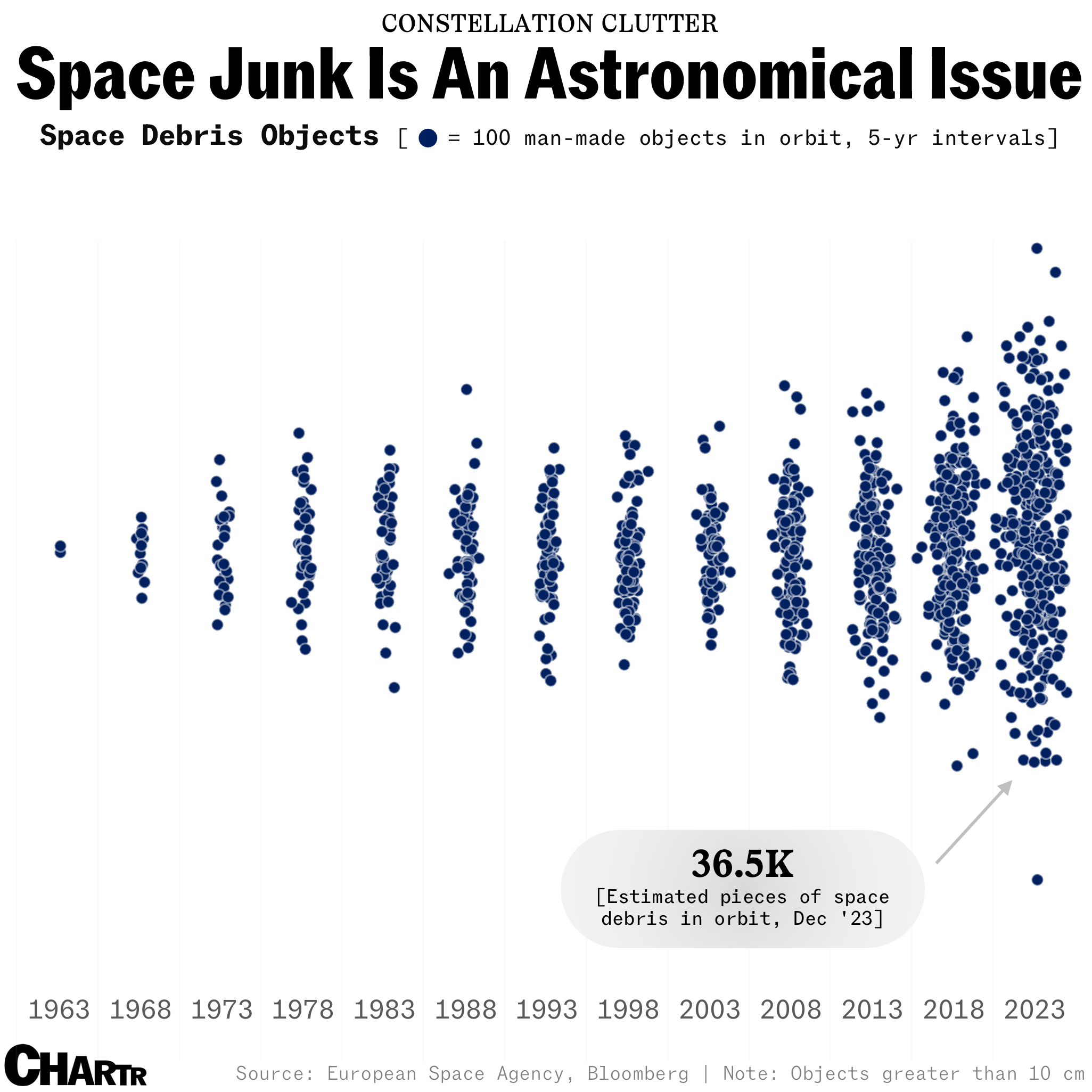
Those stats may pickup in the coming years though, as the ESA tracks the ever-growing number of man-made objects that clutter the space around Earth. At the end of last year, a staggering 36,500 space debris objects over 10 cm in length were orbiting the Earth — perhaps little shock to anyone familiar with the Kessler Syndrome, a concerning theory that the more space junk there is, the more collisions there will be, causing a self-perpetuating chain reaction that could result in Earth’s orbit becoming essentially unusable.

More World

See all World
world
Tom Jones

The UAE’s OPEC exit will hit the group in the barrels

After just shy of 60 years in OPEC, its membership even predating its status as a nation-state, the United Arab Emirates yesterday announced its shocking departure from the oil production group, effective May 1, as the knock-on effects of the Iran war continue to play out across the Middle East and the energy landscape.

For context, the UAE produces the third-highest amount of oil in the group, per April data and OPEC’s latest set of annual statistics.

According to the cartel’s 2025 Annual Statistical Bulletin, the OPEC group was collectively exporting some 19 million barrels of crude oil a day last year, with the United Arab Emirates accounting for some 14% of that daily output.

UAExit means UAExit

The nation, whose energy minister told Reuters yesterday that the decision was taken “after a careful look at current and future policies related to level of production” and wasn’t made following discussions with any other country, made up a healthy share of the group’s total confirmed crude oil reserves, as well.

OPEC exports chart
Sherwood News

Of the 12 nations in the core group, which was founded by just five oil superpowers back in September 1960, only two (Iraq and Saudi Arabia) exported more barrels of crude oil daily, pumping out 3.36 million and 6.05 million barrels, respectively, each day to nations around the world.

For its part, the UAE said it will “continue its responsible role by gradually and thoughtfully increasing production, in line with demand and market conditions,” per the official state news agency. Clearly, the nation now wants a little more control of just how much oil it can pump around the world, with the UAE having to eat a large proportion of lost revenues due to its healthy abundance and OPEC restrictions.

According to the cartel’s 2025 Annual Statistical Bulletin, the OPEC group was collectively exporting some 19 million barrels of crude oil a day last year, with the United Arab Emirates accounting for some 14% of that daily output.

UAExit means UAExit

The nation, whose energy minister told Reuters yesterday that the decision was taken “after a careful look at current and future policies related to level of production” and wasn’t made following discussions with any other country, made up a healthy share of the group’s total confirmed crude oil reserves, as well.

OPEC exports chart
Sherwood News

Of the 12 nations in the core group, which was founded by just five oil superpowers back in September 1960, only two (Iraq and Saudi Arabia) exported more barrels of crude oil daily, pumping out 3.36 million and 6.05 million barrels, respectively, each day to nations around the world.

For its part, the UAE said it will “continue its responsible role by gradually and thoughtfully increasing production, in line with demand and market conditions,” per the official state news agency. Clearly, the nation now wants a little more control of just how much oil it can pump around the world, with the UAE having to eat a large proportion of lost revenues due to its healthy abundance and OPEC restrictions.

Latest Stories

Sherwood Media, LLC produces fresh and unique perspectives on topical financial news and is a fully owned subsidiary of Robinhood Markets, Inc., and any views expressed here do not necessarily reflect the views of any other Robinhood affiliate, including Robinhood Markets, Inc., Robinhood Financial LLC, Robinhood Securities, LLC, Robinhood Crypto, LLC, Robinhood Derivatives, LLC, or Robinhood Money, LLC. Futures and event contracts are offered through Robinhood Derivatives, LLC.