World
Computer head
Getty Images
DOT-COM BUBBLE

More than 40% of American adults now report being online “almost constantly”

While a new survey showed Japan has the greatest share of perpetually online people, there was a significant number reporting not using the internet at all.

Millie Giles

The world has only been online for a short period of time, relatively speaking. Only 2% of people had used the internet in 1997; by 2019, this figure had ballooned to 53%; and, in 2023, it had jumped again to 67%.

Naturally, as internet connectivity has become nearly ubiquitous around the globe, so have the people it connects come to rely on it more relentlessly.

On Monday, the Pew Research Center published a survey conducted across 24 countries worldwide that found a median of 28% of adults reporting being online constantly... and 9% reporting not using it at all. 

The data showed greater shares of online adults in wealthier nations, with the lowest reported internet use in India and the three sub-Saharan African nations surveyed.

Nippon(line)

Of all the countries surveyed, Japan had the highest rate of frequent internet usage, with 56% of adults overall reporting being almost constantly online. However, among wealthy countries, Japan also saw the greatest share of people reportedly abstaining from the internet entirely (14%).

Considering that the country is so technologically advanced — shattering the internet speed record this summer at 4 million times the average US broadband speed — a number of these could well be “neo-Luddites” opting for a simpler, less digitally governed life.

But other highly developed countries with large shares of internet nonusers, like Italy and Hungary, also tended to have rapidly aging populations. For Japan, then, it’s perhaps more likely that members of its graying demographic are simply continuing their lives as they’ve largely known it: without the internet.

More World

See all World
world

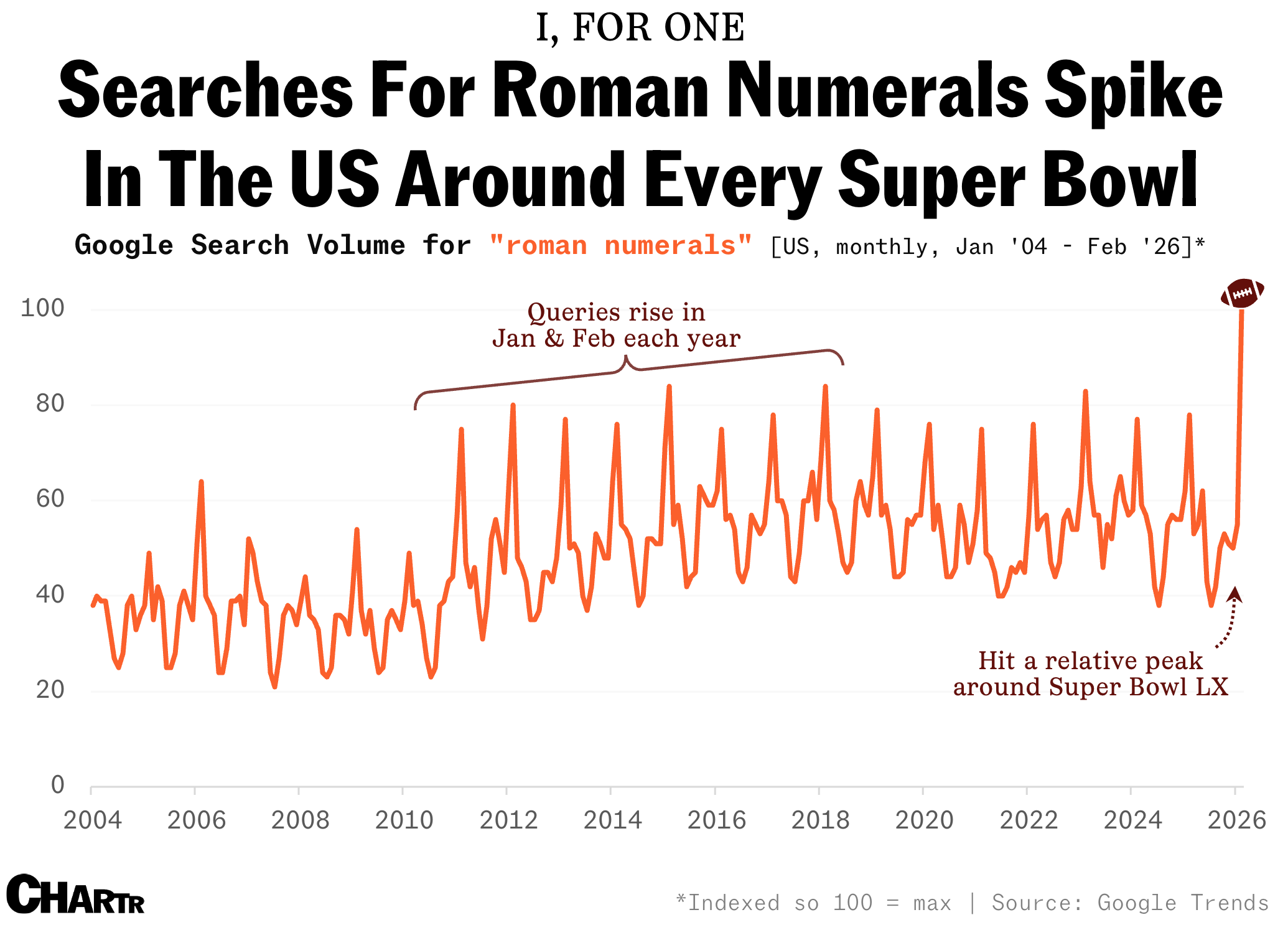
Google searches for “roman numerals” hit a new peak this Super Bowl

Following on from last year’s Super Bowl LIX, and Super Bowl LVIII before that, you’d be forgiven for thinking that the title “Super Bowl LX” might have created less confusion than previous iterations.

But it seems that the archaic notation denoting this year’s Big Game was no exception: monthly search volumes for “roman numerals” in the US were at the highest volume seen in over two decades this February, according to Google Trends data.

Roman numerals super bowl
Sherwood News

If people in shoulder pads throwing around a weirdly shaped ball is your Roman Empire, one thing you have to know is Roman numerals — or join the millions who turn to Google to work out how to read them every Super Bowl season.

Ironically, according to the NFL, the numbering system was adopted for clarity, as the game is played at the start of the year “following a chronologically recorded season.” And so, over its 60-year history, the NFL has labeled almost every Super Bowl with a selection of capital letters like X’s, I’s, and V’s — one of the rare exceptions being Super Bowl 50 in 2016, when the NFL ad designers felt Super Bowl L was too unmarketable.

At least stumped football fans in 2026 will be faring much better than those in the year 12,965 would be, who’d have to refer to the Big Game as Super Bowl (breathes in) MMMMMMMMMMDCCCCLXXXXVIIII.

Latest Stories

Sherwood Media, LLC produces fresh and unique perspectives on topical financial news and is a fully owned subsidiary of Robinhood Markets, Inc., and any views expressed here do not necessarily reflect the views of any other Robinhood affiliate, including Robinhood Markets, Inc., Robinhood Financial LLC, Robinhood Securities, LLC, Robinhood Crypto, LLC, or Robinhood Money, LLC.