
Tech
Xiaomi 2025 Q2 Revenue Growth
A Xiaomi electric vehicle is displayed in a Xiaomi Smart Home store in Shanghai, China (Costfoto/Getty Images)
On the shoulders of giants

Xiaomi is speedrunning building an electric vehicle business

Apple decided pivoting from phones to EVs was too hard. Xiaomi is finding it a piece of cake.

Going first is hard, and scary. You have to forge a path, fixing problems no one else has ever faced, without the ability to ask anyone for help. There’s a reason Google wasn’t the very first search engine and Facebook wasn’t the OG social media platform. It’s almost always easier to build on existing work — and no company is proving that better than Chinese tech giant Xiaomi with its new electric vehicle business.

Su got a fast car

In 2021, no one at Xiaomi knew how to make cars. Indeed, going from smartphones to EVs isn’t exactly a logical or easy next step — just ask Apple, which finally gave up on its moon shot car project after a decade.

But facing a fresh round of US trade sanctions in 2021, execs at Xiaomi ran a scary thought experiment — what would happen to the company if the sanctions killed off its phone business? Xiaomi Auto was founded in September of that year, and now, less than four years on, the company thinks it can deliver 350,000 electric vehicles like its SU7 this fiscal year. That’s a milestone that took Tesla more than a decade, and domestic rival BYD even longer.
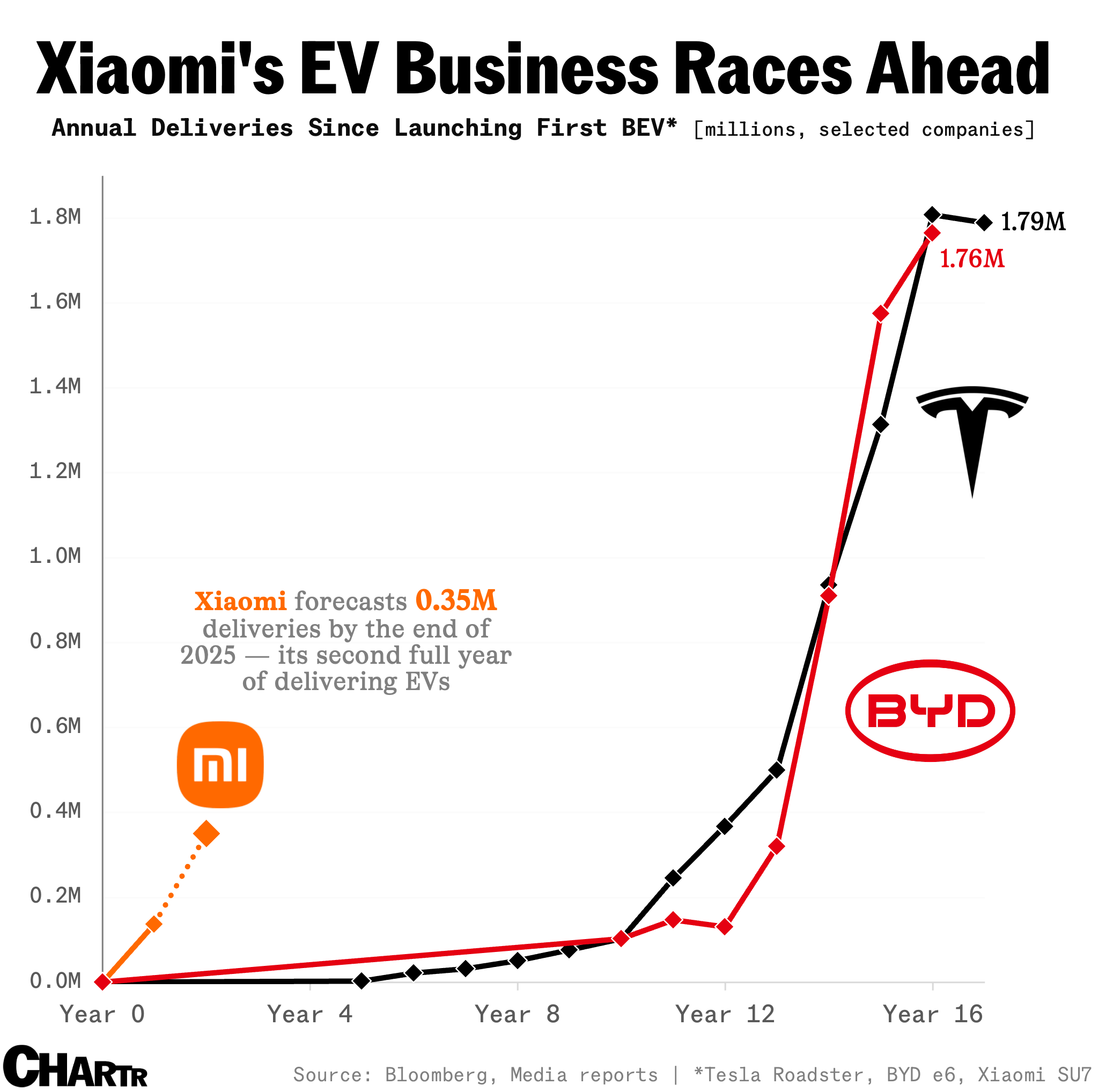
Xiaomi's EV business
Sherwood News

Phone down, car up

As yesterday’s earnings report revealed, cars are speeding up to become Xiaomi’s future, as the company — which has a ~15% share of the smartphone market — noted that the global smartphone industry itself is likely to experience near to zero collective growth this year, while intense price wars continue to chip away at profitability.

Meanwhile, Xiaomi’s smart EVs, AI, and new initiatives segment reached some $3 billion (RMB 21.3 billion) in revenue — finding a swath of middle- to high-income consumers that already love Xiaomi and aren’t swayed by rival BYD’s cheaper EV alternatives. The company is now looking to expand into Europe by 2027.

Being first is nice, but being second (or more like 50th in Xiaomi’s case) clearly doesn't prevent you from catching up quick.

More Tech

See all Tech
$26B

Nvidia is planning on spending $26 billion to train its own AI open-weight models, according to a 2025 financial filing. Wired was first to report the information. Nvidia has released several of its own AI models, including the Nemotron reasoning model, as well as specialized ones for specific tasks.

Nvidia making its own large frontier models could allow the company to go head-to-head against some of its biggest AI customers.

tech

Musk blurs the boundaries of his companies even more with joint xAI-Tesla AI agent project

Tesla and SpaceX CEO Elon Musk said Wednesday that Tesla and xAI, which is part of SpaceX, would work on a joint AI agent project called “Macrohard,” also referred to as “Digital Optimus,” as part of Tesla’s $2 billion investment in xAI. The collaboration would pair Grok with what Musk described as a real-time computer-controlling AI agent running on Tesla hardware.

In his post, Musk said Grok would serve as the higher-level “System 2” reasoning layer directing “Digital Optimus,” a faster “System 1” layer that processes the last five seconds of screen video and keyboard/mouse inputs to take action. He said the system would run inexpensively on Tesla’s low-cost AI4 chip alongside more expensive Nvidia chips at xAI, and suggested it could, “in principle,” emulate the function of entire companies. “No other company can yet do this,” he said.

Business Insider reported earlier Wednesday that Tesla was taking up the AI agent mantle as xAI’s similar project stalled, but Musk’s post suggests the initiatives are more intertwined than previously understood.

The collaboration marks the latest example of Musk’s companies working closely together, further blurring the lines between Tesla and the recently merged SpaceX-xAI entity.

tech

Meta doubles down on custom inference chips after reportedly scrapping training chip

Meta said today that it’s expanding its custom silicon development to include four new generations of Meta Training and Inference Accelerator (MTIA) chips. The announcement comes just weeks after The Information reported that the social media company had scrapped its most advanced AI training chip, dubbed Olympus, after facing design challenges. In the meantime, it signed outside chip deals with Nvidiaand Advanced Micro Devices.

Early in its recent conference call, Broadcom CEO Hock Tan sought to reassure investors that the custom chip specialist’s relationship with the social media giant was only getting stronger.

“Now contrary to recent analyst reports, Meta’s custom accelerator MTIA road map is alive and well,” he said. “We’re shipping now.”

The new road map suggests Meta’s in-house chips will focus more on inference, which has more predictable workloads, over training — a technically more demanding area dominated by Nvidia:

“MTIA 300 will be used for ranking and recommendations training, and is already in production. MTIA 400, 450 and 500 will be capable of handling all workloads, but we will primarily use these chips to support GenAI inference production in the near future and into 2027.”

Meta CFO Susan Li told attendees at Morgan Stanley’s tech conference earlier this month that the company “eventually” plans to expand its custom chip design to include training models.

Early in its recent conference call, Broadcom CEO Hock Tan sought to reassure investors that the custom chip specialist’s relationship with the social media giant was only getting stronger.

“Now contrary to recent analyst reports, Meta’s custom accelerator MTIA road map is alive and well,” he said. “We’re shipping now.”

The new road map suggests Meta’s in-house chips will focus more on inference, which has more predictable workloads, over training — a technically more demanding area dominated by Nvidia:

“MTIA 300 will be used for ranking and recommendations training, and is already in production. MTIA 400, 450 and 500 will be capable of handling all workloads, but we will primarily use these chips to support GenAI inference production in the near future and into 2027.”

Meta CFO Susan Li told attendees at Morgan Stanley’s tech conference earlier this month that the company “eventually” plans to expand its custom chip design to include training models.

tech

Google completes acquisition of Wiz — its biggest ever

Today Google said it has completed its $32 billion acquisition of cybersecurity startup Wiz, the largest deal in the company’s history.

“This acquisition is an investment by Google Cloud to improve cloud security and enable organizations to build fast and securely across any cloud or AI platform,” the company wrote in the press release.

The companies agreed to the all-cash purchase last year, after quite a bit of back-and-forth.

Alphabet updated acquisitions chart
Sherwood News
Alphabet updated acquisitions chart
Sherwood News

Latest Stories

Sherwood Media, LLC produces fresh and unique perspectives on topical financial news and is a fully owned subsidiary of Robinhood Markets, Inc., and any views expressed here do not necessarily reflect the views of any other Robinhood affiliate, including Robinhood Markets, Inc., Robinhood Financial LLC, Robinhood Securities, LLC, Robinhood Crypto, LLC, or Robinhood Money, LLC.