
Tech
A white Waymo self-driving Jaguar I-PACE, adorned with a pink breast cancer awareness ribbon, with other vehicles in the background
A white Waymo driverless Jaguar I-PACE, July 13, 2024 (Getty Images)

Waymo says its robotaxis are involved in 80% fewer injury-causing crashes than human-driven cars

Even with an exemplary safety record, Waymo will have to defend itself vigorously each time one of its autonomous vehicles illegally passes a school bus or kills a cat.

After killing a beloved neighborhood cat a little over a month ago, Alphabet’s self-driving car company, Waymo, is once again having to defend its safety protocols.

Last Friday, Waymo said that it’s planning a software recall to prevent its vehicles from failing to fully slow or stop for school buses, in response to the NHTSA launching a probe into the company. The investigation follows several incidents of Waymo cars illegally passing school buses in freshly-fleeted cities Atlanta and Austin.

In an emailed statement, the company said it updated the software “as soon as the issue was identified” on November 17, per TechCrunch, with the autonomous vehicle giant also noting its “strong safety record.”

Buckle up

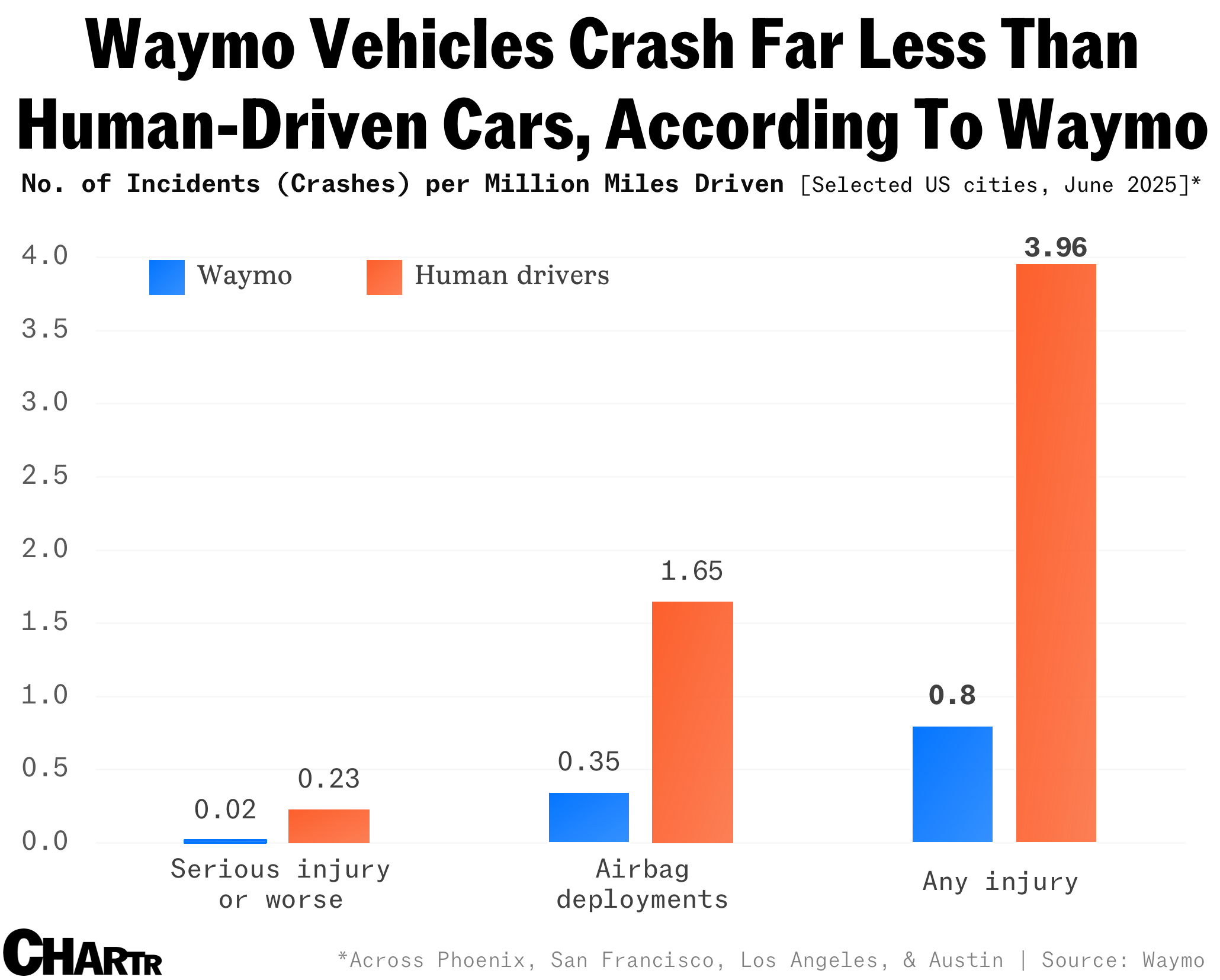
As detailed in a fascinating essay in The New York Times, data recently released by Waymo in its Safety Impact Report — which covers “nearly 100 million driverless miles” across four American cities — found that Waymo vehicles were involved in 91% fewer crashes causing serious injury or worse, and 80% fewer crashes causing any injury, than human drivers.
Waymo Safety Incidents June 2025
Sherwood News

While it’s still a relatively small pool of results in very specific locations (and cynics may be quick to point out that the analysis was carried out by Waymo itself), the statistics are pretty staggering, with the NYTimes noting that “other autonomous vehicle companies don’t report or they report incomplete data.”

With Waymo, Tesla, and others making expeditious progress in the race for self-driving supremacy, arguably the biggest obstacle for autonomous vehicles remains psychological, rather than technological, as every heart-tugging, headline-grabbing infraction weighs heavily on the minds of risk-averse would-be riders.


More Tech

See all Tech
tech

FT: Meta considering “tens of billions” in new capital to fund AI

Just days after Google announced a monster $85 billion upsized equity raise, the extremely profitable Meta is seeking to sell “tens of billions of dollars” in stock, according to a new report from the Financial Times.

Meta is planning on spending between $125 billion and $145 billion on AI capital expenditure this year alone.

Shares dropped more than 5% on the news.

tech

FT: Anthropic staff helping the NSA use Mythos for offensive cyberattacks

Anthropic’s Mythos AI model was deemed too dangerous to release to the public, with the company citing its ability to orchestrate novel cyberattacks.

And that’s just what the National Security Agency is doing, with the help of Anthropic staff embedded at the agency, according to a report from the Financial Times.

Only a small number of companies and US allies have been given access to the advanced model, which means America’s adversaries have not had the chance to shore up their defenses against the AI model’s new offensive capabilities.

The arrangement is especially unusual as the Pentagon has deemed Anthropic’s AI a national security supply chain risk — effectively blacklisting it for defense work — in response to the company’s refusal to allow its technology to be used for any legal application, which could include autonomous killing or mass surveillance. Anthropic is currently suing the US government to fight the determination.

Only a small number of companies and US allies have been given access to the advanced model, which means America’s adversaries have not had the chance to shore up their defenses against the AI model’s new offensive capabilities.

The arrangement is especially unusual as the Pentagon has deemed Anthropic’s AI a national security supply chain risk — effectively blacklisting it for defense work — in response to the company’s refusal to allow its technology to be used for any legal application, which could include autonomous killing or mass surveillance. Anthropic is currently suing the US government to fight the determination.

tech

Longtime Tesla bear JPMorgan upgraded Tesla and raised its price target to $475 from $145

For more than a decade, JPMorgan was Wall Streets most stubborn Tesla skeptic, anchored by auto analyst Ryan Brinkman’s strict focus on traditional car fundamentals and near-term delivery numbers.

But JPM recently handed coverage of the stock to a new analyst, Rajat Gupta, who is throwing that playbook out the window. In a note Friday, the firm upgraded Tesla to neutral from underweight and raised its price target 228% to $475 from $145. (The analyst consensus on FactSet is $403.) Instead of focusing on the company’s struggling vehicle business, the new analyst is orienting himself more toward Tesla’s idea of the future, now modeling Tesla’s physical AI and robotaxi fleets all the way out to the year 2040.

Here are the main reasons for the capitulation:

  • Looking past the car lot: Gupta argues that Tesla is at the forefront of physical AI, entering uncharted TAMs” and therefore deserves the benefit of the doubt to be valued on LT earnings potential rather than near-term speed bumps.

  • Unmatched vertical integration: Teslas control over everything from battery cells to custom silicon gives it a massive moat. JPM notes this starting point advantage is unmatched at an industrial level scale” and “still somewhat under-appreciated and misunderstood.

  • The AWS flywheel effect: Deploying Optimus robots inside its own factories should not only lower COGS for the base automotive business, but more importantly, help validate the product at an industrial scale.” Gupta called it “a classic flywheel effect, somewhat analogous to AWS and Kiva at AMZN.

For Tesla bulls who have argued for years that this is an AI company and not a carmaker, JPM’s sudden $3.9 trillion valuation model is the ultimate validation.

skynet terminator

Anthropic ponders self-improving AI

Anthropic says Claude already writes 80% of its code. A new post asks what happens when the models can improve themselves — and whether anyone could stop them.

Latest Stories

Sherwood Media, LLC and Chartr Limited produce fresh and unique perspectives on topical financial news and are fully owned subsidiaries of Robinhood Markets, Inc., and any views expressed here do not necessarily reflect the views of any other Robinhood affiliate, including Robinhood Markets, Inc., Robinhood Financial LLC, Robinhood Securities, LLC, Robinhood Crypto, LLC, Robinhood Money, LLC, Robinhood U.K. Ltd, Robinhood Derivatives, LLC, Robinhood Gold, LLC, Robinhood Asset Management, LLC, Robinhood Credit, Inc., Robinhood Ventures DE, LLC and, where applicable, its managed investment vehicles.
