
Tech
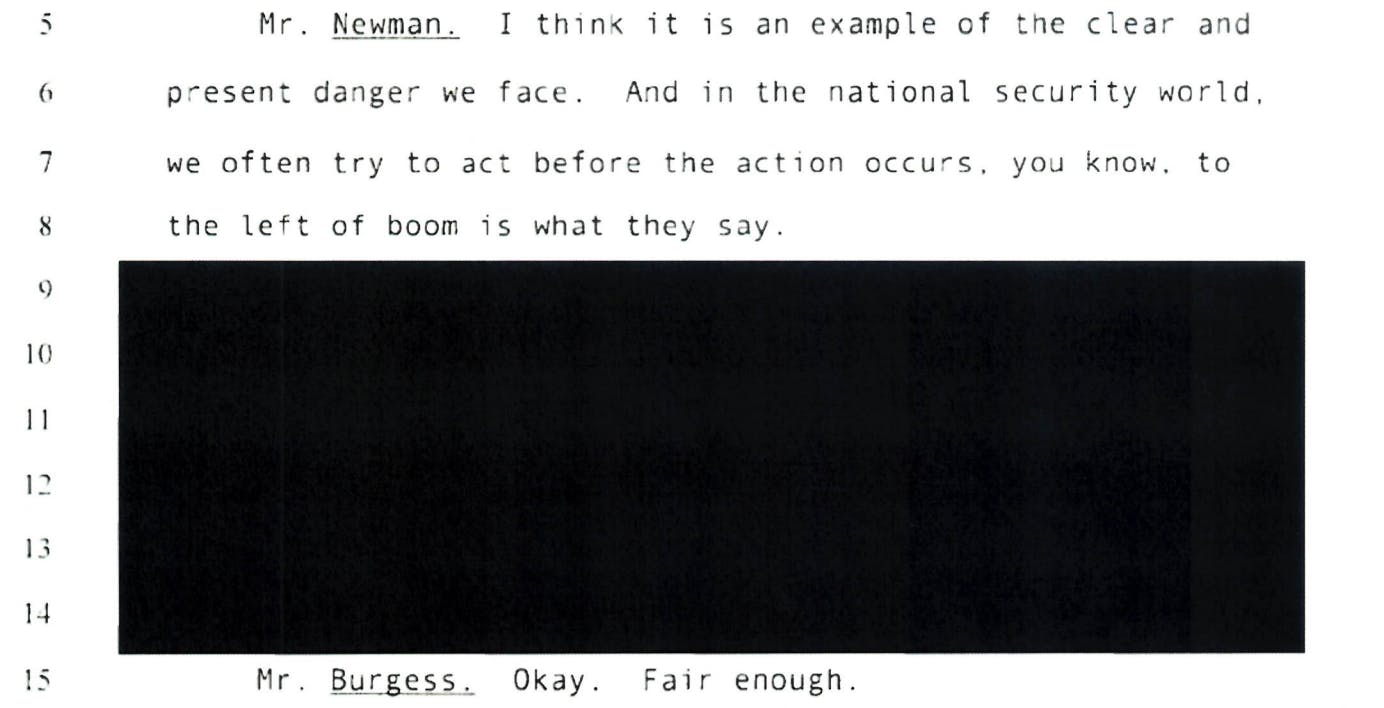
Redacted element of a transcript
US Court of Appeals for DC Circuit
Classified

Here’s the transcript of the secret briefing that kicked off the TikTok law

Matt Phillips

It’s hard for Americans — or American politicians — to agree on much of anything these days.

But, following a classified briefing on the potential national security threat posed by TikTok on March 7, the House Energy and Commerce Committee voted unanimously to advance an incredibly contentious legislation that posed a threat to TikTok, one of the most popular forms of communication in the country. (Even after TikTok sent a urgent sounding push alert to its users' phones, directing them to call Congress and generating a flood of calls to Representatives.)

It was a remarkably rapid, unified and some might say courageous decision in a legislative body not known for such things.

The unanimous committee vote gave a jolt of momentum to the bill which passed the next week in a landslide vote by the full house. The Senate passed it the next month and President Biden signed it soon afterward.

Remarkably, we now have a transcript of that classified March 7 meeting that supercharged the journey of that bill into law.

Read the transcript here.

TikTok and its parent are fighting the law in court. And as part of that civil litigation, the government filed yesterday, a heavily redacted transcript of the briefing which was delivered, in part, by a representative of the Office of the Director of National Intelligence — identified only as Jonathan — and David Newman, a national security official at the Department of Justice, as well as others.

As you might imagine, the government has taken pains to efface any blockbuster revelations that might have been included in the classified testimony. Several pages are nothing more than large black rectangles. Elsewhere, there are merely tantalizing hints of what was said.

But in its court filing introducing the transcript, the government stressed that even providing this level of disclosure of a classified briefing is highly unusual. They argued, essentially, that the government was bending over backward to provide some transparency because of the stakes of the case.

“The government is unaware of any past circumstance in which classified testimony by the intelligence community at a classified hearing before Congress has been shared with a court for consideration in connection with civil litigation,” wrote Justice Department attorneys.

The disclosures — or lack of disclosure, depending on your perspective — reflect the unusual nature of the limited access to classified information in this case. Those limits pertain not only to the public, but also to TikTok and its attorneys which are not allowed to see the classified material either.

Unlike in a criminal case, where a defendant has some rights to see the classified evidence being presented against them, TikTok’s efforts to fight the ban is a civil matter, where it has no rights to see such classified material, says Alan Rozenshtein, an associate professor of Law at the University of Minnesota Law School and a senior editor at Lawfare, the national security law publication.

“The court is being asked to uphold this law on the basis of evidence that it cannot disclose to the litigants or to the public,” he said.

More Tech

See all Tech
tech
Jon Keegan

DeepSeek releases new V4 series models highlighting efficiency and long context

Chinese AI lab DeepSeek has released a major new version of its eponymous open-source AI models that are nipping at the heels of leading frontier models in some areas.

The most significant DeepSeek-V4 Pro and DeepSeek-V4 Flash both have a 1 million-token context — the amount of information the model can actively work with in a single session — which is a crucial feature for complex, long-running coding tasks.

DeepSeek rebuilt how the models process information under the hood, making them substantially more efficient — and that efficiency is what makes the large context window actually usable.

Also, the new models’ coding skills have closed the gap with the major frontier models from Anthropic, OpenAI, and Google.

The authors of the model acknowledge some of V4’s shortcomings, such as its lower scores on reasoning benchmarks, saying that V4 “trails state-of-the-art frontier models by approximately 3 to 6 months.”

As open-weight models, V4 can be run on any user’s own hardware, making the V4 models among the top-performing open-source models out there. V4’s large context and token efficiency are especially significant among open-source models.

But like with earlier DeepSeek models, don’t ask it about Tiananmen Square.

DeepSeek rebuilt how the models process information under the hood, making them substantially more efficient — and that efficiency is what makes the large context window actually usable.

Also, the new models’ coding skills have closed the gap with the major frontier models from Anthropic, OpenAI, and Google.

The authors of the model acknowledge some of V4’s shortcomings, such as its lower scores on reasoning benchmarks, saying that V4 “trails state-of-the-art frontier models by approximately 3 to 6 months.”

As open-weight models, V4 can be run on any user’s own hardware, making the V4 models among the top-performing open-source models out there. V4’s large context and token efficiency are especially significant among open-source models.

But like with earlier DeepSeek models, don’t ask it about Tiananmen Square.

$28.5T
Rani Molla

SpaceX thinks its total addressable market (TAM) is a whopping $28.5 trillion for its businesses, according to an S-1 filing for its upcoming IPO reviewed by Reuters. And most of that market isn’t rockets. The company says roughly 90% could come from AI — largely selling artificial intelligence tools to businesses.

“We believe that our enterprise strategy, which is focused on serving the digital needs of the world’s largest industries with Al solutions, positions us competitively to pursue this rapidly ⁠growing opportunity,” ​SpaceX said in the filing. “We believe we have identified the largest actionable total addressable market in human ​history.”

TAM, of course, assumes capturing every possible customer. But even a small slice of a $28.5 trillion market would be enormous.

tech
Rani Molla

Tesla Cybercab production has begun

On Tesla’s earnings call earlier this week, CEO Elon Musk said production of the company’s steering-wheel-less Cybercab had begun. Since then, Musk and Tesla have posted videos showing the gold two-seater rolling off the line at its Texas Gigafactory and onto the road.

The Cybercab — meant both for consumers and Tesla’s Robotaxi network — is widely seen as central to the company’s future. “The future of the company is fundamentally based on large-scale autonomous cars and large scale and large volume, vast numbers of autonomous humanoid robots,” Musk said last year.

Whether these cars actually make it to consumers is another question. For now, regulations generally require steering wheels, and Tesla still has to prove the vehicles can reliably drive themselves.

On the earnings call, Musk said production would be “very slow” but would ramp up and go “kind of exponential towards the end of the year and certainly next year.”

tech
Rani Molla

Meta signs deal to use Amazon Graviton chips

Meta said it will deploy “tens of millions” of Amazon Web Services Graviton CPU cores to power so-called “agentic” AI systems — tools that can reason, plan, and act on their own. The move makes Meta one of the largest customers of Amazon’s in-house chips.

The deal also underscores a broader shift in AI infrastructure, as companies move beyond Nvidia GPUs and use different chips for different tasks.

Meta, which is working on its own custom inference chips, also has chip deals with Advanced Micro Devices and Nvidia.

The deal also underscores a broader shift in AI infrastructure, as companies move beyond Nvidia GPUs and use different chips for different tasks.

Meta, which is working on its own custom inference chips, also has chip deals with Advanced Micro Devices and Nvidia.

tech
Rani Molla

Oracle rises after Wedbush’s Dan Ives calls the stock a buy with 25% upside

Oracle extended its premarket gains Friday after Wedbush Securities’ Dan Ives initiated coverage with an “outperform” rating and a $225 price target — about 25% upside to its pre-initiation level — calling the enterprise software and cloud infrastructure company a “foundational infrastructure provider for the AI revolution.”

Ives argues investors are misreading Oracle’s heavy capital spending and negative free cash flow as risky, despite being backed by a massive $553 billion backlog of contracted demand. He says the company’s “secret sauce” is a two-part strategy: building high-performance cloud infrastructure for AI workloads while connecting those models directly to companies’ own data.

“We believe Oracle is in the early innings of a significant repositioning as it executes on this generational opportunity,” Ives wrote.

Latest Stories

Sherwood Media, LLC produces fresh and unique perspectives on topical financial news and is a fully owned subsidiary of Robinhood Markets, Inc., and any views expressed here do not necessarily reflect the views of any other Robinhood affiliate, including Robinhood Markets, Inc., Robinhood Financial LLC, Robinhood Securities, LLC, Robinhood Crypto, LLC, Robinhood Derivatives, LLC, or Robinhood Money, LLC. Futures and event contracts are offered through Robinhood Derivatives, LLC.

