
Tech
Tesla Robotaxi
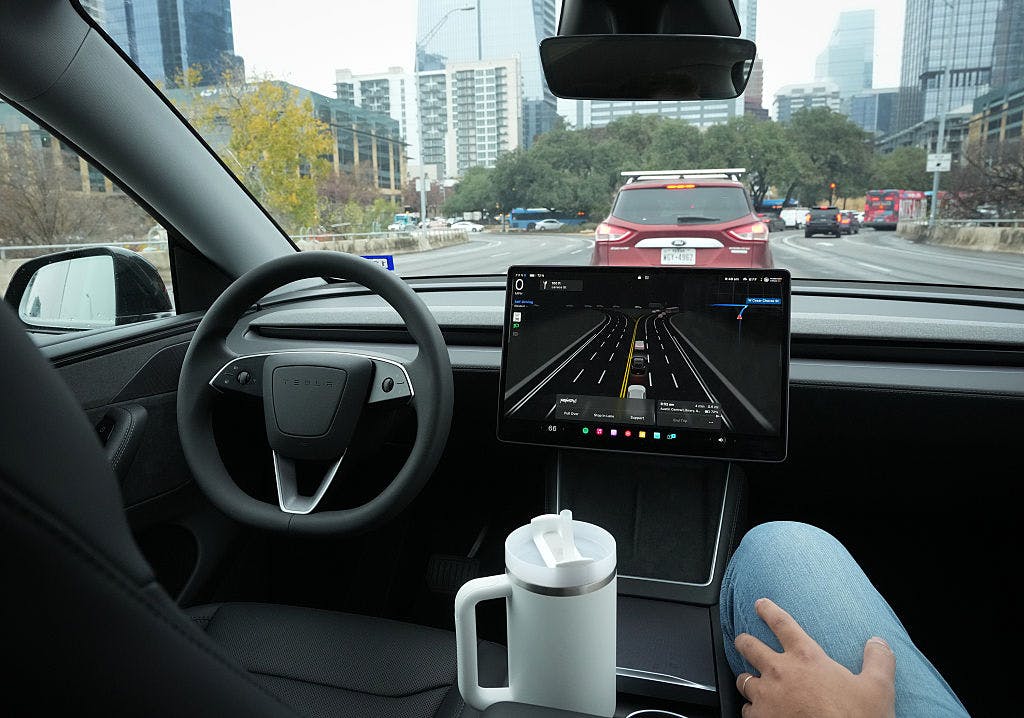
A safety monitor rides in the front passenger seat as a Tesla Robotaxi drives in Austin (Jay Janner/Getty Images)

The vast majority of Tesla Robotaxi rides in Austin still have a safety driver

In January, Tesla announced its Robotaxis would begin operating without safety monitors. It doesn’t appear to have scaled up much.

Rani Molla

When Tesla CEO Elon Musk announced in January that Austin Robotaxis were beginning to operate without safety monitors in the front seats, the stock jumped, signaling investor excitement about progress toward full autonomy.

At the time, observers estimated that just two of the roughly 45 Robotaxis in the fleet were without monitors, but Tesla said the ratio would increase quickly.

“We, obviously, are being very cautious about this because we want to have no injuries or serious accidents along the way,” Musk said of removing safety drivers from Austin Robotaxis on the company’s fourth-quarter earnings call a few days later. “But you’ll see the amount of autonomy increase dramatically, I think, every month essentially.”

More than a month later, that increase hasn’t materialized. A report late last week from Jefferies analysts found that just two of the 15 Austin Robotaxi rides they took were without a safety driver. (Separately, they found that while Robotaxis were cheaper than Waymos and regular Ubers operating in the same area, their wait times and trip times were notably longer — consistent with previous reporting from ride-share comparison app Obi.)

Unsupervised Tesla Robotaxis in Austin
Note that just one of these unsupervised Austin Robotaxis has been seen in the past week (Robotaxi Tracker)

Data from Robotaxi Tracker has identified eight unsupervised Tesla Robotaxis. But only one has been spotted in the past week; the rest were last seen roughly three weeks ago. In other words, the number of monitor-less Teslas currently on the road, compared to the time of the initial announcement, appears somewhere in the range of largely unchanged to possibly down.

Tesla said it plans to expand its Robotaxi fleet to a half dozen new markets in the first half of 2026. (It’s currently also in the Bay Area with drivers using supervised Full Self-Driving tech.) As we’ve noted, if Tesla’s Robotaxi expansion goes forward, it will probably look a lot more like a traditional driver-having Uber than an autonomous Waymo.


More Tech

See all Tech
tech
Jon Keegan

Report: Google DeepMind builds “strike team” to catch up to Anthropic models

Anthropic’s recent momentum, powered by the success of its popular Claude Code tool, is turning up the heat among its AI competitors — not only for its AI startup peer OpenAI, but also with established Big Tech giants like Google.

The Information reports that within Google DeepMind, a “strike team” has been assembled to make a serious push to improve Gemini’s coding capabilities. According to the report, leaders within Google, including cofounder Sergey Brin, are sounding the alarm after determining that Anthropic’s Claude has superior coding skills. The new team’s goal is to create a AI system that can improve itself.

“To win the final sprint, we must urgently bridge the gap in agentic execution and turn our models into primary developers,” Brin wrote in a recent memo to DeepMind staff.

The Information reports that within Google DeepMind, a “strike team” has been assembled to make a serious push to improve Gemini’s coding capabilities. According to the report, leaders within Google, including cofounder Sergey Brin, are sounding the alarm after determining that Anthropic’s Claude has superior coding skills. The new team’s goal is to create a AI system that can improve itself.

“To win the final sprint, we must urgently bridge the gap in agentic execution and turn our models into primary developers,” Brin wrote in a recent memo to DeepMind staff.

$0
Rani Molla

Tesla’s federal tax bill last year was once again $0, Reuters reports. While past losses and green energy credits helped shrink the bill, Reuters found that Tesla also leaned on a classic corporate maneuver: offshore profit-shifting. By routing intellectual property rights through paper-only subsidiaries in the Netherlands and Singapore, Tesla effectively parked $18 billion in profits overseas between 2023 and early 2025. The entirely legal setup saved Tesla an estimated $400 million in US taxes. Not bad for a company whose CEO is not a fan of “shady” tax loopholes.

Latest Stories

Sherwood Media, LLC produces fresh and unique perspectives on topical financial news and is a fully owned subsidiary of Robinhood Markets, Inc., and any views expressed here do not necessarily reflect the views of any other Robinhood affiliate, including Robinhood Markets, Inc., Robinhood Financial LLC, Robinhood Securities, LLC, Robinhood Crypto, LLC, Robinhood Derivatives, LLC, or Robinhood Money, LLC. Futures and event contracts are offered through Robinhood Derivatives, LLC.
