
Tech
Tesla Robotaxi app person holding
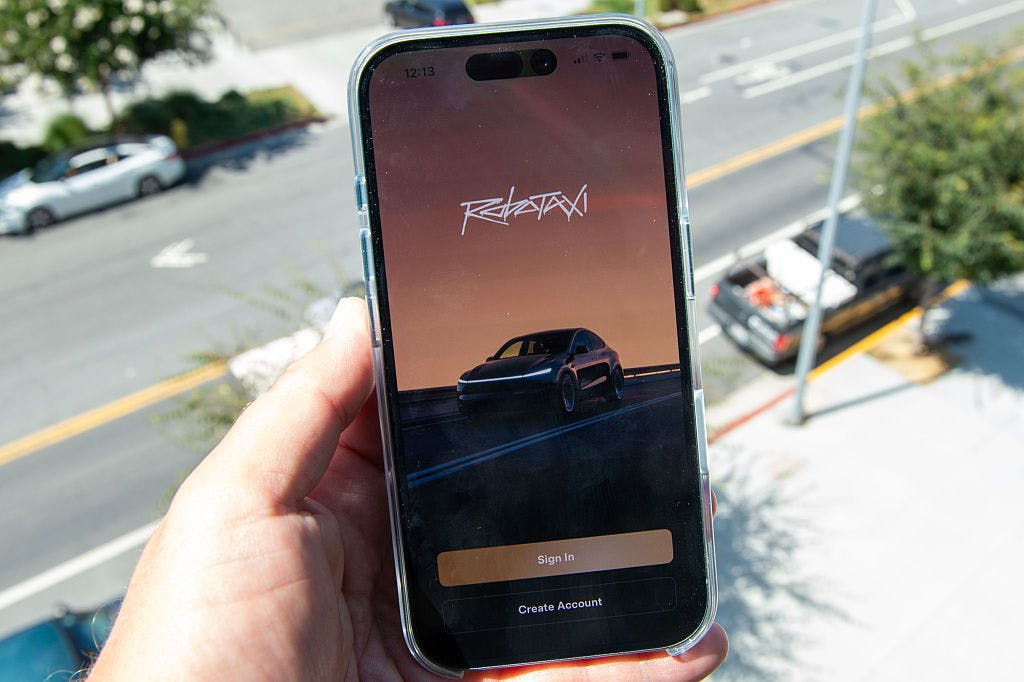
Robotaxi customers are having to wait a bit longer for their rides (Andrej Sokolow/Getty Images)
Waitlist

Tesla Robotaxi demand outpacing supply in Austin and San Francisco

The service finally became available to the public this week.

Rani Molla

Would-be Tesla Robotaxi riders in Austin and the Bay Area are having trouble actually accessing the service, which just became open to the public, instead of invite-only, earlier this week. A number of users are receiving notifications that say, “High service demand. Please come back later,” according to screenshots they’ve sent to us or posted on social media.

When service is available, many are reporting wait times of 40 minutes or more to catch a ride in the autonomous and semi-autonomous vehicles. (They have a safety monitor in the passenger seat in Austin and a driver using supervised Full Self-Driving in the Bay Area.)

It seems demand for the service, whose app briefly neared the top of the App Store rankings when the waitlist became available in September, is outpacing supply.

When Tesla launched its service in Austin this summer, it started out with about 20 vehicles. It has since expanded to the Bay Area, where it operates a service with an unknown number of vehicles that’s more akin to Uber since a person is driving the car. Tesla hasn’t disclosed the current number of vehicles on the road in each market, but CEO Elon Musk recently said he expects there to be 500 in Austin and 1,000 in the Bay Area by the end of the year. For comparison, Google’s Waymo currently has more than 1,000 vehicles in the Bay Area and more than 100 in Austin.

Separately, Musk said on the company’s last earnings call that its Robotaxi service would expand into 8 to 10 markets this year, up from the two it’s currently in. Waymo is operational in five markets and has plans to expand to more than 20 markets.

Read More: Who has the wheel

Tesla’s Robotaxi service area in Austin is about 245 square miles, and in northern California, its coverage spans San Francisco down to San Jose and includes parts of East Bay. For now, however many vehicles it has in service isn’t cutting it.

Of course, scaling up is supposed to be easy for Tesla, whose CEO has repeatedly said much of the company’s existing consumer fleet, which numbers in the millions, could potentially convert to robotaxis at a moment’s notice.

“There are millions of cars out there that, with a software update, become Full Self-Driving cars,” Musk said on Tesla’s recent earnings call.

More Tech

See all Tech
tech

Google’s YouTube maintains its top spot as streaming accounts for nearly half of all TV-watching time

People spent a record 47.5% of their TV-watching time on streaming platforms in December, according to new data from Nielsen, up from the previous record of 47.3% in July. Google’s YouTube once again was the most popular streaming service by time spent, but Netflix’s share inched slightly upward to 9% from 8.8% in July, while YouTube’s fell to 12.7% from 13.4%. The jump was largely thanks to Stranger Things, which was the most watched streaming title last month.

tech

Amazon CEO says tariffs are inflating prices and buyers are looking for bargains

While the legality of President Trump’s tariffs winds its way through the courts, their effects are beginning to show up in prices.

During an interview at the World Economic Forum in Davos, Switzerland, Amazon CEO Andy Jassy said he is starting to see tariffs “creep into” pricing, as some sellers are “passing on those higher costs to consumers in the form of higher prices.”

Jassy said that while consumers are still spending, they are becoming more price conscious.

“I think that wherever they can, they are trying to trade down in price — they are looking for bargains wherever they can find bargains,” he said. “I see people a little more hesitant on higher-priced discretionary items.”

Trump has maintained that other countries are footing the bill for his tariffs. But new research suggests Americans will ultimately be the ones paying those higher prices.

Jassy said that while consumers are still spending, they are becoming more price conscious.

“I think that wherever they can, they are trying to trade down in price — they are looking for bargains wherever they can find bargains,” he said. “I see people a little more hesitant on higher-priced discretionary items.”

Trump has maintained that other countries are footing the bill for his tariffs. But new research suggests Americans will ultimately be the ones paying those higher prices.

tech

Musk: Tesla restarting Dojo supercomputer effort as “AI5 chip design is in good shape”

Tesla CEO Elon Musk said in a post on X over the weekend that the company plans to restart work on its Dojo supercomputer, dubbed Dojo3, saying that the AI5 chip the company had been developing is in “good shape.”

The Dojo supercomputer trains Tesla’s AI models, including the one behind its all-important Full Self-Driving tech. The company stopped work on Dojo in August. “It doesn’t make sense for Tesla to divide its resources and scale two quite different AI chip designs,” Musk said at the time. “The Tesla AI5, AI6 and subsequent chips will be excellent for inference and at least pretty good for training.”

“Pretty good” appears to be good enough.

In the interim, Tesla relied more on companies like Nvidia and Advanced Micro Devices for AI training. Restarting Dojo suggests Tesla plans to bring at least some AI training back in-house.

Musk also runs AI company xAI, which has its own supercomputer and a substantial business relationship with Tesla. A plurality of Tesla shareholders recently voted in favor of investing in Musk’s AI company, but the board declined to approve the measure because of a large number of abstentions.

tech
Jon Keegan

EPA: xAI’s Colossus data center illegally used gas turbines without permits

The Environmental Protection Agency has ruled that xAI violated the law when it used dozens of portable gas generators for its Colossus 1 data center without air quality permits.

When xAI set out to build Colossus 1 in Memphis, Tennessee, CEO Elon Musk wanted to move with unprecedented speed, avoiding all of the red tape that could slow such a big project down.

To power the 1-gigawatt data center, Musk took advantage of a local loophole that allowed portable gas generators to be used without any permits, as long as they did not spend more than 364 days in the same spot. That allowed xAI to bring in dozens of truck-sized gas generators to quickly supply the massive amount of power the data center needed to train xAI’s Grok model.

The new EPA rule says the use of such portable generators falls under federal regulation, and the company did need air quality permits to operate the turbines. xAI is also using dozens of such generators to power its Colossus 2 data center just over the border in Alabama.

To power the 1-gigawatt data center, Musk took advantage of a local loophole that allowed portable gas generators to be used without any permits, as long as they did not spend more than 364 days in the same spot. That allowed xAI to bring in dozens of truck-sized gas generators to quickly supply the massive amount of power the data center needed to train xAI’s Grok model.

The new EPA rule says the use of such portable generators falls under federal regulation, and the company did need air quality permits to operate the turbines. xAI is also using dozens of such generators to power its Colossus 2 data center just over the border in Alabama.

Latest Stories

Sherwood Media, LLC produces fresh and unique perspectives on topical financial news and is a fully owned subsidiary of Robinhood Markets, Inc., and any views expressed here do not necessarily reflect the views of any other Robinhood affiliate, including Robinhood Markets, Inc., Robinhood Financial LLC, Robinhood Securities, LLC, Robinhood Crypto, LLC, or Robinhood Money, LLC.