

Tech
Chatbot speech bubbles
(Getty Images)
out of character

Teens are upset that they can’t speak to Character.AI chatbots anymore

The platform has restricted access for those under 18, as concerns around the tech’s impact grow.

Tom Jones

As far as execs at Character.AI are concerned, (role) playtime’s over for under-18s, as they start to ban teens from using the platform’s chatbots this week

The chatbot company, which clocks about 184 million website visits around the world each month — and millions more app sessions — per data from Similarweb, announced at the end of last month that it would be rolling back access to its open-ended chat feature for minors. Users who are under 18 have been limited to daily two-hour open-ended chats since the late October notice, and access started ramping down for most of those in the age range yesterday.

Indeed, a selection of young “power users,” as The Wall Street Journal termed them in a piece on the anguish some under-18 users are experiencing at being separated from the chatbots, are being given a weeks-long grace period where they can still access hour-long open-ended chats with the characters they’ve been interacting with, to “help minimize disruption” to the teen users.

Clearly, AI-generated conversations with popular characters like Yor Forger, “a loving mom who’s definitely not an assassin,” and Itoshi Rin, who “only loves soccer... and you,” have a lot of (mostly younger) users in the site’s full thrall.
Character.ai demographic chart
Sherwood News

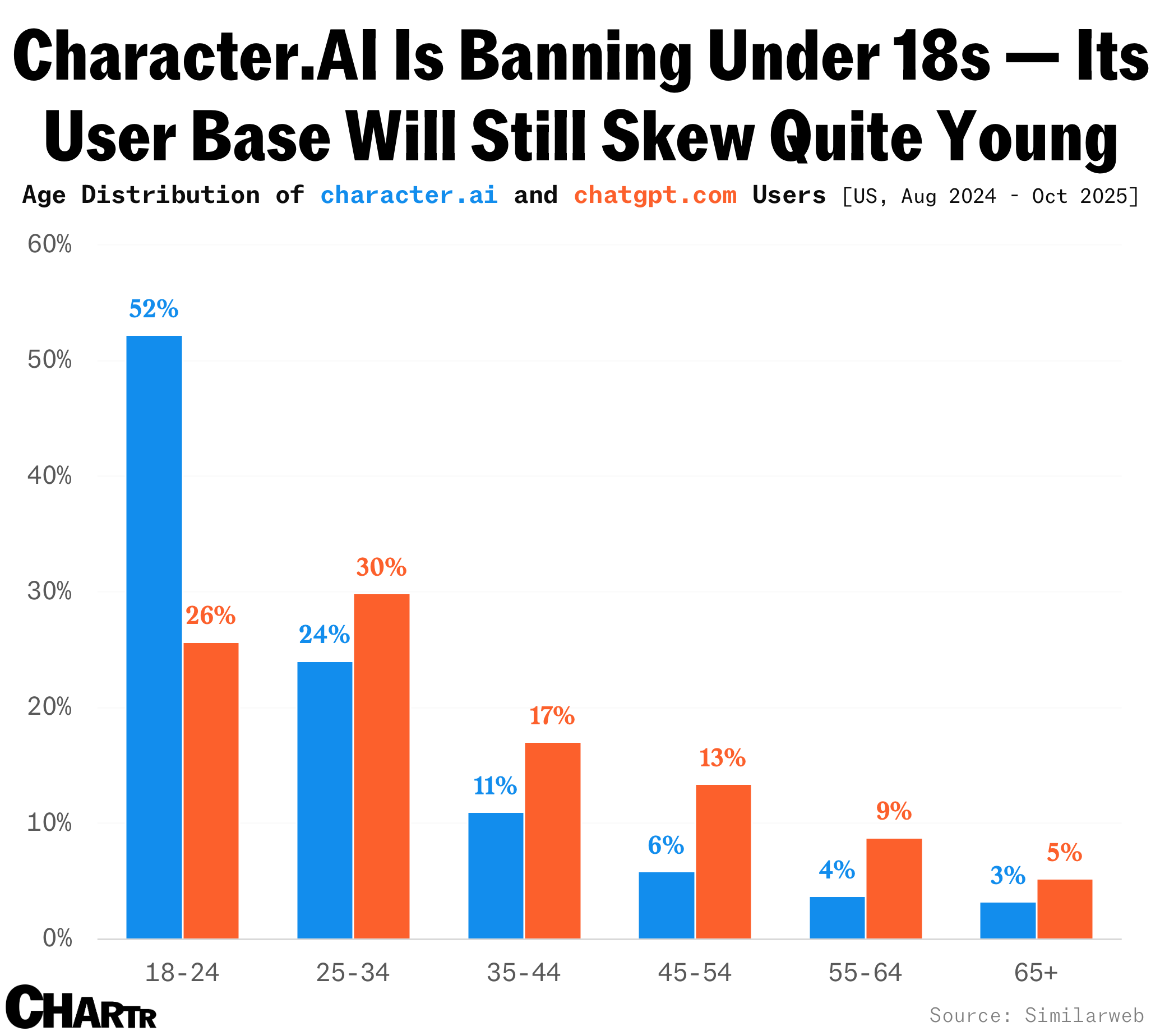
Though traffic-tracking site Similarweb doesn’t break out under-18s in its demographics data, the figures it does disclose already show that Character.AI tends to skew a lot younger than more general competitors like ChatGPT.

According to US-specific figures from Similarweb, of the 1.7 million monthly unique web visitors character.ai notched on average from August to October, some 52% were aged between 18 and 24, compared to a 26% share on chatgpt.com.

A lot to talk about

Character.AI’s younger users tend to be way more locked in, too: per the data, they visited 26 times each month on average and spent 18 minutes in a typical session using Character.AI — much higher than ChatGPT users, who visited the OpenAI chatbot 13 times on average across the month, spending around 6 minutes per visit.

Those sorts of numbers, paired with deaths linked to the platform and increasing concerns around the detrimental effects of chatbots on younger minds more generally, were likely factors in the move to pare back teen user access, which — at least according to Character.AI CEO Karandeep Anand — “wasn’t a very hard decision.”


More Tech

See all Tech
tech

FT: Meta considering “tens of billions” in new capital to fund AI

Just days after Google announced a monster $85 billion upsized equity raise, the extremely profitable Meta is seeking to sell “tens of billions of dollars” in stock, according to a new report from the Financial Times.

Meta is planning on spending between $125 billion and $145 billion on AI capital expenditure this year alone.

Shares dropped more than 5% on the news.

tech

FT: Anthropic staff helping the NSA use Mythos for offensive cyberattacks

Anthropic’s Mythos AI model was deemed too dangerous to release to the public, with the company citing its ability to orchestrate novel cyberattacks.

And that’s just what the National Security Agency is doing, with the help of Anthropic staff embedded at the agency, according to a report from the Financial Times.

Only a small number of companies and US allies have been given access to the advanced model, which means America’s adversaries have not had the chance to shore up their defenses against the AI model’s new offensive capabilities.

The arrangement is especially unusual as the Pentagon has deemed Anthropic’s AI a national security supply chain risk — effectively blacklisting it for defense work — in response to the company’s refusal to allow its technology to be used for any legal application, which could include autonomous killing or mass surveillance. Anthropic is currently suing the US government to fight the determination.

Only a small number of companies and US allies have been given access to the advanced model, which means America’s adversaries have not had the chance to shore up their defenses against the AI model’s new offensive capabilities.

The arrangement is especially unusual as the Pentagon has deemed Anthropic’s AI a national security supply chain risk — effectively blacklisting it for defense work — in response to the company’s refusal to allow its technology to be used for any legal application, which could include autonomous killing or mass surveillance. Anthropic is currently suing the US government to fight the determination.

tech

Longtime Tesla bear JPMorgan upgraded Tesla and raised its price target to $475 from $145

For more than a decade, JPMorgan was Wall Streets most stubborn Tesla skeptic, anchored by auto analyst Ryan Brinkman’s strict focus on traditional car fundamentals and near-term delivery numbers.

But JPM recently handed coverage of the stock to a new analyst, Rajat Gupta, who is throwing that playbook out the window. In a note Friday, the firm upgraded Tesla to neutral from underweight and raised its price target 228% to $475 from $145. (The analyst consensus on FactSet is $403.) Instead of focusing on the company’s struggling vehicle business, the new analyst is orienting himself more toward Tesla’s idea of the future, now modeling Tesla’s physical AI and robotaxi fleets all the way out to the year 2040.

Here are the main reasons for the capitulation:

  • Looking past the car lot: Gupta argues that Tesla is at the forefront of physical AI, entering uncharted TAMs” and therefore deserves the benefit of the doubt to be valued on LT earnings potential rather than near-term speed bumps.

  • Unmatched vertical integration: Teslas control over everything from battery cells to custom silicon gives it a massive moat. JPM notes this starting point advantage is unmatched at an industrial level scale” and “still somewhat under-appreciated and misunderstood.

  • The AWS flywheel effect: Deploying Optimus robots inside its own factories should not only lower COGS for the base automotive business, but more importantly, help validate the product at an industrial scale.” Gupta called it “a classic flywheel effect, somewhat analogous to AWS and Kiva at AMZN.

For Tesla bulls who have argued for years that this is an AI company and not a carmaker, JPM’s sudden $3.9 trillion valuation model is the ultimate validation.

skynet terminator

Anthropic ponders self-improving AI

Anthropic says Claude already writes 80% of its code. A new post asks what happens when the models can improve themselves — and whether anyone could stop them.

Latest Stories

Sherwood Media, LLC and Chartr Limited produce fresh and unique perspectives on topical financial news and are fully owned subsidiaries of Robinhood Markets, Inc., and any views expressed here do not necessarily reflect the views of any other Robinhood affiliate, including Robinhood Markets, Inc., Robinhood Financial LLC, Robinhood Securities, LLC, Robinhood Crypto, LLC, Robinhood Money, LLC, Robinhood U.K. Ltd, Robinhood Derivatives, LLC, Robinhood Gold, LLC, Robinhood Asset Management, LLC, Robinhood Credit, Inc., Robinhood Ventures DE, LLC and, where applicable, its managed investment vehicles.
