Tech
In this photo illustration, the Stack Overflow logo is seen...
The Stack Overflow logo seen displayed on a smartphone screen (Thomas Fuller/Getty Images)
isn’t it aironic?

Stack Overflow’s forum is dead thanks to AI, but the company’s still kicking... thanks to AI

The platform is raking in millions of dollars in revenue, with AI an ironic new source of revenue.

Claire Yubin Oh

When Elon Musk described Stack Overflow’s plight as “death by LLM” in July 2023, he wasn’t exaggerating.

Having been the go-to resource for developers looking for technical help for a long time, Stack Overflow neared the peak of its powers during the pandemic, with coders seeking the evergreen information on the company’s popular Q&A forum. But amid a wave of powerful code-writing AI assistants like ChatGPT, Cursor, Claude, Google’s Gemini, and Microsoft’s Copilot, traffic to the site has plummeted.

Last month, Stack Overflow recorded just 6,866 questions — roughly equal to the typical volume when the site first launched back in 2008.
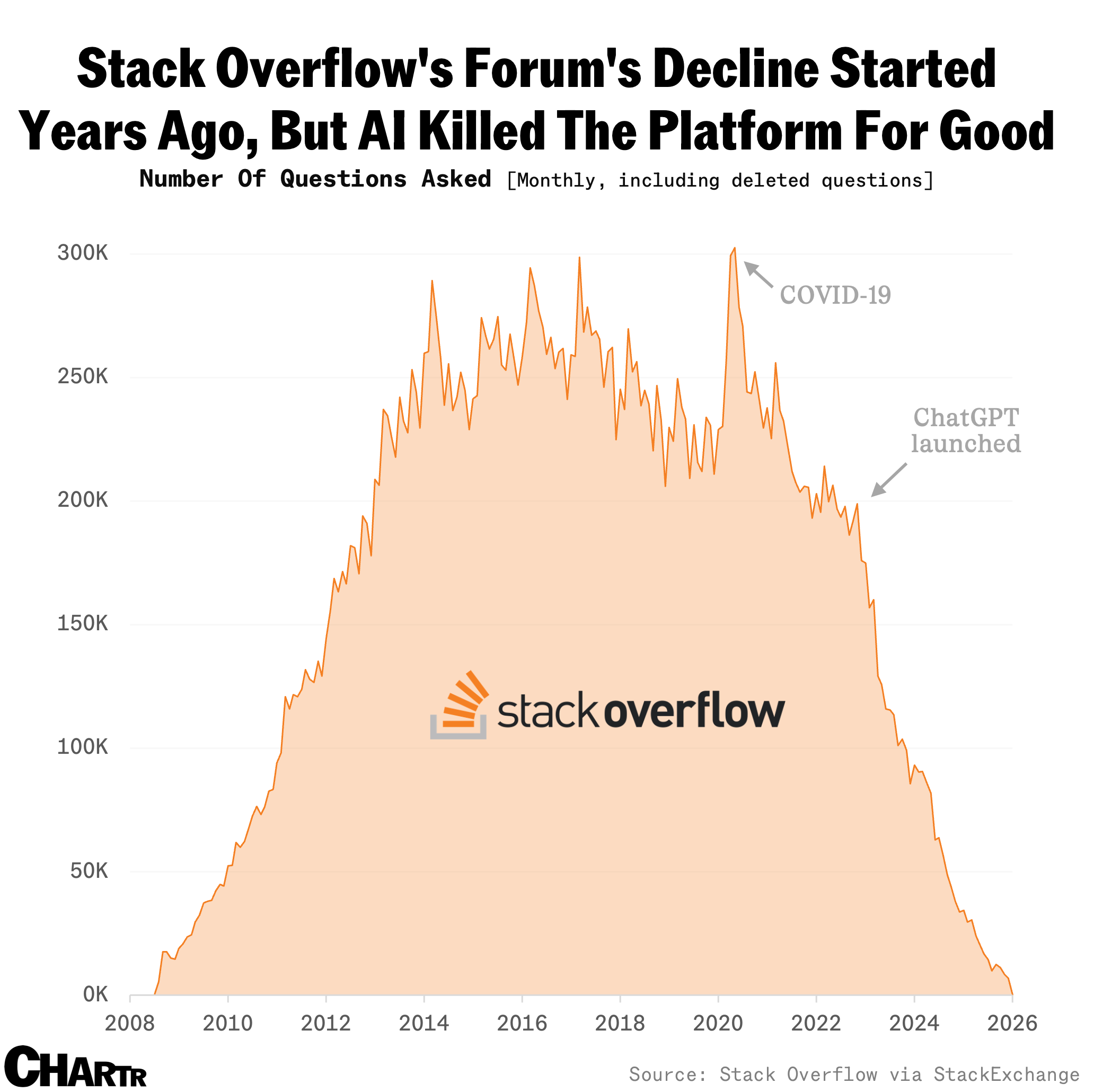
Stack overflow’s traffic
Sherwood News

But while Stack Overflow the Q&A forum looks dead, Stack Overflow the company looks to be limping along.

Unlike Chegg and other knowledge hubs that have fallen victim to generative AI, Stack Overflow has found a way to monetize its enormous back catalog of content. Indeed, even with engagement falling off a cliff since ChatGPT’s 2022 debut, the company’s annual revenue has roughly doubled to $115 million. Losses have slimmed, too, from $84 million in FY2023 to $22 million as of the last fiscal year, as desperate cost-cutting efforts, including mass layoffs, helped boost the bottom line.

Once dependent on ads across its buzzy forum, Stack Overflow now primarily makes money from enterprise solutions like “Stack Internal,” which provides a generative-AI add-on powered by the millions of questions and answers on the site through the years. Stack Internal is now used by 25,000 companies around the world. It also licenses its data to AI companies, in a Reddit-like model — a platform that made more than $200 million from licensing user-generated content in 2024. 

Put simply, Stack Overflows new niche is the trust built by its old community and their expertise. In the words of CEO Prashanth Chandrasekar last December:

...when we saw the questions decline in early 2023, what we realized is that pretty much all those declines were with very simple questions. The complex questions still get asked on Stack because there’s no other place. If the LLMs are only as good as the data, which is typically human curated, we’re one of the best places for that, if not the best for technology.

Large language models want data about coding problems and how to solve them. Stack Overflow has a big digital warehouse full of that, but it’s increasingly aging, as queries move into private chat windows with LLM models... which need huge chunks of data to work. Stack Overflow has become a fascinating canary in tech’s new, circular coal mine.


More Tech

See all Tech
tech
Jon Keegan

DeepSeek releases new V4 series models highlighting efficiency and long context

Chinese AI lab DeepSeek has released a major new version of its eponymous open-source AI models that are nipping at the heels of leading frontier models in some areas.

The most significant DeepSeek-V4 Pro and DeepSeek-V4 Flash both have a 1 million-token context — the amount of information the model can actively work with in a single session — which is a crucial feature for complex, long-running coding tasks.

DeepSeek rebuilt how the models process information under the hood, making them substantially more efficient — and that efficiency is what makes the large context window actually usable.

Also, the new models’ coding skills have closed the gap with the major frontier models from Anthropic, OpenAI, and Google.

The authors of the model acknowledge some of V4’s shortcomings, such as its lower scores on reasoning benchmarks, saying that V4 “trails state-of-the-art frontier models by approximately 3 to 6 months.”

As open-weight models, V4 can be run on any user’s own hardware, making the V4 models among the top-performing open-source models out there. V4’s large context and token efficiency are especially significant among open-source models.

But like with earlier DeepSeek models, don’t ask it about Tiananmen Square.

DeepSeek rebuilt how the models process information under the hood, making them substantially more efficient — and that efficiency is what makes the large context window actually usable.

Also, the new models’ coding skills have closed the gap with the major frontier models from Anthropic, OpenAI, and Google.

The authors of the model acknowledge some of V4’s shortcomings, such as its lower scores on reasoning benchmarks, saying that V4 “trails state-of-the-art frontier models by approximately 3 to 6 months.”

As open-weight models, V4 can be run on any user’s own hardware, making the V4 models among the top-performing open-source models out there. V4’s large context and token efficiency are especially significant among open-source models.

But like with earlier DeepSeek models, don’t ask it about Tiananmen Square.

$28.5T
Rani Molla

SpaceX thinks its total addressable market (TAM) is a whopping $28.5 trillion for its businesses, according to an S-1 filing for its upcoming IPO reviewed by Reuters. And most of that market isn’t rockets. The company says roughly 90% could come from AI — largely selling artificial intelligence tools to businesses.

“We believe that our enterprise strategy, which is focused on serving the digital needs of the world’s largest industries with Al solutions, positions us competitively to pursue this rapidly ⁠growing opportunity,” ​SpaceX said in the filing. “We believe we have identified the largest actionable total addressable market in human ​history.”

TAM, of course, assumes capturing every possible customer. But even a small slice of a $28.5 trillion market would be enormous.

tech
Rani Molla

Tesla Cybercab production has begun

On Tesla’s earnings call earlier this week, CEO Elon Musk said production of the company’s steering-wheel-less Cybercab had begun. Since then, Musk and Tesla have posted videos showing the gold two-seater rolling off the line at its Texas Gigafactory and onto the road.

The Cybercab — meant both for consumers and Tesla’s Robotaxi network — is widely seen as central to the company’s future. “The future of the company is fundamentally based on large-scale autonomous cars and large scale and large volume, vast numbers of autonomous humanoid robots,” Musk said last year.

Whether these cars actually make it to consumers is another question. For now, regulations generally require steering wheels, and Tesla still has to prove the vehicles can reliably drive themselves.

On the earnings call, Musk said production would be “very slow” but would ramp up and go “kind of exponential towards the end of the year and certainly next year.”

tech
Rani Molla

Meta signs deal to use Amazon Graviton chips

Meta said it will deploy “tens of millions” of Amazon Web Services Graviton CPU cores to power so-called “agentic” AI systems — tools that can reason, plan, and act on their own. The move makes Meta one of the largest customers of Amazon’s in-house chips.

The deal also underscores a broader shift in AI infrastructure, as companies move beyond Nvidia GPUs and use different chips for different tasks.

Meta, which is working on its own custom inference chips, also has chip deals with Advanced Micro Devices and Nvidia.

The deal also underscores a broader shift in AI infrastructure, as companies move beyond Nvidia GPUs and use different chips for different tasks.

Meta, which is working on its own custom inference chips, also has chip deals with Advanced Micro Devices and Nvidia.

tech
Rani Molla

Oracle rises after Wedbush’s Dan Ives calls the stock a buy with 25% upside

Oracle extended its premarket gains Friday after Wedbush Securities’ Dan Ives initiated coverage with an “outperform” rating and a $225 price target — about 25% upside to its pre-initiation level — calling the enterprise software and cloud infrastructure company a “foundational infrastructure provider for the AI revolution.”

Ives argues investors are misreading Oracle’s heavy capital spending and negative free cash flow as risky, despite being backed by a massive $553 billion backlog of contracted demand. He says the company’s “secret sauce” is a two-part strategy: building high-performance cloud infrastructure for AI workloads while connecting those models directly to companies’ own data.

“We believe Oracle is in the early innings of a significant repositioning as it executes on this generational opportunity,” Ives wrote.

Latest Stories

Sherwood Media, LLC produces fresh and unique perspectives on topical financial news and is a fully owned subsidiary of Robinhood Markets, Inc., and any views expressed here do not necessarily reflect the views of any other Robinhood affiliate, including Robinhood Markets, Inc., Robinhood Financial LLC, Robinhood Securities, LLC, Robinhood Crypto, LLC, Robinhood Derivatives, LLC, or Robinhood Money, LLC. Futures and event contracts are offered through Robinhood Derivatives, LLC.