

Tech
tech
Tom Jones

Shopify is looking to AI to keep its workforce lean

In an internal memo to staff, which he then made public after it got leaked yesterday, Shopify CEO Tobi Lütke announced a raft of new company policies and expectations around AI — most notably the fact that Shopify staffers must now demonstrate why the tech can’t do the job itself before even asking about new hires.

Lütke also outlined that using AI effectively is now a “fundamental expectation” of all staff and that effective usage would be added to company-wide performance and peer reviews, as the online shopping software business doubles down on the tech’s potential across the board.

Shopify leaning in to increasing AI usage comes as the company continues to “quietly” cut staff in its customer support division, on the back of broader layoff rounds that have seen headcount tumble over the last couple of years.
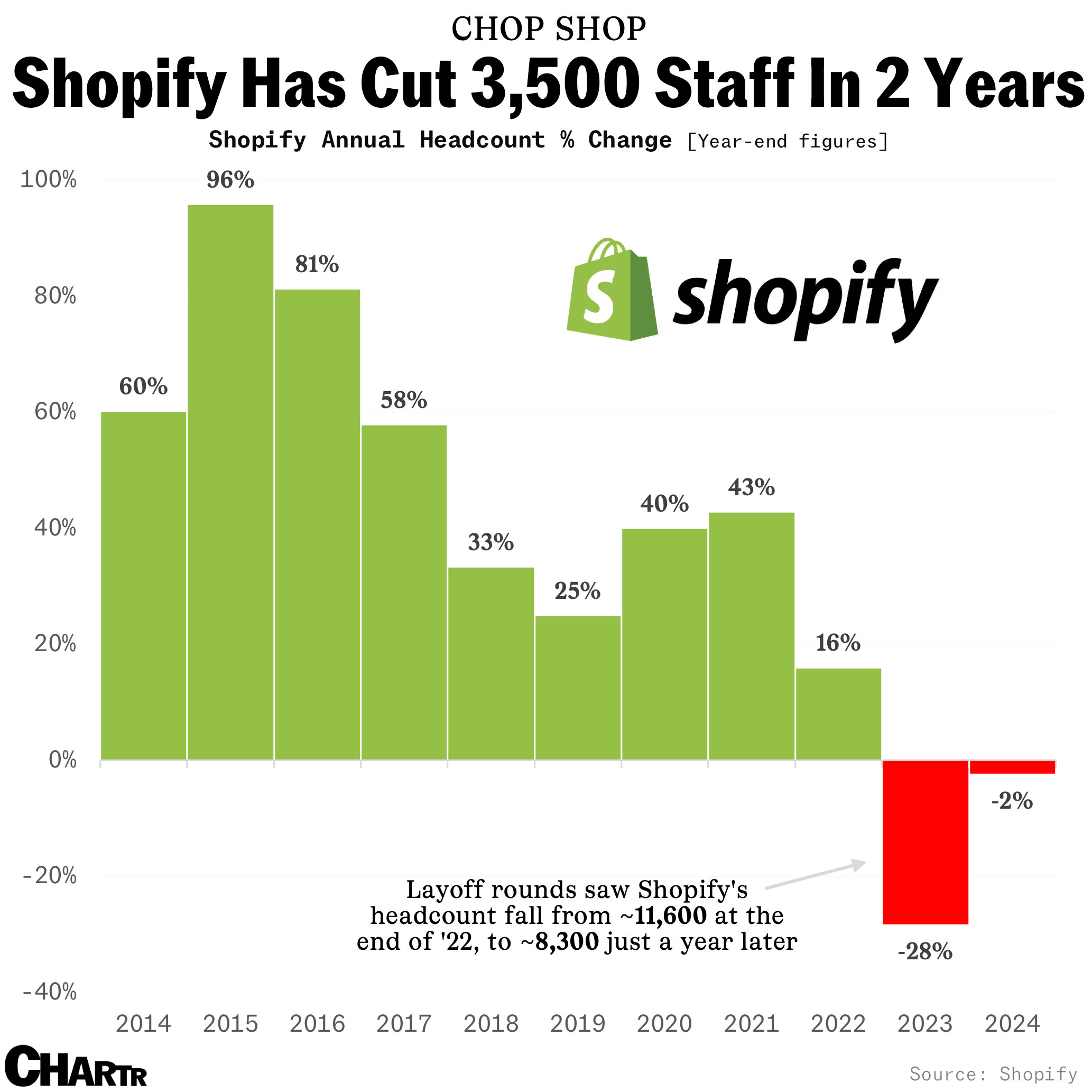
Shopify headcount chart
Sherwood News

The newly Nasdaq-listed company has been making efforts to downsize for years, with (sometimes controversial) rounds of cutbacks affecting as much as one-fifth of its global workforce at a time. While Shopify’s headcount peaked at approximately 11,600 employees by December 2022, per the company’s annual filings, it came in ~3,300 (28%) lighter by the end of the next year and fell a further 2% in 2024, as well.

Clearly, Lütke feels that AI could be key in maintaining Shopify’s lean(er) machine moving forward.

Shopify headcount chart
Sherwood News

The newly Nasdaq-listed company has been making efforts to downsize for years, with (sometimes controversial) rounds of cutbacks affecting as much as one-fifth of its global workforce at a time. While Shopify’s headcount peaked at approximately 11,600 employees by December 2022, per the company’s annual filings, it came in ~3,300 (28%) lighter by the end of the next year and fell a further 2% in 2024, as well.

Clearly, Lütke feels that AI could be key in maintaining Shopify’s lean(er) machine moving forward.

More Tech

See all Tech
tech

FT: Meta considering “tens of billions” in new capital to fund AI

Just days after Google announced a monster $85 billion upsized equity raise, the extremely profitable Meta is seeking to sell “tens of billions of dollars” in stock, according to a new report from the Financial Times.

Meta is planning on spending between $125 billion and $145 billion on AI capital expenditure this year alone.

Shares dropped more than 5% on the news.

tech

FT: Anthropic staff helping the NSA use Mythos for offensive cyberattacks

Anthropic’s Mythos AI model was deemed too dangerous to release to the public, with the company citing its ability to orchestrate novel cyberattacks.

And that’s just what the National Security Agency is doing, with the help of Anthropic staff embedded at the agency, according to a report from the Financial Times.

Only a small number of companies and US allies have been given access to the advanced model, which means America’s adversaries have not had the chance to shore up their defenses against the AI model’s new offensive capabilities.

The arrangement is especially unusual as the Pentagon has deemed Anthropic’s AI a national security supply chain risk — effectively blacklisting it for defense work — in response to the company’s refusal to allow its technology to be used for any legal application, which could include autonomous killing or mass surveillance. Anthropic is currently suing the US government to fight the determination.

Only a small number of companies and US allies have been given access to the advanced model, which means America’s adversaries have not had the chance to shore up their defenses against the AI model’s new offensive capabilities.

The arrangement is especially unusual as the Pentagon has deemed Anthropic’s AI a national security supply chain risk — effectively blacklisting it for defense work — in response to the company’s refusal to allow its technology to be used for any legal application, which could include autonomous killing or mass surveillance. Anthropic is currently suing the US government to fight the determination.

tech

Longtime Tesla bear JPMorgan upgraded Tesla and raised its price target to $475 from $145

For more than a decade, JPMorgan was Wall Streets most stubborn Tesla skeptic, anchored by auto analyst Ryan Brinkman’s strict focus on traditional car fundamentals and near-term delivery numbers.

But JPM recently handed coverage of the stock to a new analyst, Rajat Gupta, who is throwing that playbook out the window. In a note Friday, the firm upgraded Tesla to neutral from underweight and raised its price target 228% to $475 from $145. (The analyst consensus on FactSet is $403.) Instead of focusing on the company’s struggling vehicle business, the new analyst is orienting himself more toward Tesla’s idea of the future, now modeling Tesla’s physical AI and robotaxi fleets all the way out to the year 2040.

Here are the main reasons for the capitulation:

  • Looking past the car lot: Gupta argues that Tesla is at the forefront of physical AI, entering uncharted TAMs” and therefore deserves the benefit of the doubt to be valued on LT earnings potential rather than near-term speed bumps.

  • Unmatched vertical integration: Teslas control over everything from battery cells to custom silicon gives it a massive moat. JPM notes this starting point advantage is unmatched at an industrial level scale” and “still somewhat under-appreciated and misunderstood.

  • The AWS flywheel effect: Deploying Optimus robots inside its own factories should not only lower COGS for the base automotive business, but more importantly, help validate the product at an industrial scale.” Gupta called it “a classic flywheel effect, somewhat analogous to AWS and Kiva at AMZN.

For Tesla bulls who have argued for years that this is an AI company and not a carmaker, JPM’s sudden $3.9 trillion valuation model is the ultimate validation.

skynet terminator

Anthropic ponders self-improving AI

Anthropic says Claude already writes 80% of its code. A new post asks what happens when the models can improve themselves — and whether anyone could stop them.

Latest Stories

Sherwood Media, LLC and Chartr Limited produce fresh and unique perspectives on topical financial news and are fully owned subsidiaries of Robinhood Markets, Inc., and any views expressed here do not necessarily reflect the views of any other Robinhood affiliate, including Robinhood Markets, Inc., Robinhood Financial LLC, Robinhood Securities, LLC, Robinhood Crypto, LLC, Robinhood Money, LLC, Robinhood U.K. Ltd, Robinhood Derivatives, LLC, Robinhood Gold, LLC, Robinhood Asset Management, LLC, Robinhood Credit, Inc., Robinhood Ventures DE, LLC and, where applicable, its managed investment vehicles.
