Tech
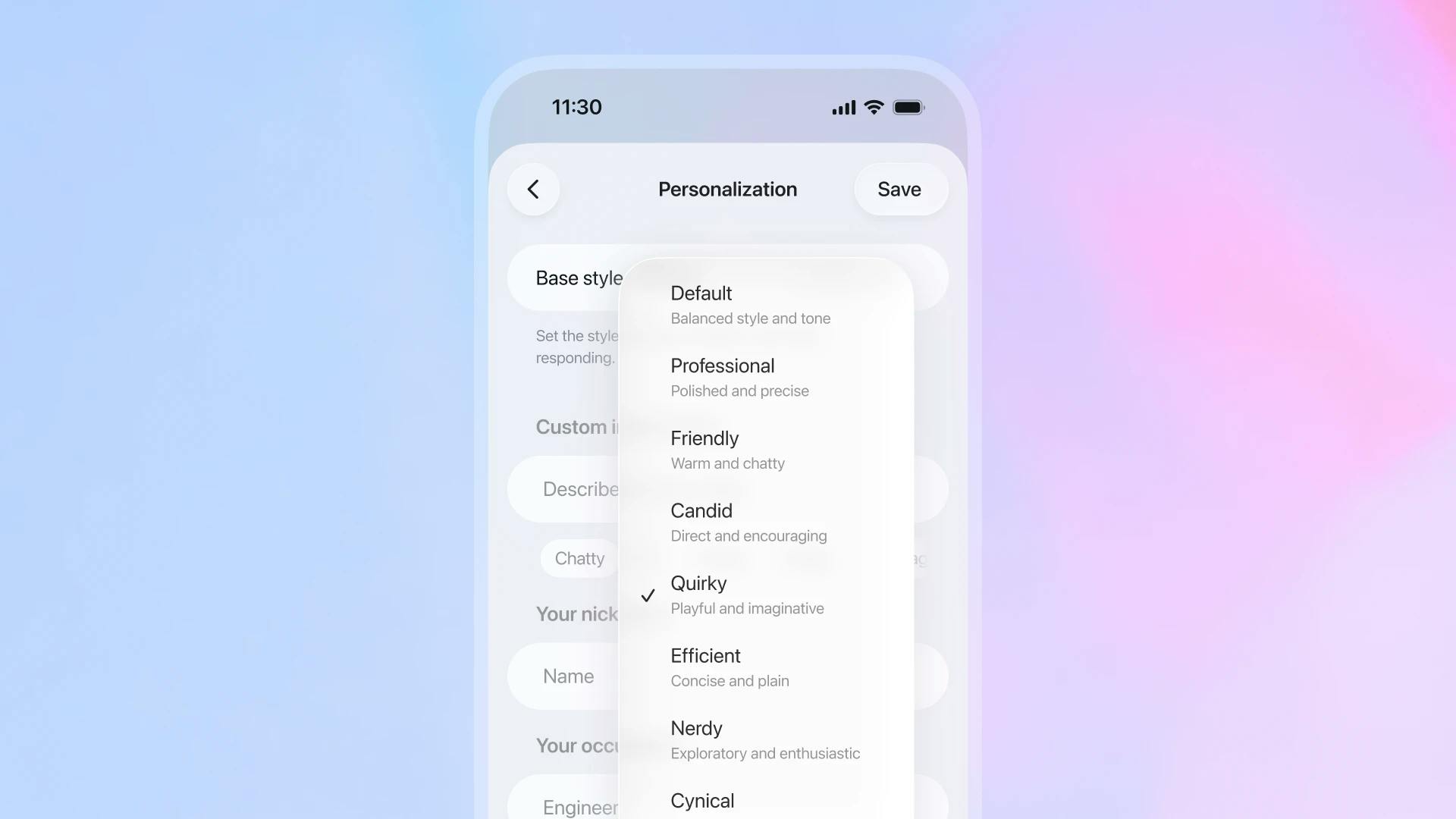
GPT-5.1 screenshot
(OpenAI)

OpenAI releases GPT 5.1, which can be “Professional,” “Candid,” or “Quirky”

The new “more conversational” model follows instructions better, but backslides on some safety tests.

Jon Keegan

Today OpenAI released GPT 5.1, an update that aims to make ChatGPT “more conversational.” The model comes in two versions: GPT-5.1 Instant (“now warmer, more intelligent, and better at following your instructions”) and GPT-5.1 Thinking (“now easier to understand and faster on simple tasks, more persistent on complex ones”).

Despite an earlier update this year that was rolled back due to being overly sycophantic, the new model responds in more chummy conversation that the company says “surprises people with its playfulness” in testing.

Users now have finer control over ChatGPT’s “personality,” with new settings for “Professional,” “Candid,” and “Quirky.”

In the model’s system card, OpenAI details how well the new 5.1 models compare to the earlier 5.0 models on internal benchmarks for disallowed content.

The company has said it is prioritizing the addition of new checks to help users who may be suffering a mental health crisis, after a series of alarming incidents where ChatGPT encouraged self-harm and reinforced delusional behavior.

Two new tests were included with this release for the first time: “mental health” and “emotional reliance.” GPT 5.1 Thinking actually scored slightly lower on 9 of 13 testing categories than its predecessor, GPT-5 Thinking, and GPT-5.1 Instant scored lower than GPT-5 Instant on 5 of 13 tests.

More thinking, more tokens

OpenAI says that GPT-5.1 Thinking now spends less time on simple tasks and more time on difficult problems. This is measured by the number of model-generated tokens (tiny bits of text). Based on a chart in the announcement, the very toughest queries handled by GPT-5.1 Thinking will use 71% more tokens to complete the query. That’s a lot more tokens, and a lot more computing!

All those tokens can add up. Every time OpenAI’s customer-facing models gobble up more computing cycles, it spends more on “inference,” or running the models (as opposed to the more resource-intensive training process that happens while building the models). When enterprise customers use OpenAI’s API to use the models, the customer pays by the token count, but free users using the chat interface do not.

As a private company, OpenAI’s finances aren’t public, but a new report from the Financial Times raises the question of how much all these “thinking” models are costing the company. While The Information recently reported that OpenAI spent $2.5 billion in the first half of 2025, AI skeptic, podcaster, and writer Ed Zitron told the FT he has seen internal OpenAI figures showing that OpenAI’s cash burn for the first half of the year was much higher — close to $5 billion.

To satisfy the $1 trillion in recent deals it has signed on to, OpenAI will need to find a way to generate more revenue.

More Tech

See all Tech
tech

Anthropic reportedly doubles current fundraising round to $20 billion

Anthropic has doubled its current fundraising round to $20 billion on strong investor demand, according reporting from the Financial Times. The new fundraising round would value the company at a staggering $350 billion. That’s up 91% from September when it raised at a valuation of $183 billion.

The company reportedly received interest totaling fix to six times their original $10 billion fundraising goal, and they are expected to haul in several billion more than that tally before the current round closes.

Anthropic’s success with enterprise customers and the popularity of its Claude Code product are boosting the company’s momentum as it chases the current valuation leader of the AI startup pack, OpenAI.

The company reportedly received interest totaling fix to six times their original $10 billion fundraising goal, and they are expected to haul in several billion more than that tally before the current round closes.

Anthropic’s success with enterprise customers and the popularity of its Claude Code product are boosting the company’s momentum as it chases the current valuation leader of the AI startup pack, OpenAI.

Produce At Whole Foods Market's Flagship Store

Amazon says it’s doubling down on opening Whole Foods stores. That sounds familiar.

The company says it’ll open 100 Whole Foods locations in the next few years. That sounds similar to plans Whole Foods’ CEO laid out for opening 30 stores a year in 2024. Since then, it appears to have added 14, total.

Incredulous Man

One year after the DeepSeek freak, the AI industry has adjusted and roared back

A look back at how the Chinese startup shattered conventions, changed the way Big Tech thought about AI, and blew a $1 trillion hole in the stock market that got filled right back up... and then soared to new levels.

tech

Georgia lawmakers introduce data center construction moratorium amid statewide pushback

More and more communities across the US are wrestling with the pros and cons of having a data center come to town. Georgia has become a hotspot of resistance to the data centers planned by Big Tech, according to a new report from The Guardian. The Atlanta metro area led the nation in data center construction in 2024.

Georgia state representatives introduced legislation that would place a one-year moratorium on data center construction in the state. Ten Georgia municipalities have already passed local bans on data centers.

Per the report, at least three other states have seen similar data center moratorium legislation introduced in the last week, including Maryland and Oklahoma.

Georgia state representatives introduced legislation that would place a one-year moratorium on data center construction in the state. Ten Georgia municipalities have already passed local bans on data centers.

Per the report, at least three other states have seen similar data center moratorium legislation introduced in the last week, including Maryland and Oklahoma.

Latest Stories

Sherwood Media, LLC produces fresh and unique perspectives on topical financial news and is a fully owned subsidiary of Robinhood Markets, Inc., and any views expressed here do not necessarily reflect the views of any other Robinhood affiliate, including Robinhood Markets, Inc., Robinhood Financial LLC, Robinhood Securities, LLC, Robinhood Crypto, LLC, or Robinhood Money, LLC.