

Tech
tech
Jon Keegan

OpenAI and SoftBank’s $500 billion AI data center “Stargate” stumbles

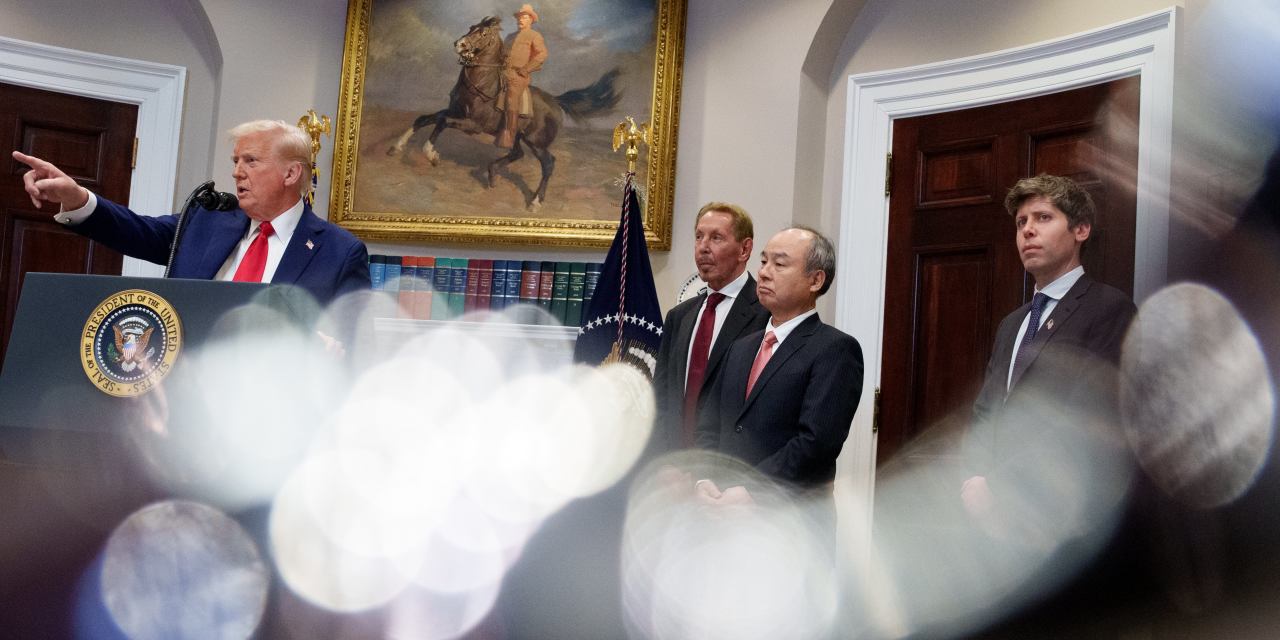
On the second day of his second term, President Trump stood alongside SoftBank CEO Masayoshi Son, Oracle founder Larry Ellison, and OpenAI cofounder and CEO Sam Altman to announce the $500 billion “Project Stargate,” which Trump said included “the construction of colossal data centers, very, very massive structures.”

While it sounded like SoftBank’s Son was ready to “immediately start deploying $100 billion with a goal of making $500 billion within the next four years,” the company started looking for a $16.5 billion loan to cover the investment. And Trump’s chaotic tariff announcements have reportedly delayed SoftBank’s initial $100 billion investment, amid chatter of a possible oversupply of AI data centers.

Now The Wall Street Journal reports that there are deeper problems with Stargate, and the plans may be significantly scaled back. Apparently the organization is not fully formed yet, according to an Oracle executive on an investor call last month, and the Journal reports that Stargate has “yet to complete a single deal for a data center.”

OpenAI is moving forward on its own, including a massive data center under construction in Abilene, Texas, that the company is applying the “Stargate” name to, though it technically is not part of the SoftBank-OpenAI partnership.

Bloomberg is reporting that OpenAI’s relationship with Oracle is bearing more fruit. Oracle is reportedly supplying OpenAI with 2 million of Nvidia’s top-of-the-line GB200 GPUs as they develop 4.5 gigawatts of additional AI data center capacity in Texas, Michigan, Wisconsin, and Wyoming.
While it sounded like SoftBank’s Son was ready to “immediately start deploying $100 billion with a goal of making $500 billion within the next four years,” the company started looking for a $16.5 billion loan to cover the investment. And Trump’s chaotic tariff announcements have reportedly delayed SoftBank’s initial $100 billion investment, amid chatter of a possible oversupply of AI data centers.

Now The Wall Street Journal reports that there are deeper problems with Stargate, and the plans may be significantly scaled back. Apparently the organization is not fully formed yet, according to an Oracle executive on an investor call last month, and the Journal reports that Stargate has “yet to complete a single deal for a data center.”

OpenAI is moving forward on its own, including a massive data center under construction in Abilene, Texas, that the company is applying the “Stargate” name to, though it technically is not part of the SoftBank-OpenAI partnership.

Bloomberg is reporting that OpenAI’s relationship with Oracle is bearing more fruit. Oracle is reportedly supplying OpenAI with 2 million of Nvidia’s top-of-the-line GB200 GPUs as they develop 4.5 gigawatts of additional AI data center capacity in Texas, Michigan, Wisconsin, and Wyoming.

More Tech

See all Tech
tech

Georgia lawmakers introduce data center construction moratorium amid statewide pushback

More and more communities across the US are wrestling with the pros and cons of having a data center come to town. Georgia has become a hotspot of resistance to the data centers planned by Big Tech, according to a new report from The Guardian. The Atlanta metro area led the nation in data center construction in 2024.

Georgia state representatives introduced legislation that would place a one-year moratorium on data center construction in the state. Ten Georgia municipalities have already passed local bans on data centers.

Per the report, at least three other states have seen similar data center moratorium legislation introduced in the last week, including Maryland and Oklahoma.

Georgia state representatives introduced legislation that would place a one-year moratorium on data center construction in the state. Ten Georgia municipalities have already passed local bans on data centers.

Per the report, at least three other states have seen similar data center moratorium legislation introduced in the last week, including Maryland and Oklahoma.

tech

Corning soars after striking deal to sell up to $6 billion in optical infrastructure to Meta

Glass company Corning is soaring in early trading after announcing a $6 billion deal with Meta to provide its data centers with fiber-optic cable products. Thanks to a string of big tech deals — including partnerships with Broadcom and Apple — Corning’s stock is up about 100% over the past year.

A 175-year-old glass manufacturer, Corning is known for its Gorilla Glass, used in smartphone and laptop screens. It was known in the past for its iconic blue cornflower CorningWare ceramics, a consumer cookware business it spun off in the 1990s.

In an interview, Corning CEO Wendell Weeks told CNBC that he thinks “next year the hyperscalers will be our biggest customers,” amid demand from tech giants including Google and Microsoft.

tech

Wedbush’s Dan Ives predicts Tesla FSD penetration will rise from 12% to above 50%, but doesn’t say how

Ahead of earnings Wednesday, a new note on Tesla from Wedbush Securities analyst Dan Ives argues the company is on the cusp of a Robotaxi-driven transformation, with Full Self-Driving penetration rising above 50% and autonomy unlocking as much as $1 trillion in value — putting Tesla on a path to a $2 trillion to $3 trillion market cap over the coming year.

The issue isn’t the optimism; it’s the absence of mechanics. FSD penetration across Tesla’s global fleet currently sits in the low teens. The note doesn’t explain how Tesla bridges that gap — whether through pricing changes, bundling, or a behavioral shift among mass-market buyers. Tesla is ending the option to buy FSD outright in favor of subscriptions, but that alone isn’t going to push adoption from roughly 12% to 50%.

Ives treats Teslas Robotaxi progress as inevitable rather than conditional. The removal of safety drivers in Austin — which for now is isolated to two or three vehicles and involves using an extra car to follow the Robotaxi — is framed as a tipping point. But there’s little discussion of scaling risks, regulation, real-world performance data, or actual demand. Ives only says President Trump will likely issue an executive order on autonomous rules and regulatory hurdles will effectively disappear — with the implication that FSD adoption would accelerate rapidly.

Even near-term fundamentals are stretched to support the narrative. Tesla didn’t beat Q4 delivery expectations, though Ives says it did, having previously cited whisper numbers rather than the analyst consensus. That claim is then used to clear the runway for a valuation argument focused almost entirely on future autonomy.

In the end, this is less an earnings preview note than a statement of belief: autonomy works; adoption follows; Tesla wins at scale.

That story may eventually prove right — but for now, it’s an assertion that outstrips the evidence.

Latest Stories

Sherwood Media, LLC produces fresh and unique perspectives on topical financial news and is a fully owned subsidiary of Robinhood Markets, Inc., and any views expressed here do not necessarily reflect the views of any other Robinhood affiliate, including Robinhood Markets, Inc., Robinhood Financial LLC, Robinhood Securities, LLC, Robinhood Crypto, LLC, or Robinhood Money, LLC.