

Tech
tech

Investors loved BYD’s new superfast chargers, but how do they stack up against the competition?

BYD investors were cheering at the start of the week, after the Chinese electric vehicle giant unveiled its new superfast charging tech at an event in Shenzhen on Monday, with plans to install 4,000 “Super e-Platform” ports across its home nation to try and quell range anxiety.

But just how fast is “superfast”? And how does BYD’s new technology stack up against some of its biggest competitors in the EV market?

Though there’s no one-size-fits-all standardized measure of charging speeds, electric vehicle manufacturers tend to discuss milestones or benchmarks — like BYD claiming that it can add ~250 miles of range in five minutes. From those claims, we can work out how many miles of range are added per minute.

Tesla, for example, says that its Superchargers can add “up to 200 miles in 15 minutes of charge” — the equivalent of about 13 miles added per minute of charging. Mercedes-Benz claims that its “CLA 250+ with EQ Technology can be recharged to a range of up to 325 kilometres within ten minutes,” or roughly 20 miles every minute.

Here’s how a few major EV makers stack up, based on public statements about charger tech and company claims about their fastest-charging models (where available).
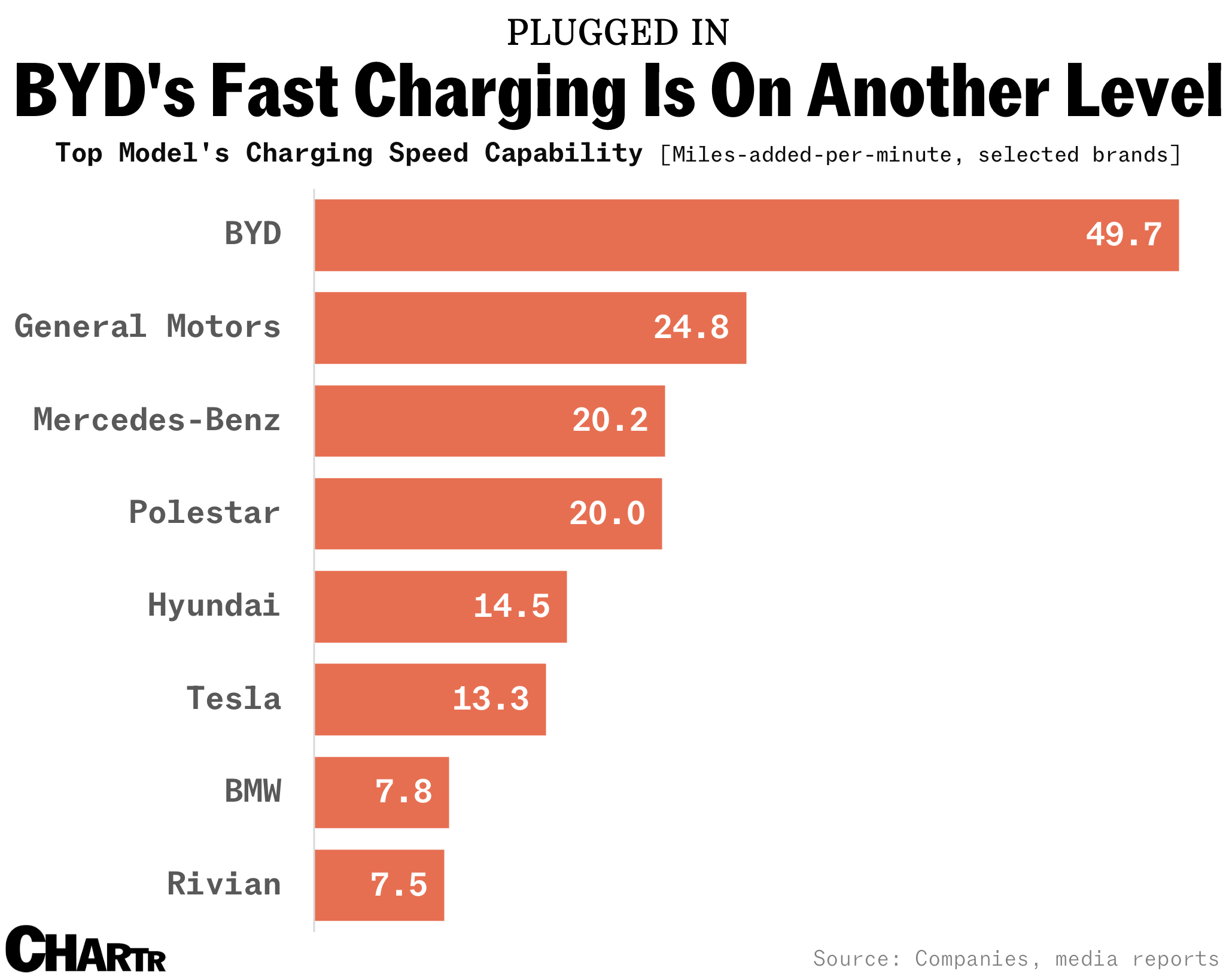
BYD vs. Tesla vs. Ford electric vehicle charging speeds
Sherwood News

Per Wang Chuanfu, BYD’s founder and CEO, the company aims to “make the charging time of electric vehicles as short as the refuelling time of petrol vehicles.” If the new charging tech is as quick as the automaker says, that goal isn’t far off. 
But just how fast is “superfast”? And how does BYD’s new technology stack up against some of its biggest competitors in the EV market?

Though there’s no one-size-fits-all standardized measure of charging speeds, electric vehicle manufacturers tend to discuss milestones or benchmarks — like BYD claiming that it can add ~250 miles of range in five minutes. From those claims, we can work out how many miles of range are added per minute.

Tesla, for example, says that its Superchargers can add “up to 200 miles in 15 minutes of charge” — the equivalent of about 13 miles added per minute of charging. Mercedes-Benz claims that its “CLA 250+ with EQ Technology can be recharged to a range of up to 325 kilometres within ten minutes,” or roughly 20 miles every minute.

Here’s how a few major EV makers stack up, based on public statements about charger tech and company claims about their fastest-charging models (where available).

BYD vs. Tesla vs. Ford electric vehicle charging speeds
Sherwood News

Per Wang Chuanfu, BYD’s founder and CEO, the company aims to “make the charging time of electric vehicles as short as the refuelling time of petrol vehicles.” If the new charging tech is as quick as the automaker says, that goal isn’t far off. 
More Tech

See all Tech
tech

Apple to promote Siri from assistant to chatbot

Bloomberg reports that Apple plans to transform its Siri assistant into a full-fledged chatbot similar to OpenAI’s ChatGPT.

The chatbot would be integrated throughout the iPhone’s operating system rather than offered as a stand-alone app. It’s expected to arrive later this year and would be separate from more incremental, non-chatbot improvements to Siri rolling out in the coming months aimed at making the existing assistant more usable.

Both updates will be powered by Google’s AI models, Bloomberg reports, but the chatbot upgrade will be more advanced and akin to the much-lauded Gemini 3.

While the difference between an assistant and a chatbot may sound subtle, it represents a meaningful shift for Apple, which has long avoided a fully conversational interface and has lagged rivals that embraced one. Any new Siri chat capabilities could also eventually extend to other Apple devices under development, including wearables such as the pin Apple is developing.

Both updates will be powered by Google’s AI models, Bloomberg reports, but the chatbot upgrade will be more advanced and akin to the much-lauded Gemini 3.

While the difference between an assistant and a chatbot may sound subtle, it represents a meaningful shift for Apple, which has long avoided a fully conversational interface and has lagged rivals that embraced one. Any new Siri chat capabilities could also eventually extend to other Apple devices under development, including wearables such as the pin Apple is developing.

tech

OpenAI shares how it will charge for ChatGPT ads

Last week, OpenAI announced that ads were going to be rolling out in ChatGPT in the coming weeks.

Now we have more details about what OpenAI is telling advertisers. According to a report from The Information, the company has reached out to “dozens” of advertisers, and will charge based on ad views.

Advertisers are still waiting for further details, but OpenAI is asking for less than $1 million each in ad spending while it tests out the new system, per the report.

Ads are supposed to begin in February, and will only appear for free ChatGPT and ChatGPT Go users.

Advertisers are still waiting for further details, but OpenAI is asking for less than $1 million each in ad spending while it tests out the new system, per the report.

Ads are supposed to begin in February, and will only appear for free ChatGPT and ChatGPT Go users.

tech

Apple is reportedly working on a wearable AI pin

Move over OpenAI, Apple is reportedly also developing a mysterious AI-powered wearable device: a pin that looks like a thin, flat, circular disc with an aluminum-and-glass shell.”

The Information reports that the device is the size of an Apple AirTag and has two cameras, a speaker, three microphones, and wireless charging. It could be available by early 2027.

Apple, which has lagged its peers in AI and recently teamed up with Google to support its upcoming Siri revamp, is hoping to keep up with ChatGPT and Google, which, like Apple, has an AI smartphone. Meta and Google are both also pushing into smart AI glasses.

It’s not to be mistaken with OpenAI’s secretive wearable AI device, which is being made in conjunction with former Apple designer Jony Ive and expected to debut in late 2026. The latest rumors suggest the unnamed device, meant to eventually compete with smartphones, might be earbuds.

Apple, which has lagged its peers in AI and recently teamed up with Google to support its upcoming Siri revamp, is hoping to keep up with ChatGPT and Google, which, like Apple, has an AI smartphone. Meta and Google are both also pushing into smart AI glasses.

It’s not to be mistaken with OpenAI’s secretive wearable AI device, which is being made in conjunction with former Apple designer Jony Ive and expected to debut in late 2026. The latest rumors suggest the unnamed device, meant to eventually compete with smartphones, might be earbuds.

tech

Morgan Stanley expects Tesla to have 1,000 Robotaxis by the end of 2026. Musk had predicted 1,500 by the end of 2025

Ahead of Tesla’s earnings report next week, Morgan Stanley has released a note estimating that the company will scale its Robotaxi fleet much more slowly than CEO Elon Musk has said. The firm thinks the automaker will have 1,000 vehicles in its Robotaxi service by the end of 2026 — 500 fewer than Musk estimated a few months ago Tesla would have by the end of 2025.

More key to Tesla’s success, however, will be removing the safety monitors from those rides, which Morgan Stanley says will be a “precursor to personal unsupervised FSD [Full Self-Driving] rollout.” Musk, of course, had also promised to remove safety drivers in Austin by the end of 2025, but driverless rides are still in the testing stage.

Latest Stories

Sherwood Media, LLC produces fresh and unique perspectives on topical financial news and is a fully owned subsidiary of Robinhood Markets, Inc., and any views expressed here do not necessarily reflect the views of any other Robinhood affiliate, including Robinhood Markets, Inc., Robinhood Financial LLC, Robinhood Securities, LLC, Robinhood Crypto, LLC, or Robinhood Money, LLC.