

Tech
Go Back Three Spaces
Getty Images
MONOCHROME

Google may have to sell off Chrome — but who could buy it?

Forcing a sale of Google Chrome could weaken Google’s stranglehold on search.

Tom Jones

“Which lawyers did Microsoft use for its antitrust case in 2000” — Google execs this morning, probably.

Done searching

According to a report from Bloomberg yesterday, Department of Justice officials are planning to recommend that Amit Mehta — the US District Judge who ruled in August that Alphabet’s search giant holds an illegal monopoly over the market — force the company to sell off its Google Chrome browser, impose data-licensing requirements, and implement measures around the company’s Android operating system and burgeoning AI efforts.

Those recommendations show just how serious America’s antitrust authorities are about cracking down on Google’s dominance in the world of looking stuff up online. It’s the biggest antitrust action against Big Tech in the US since the United States vs. Microsoft Corp. case more than two decades ago (spoiler: Microsoft wasn’t broken up).

According to Statcounter, Google Chrome has a 67% share of the global web-browser market — way ahead of the next biggest competitor, Apple’s Safari, the default browser on every iPad and iPhone (unless users switch their settings). Though Chrome isn’t a huge money spinner in a direct sense, being free to download and use, it’s a phenomenal source of traffic for the search engine itself, which makes plenty of money (some $49 billion last quarter). On Chrome, users are sent straight to google.com by default when they search, and Google gets data on what logged-in users are doing, helping its targeted-advertising efforts.
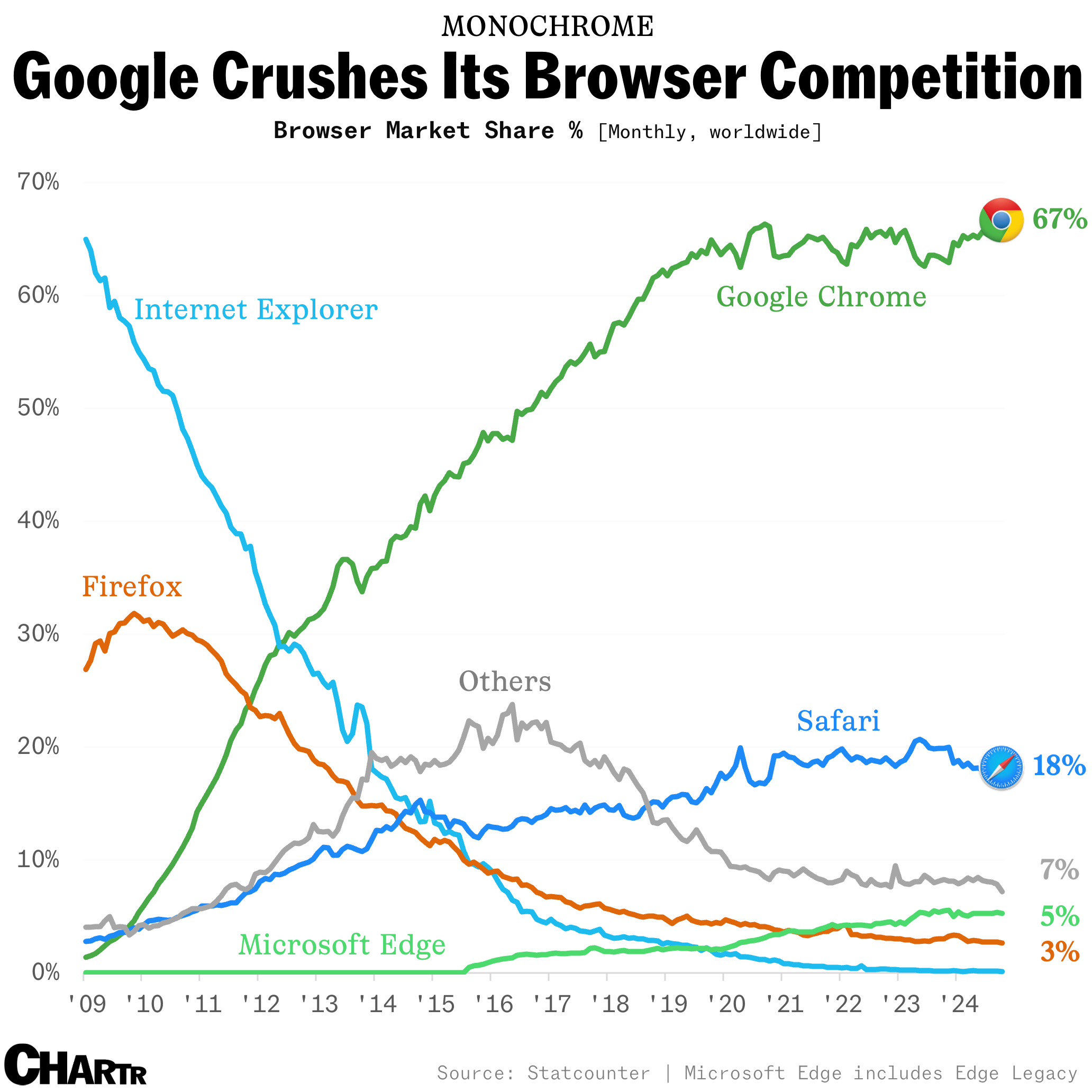
Google Chrome market share
Sherwood News

Gatekeeping gateway

While Chrome was never really the product at the heart of the DOJ’s lawsuit, which was first launched under the Trump administration in 2020, the browser plays a massive part in the crux of the case — Google’s total domination of search. According to website-intelligence platform Similarweb, google.com has a staggering 93% share of American web searches.
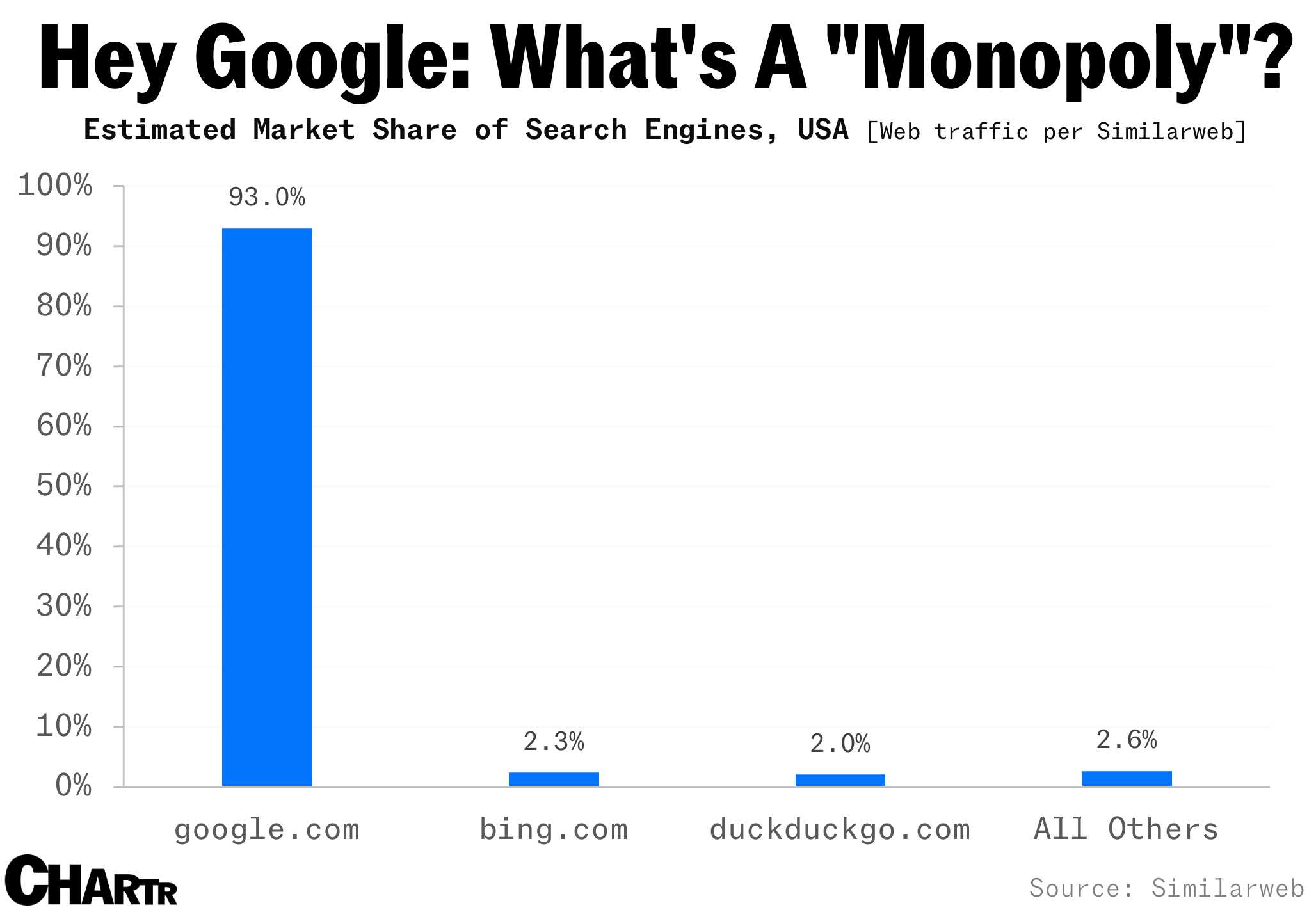
Google market share searches (Similarweb)
Sherwood News

That level of domination, as antitrust expert George Hay simplified for Sherwood News in the wake of the August ruling, amounts to a monopoly which Google monetizes with advertising and cements via exclusive deals with the makers of Apple and Android devices. Thanks to unsealed court documents, we know that Google paid Apple an eye-watering $20 billion in 2022 alone to be the default search engine in Apple’s Safari browser. If Chrome was owned by someone else, Google would presumably have to pay to be the default search engine in a similar fashion.

The obvious complication with forcing Alphabet to sell Google Chrome is that it’s really big. There’s not that many companies that could afford and make use of an internet browser that has hundreds of millions of users and, from the small pool of competitors that could (e.g. Amazon, Microsoft, Apple), which of them would be impervious to the same monopoly charges further down the line? While such recommendations might work in theory, breaking up Google in practice, as Rani Molla observed in August, will prove hard to do.


More Tech

See all Tech
tech

FT: Meta considering “tens of billions” in new capital to fund AI

Just days after Google announced a monster $85 billion upsized equity raise, the extremely profitable Meta is seeking to sell “tens of billions of dollars” in stock, according to a new report from the Financial Times.

Meta is planning on spending between $125 billion and $145 billion on AI capital expenditure this year alone.

Shares dropped more than 5% on the news.

tech

FT: Anthropic staff helping the NSA use Mythos for offensive cyberattacks

Anthropic’s Mythos AI model was deemed too dangerous to release to the public, with the company citing its ability to orchestrate novel cyberattacks.

And that’s just what the National Security Agency is doing, with the help of Anthropic staff embedded at the agency, according to a report from the Financial Times.

Only a small number of companies and US allies have been given access to the advanced model, which means America’s adversaries have not had the chance to shore up their defenses against the AI model’s new offensive capabilities.

The arrangement is especially unusual as the Pentagon has deemed Anthropic’s AI a national security supply chain risk — effectively blacklisting it for defense work — in response to the company’s refusal to allow its technology to be used for any legal application, which could include autonomous killing or mass surveillance. Anthropic is currently suing the US government to fight the determination.

Only a small number of companies and US allies have been given access to the advanced model, which means America’s adversaries have not had the chance to shore up their defenses against the AI model’s new offensive capabilities.

The arrangement is especially unusual as the Pentagon has deemed Anthropic’s AI a national security supply chain risk — effectively blacklisting it for defense work — in response to the company’s refusal to allow its technology to be used for any legal application, which could include autonomous killing or mass surveillance. Anthropic is currently suing the US government to fight the determination.

tech

Longtime Tesla bear JPMorgan upgraded Tesla and raised its price target to $475 from $145

For more than a decade, JPMorgan was Wall Streets most stubborn Tesla skeptic, anchored by auto analyst Ryan Brinkman’s strict focus on traditional car fundamentals and near-term delivery numbers.

But JPM recently handed coverage of the stock to a new analyst, Rajat Gupta, who is throwing that playbook out the window. In a note Friday, the firm upgraded Tesla to neutral from underweight and raised its price target 228% to $475 from $145. (The analyst consensus on FactSet is $403.) Instead of focusing on the company’s struggling vehicle business, the new analyst is orienting himself more toward Tesla’s idea of the future, now modeling Tesla’s physical AI and robotaxi fleets all the way out to the year 2040.

Here are the main reasons for the capitulation:

  • Looking past the car lot: Gupta argues that Tesla is at the forefront of physical AI, entering uncharted TAMs” and therefore deserves the benefit of the doubt to be valued on LT earnings potential rather than near-term speed bumps.

  • Unmatched vertical integration: Teslas control over everything from battery cells to custom silicon gives it a massive moat. JPM notes this starting point advantage is unmatched at an industrial level scale” and “still somewhat under-appreciated and misunderstood.

  • The AWS flywheel effect: Deploying Optimus robots inside its own factories should not only lower COGS for the base automotive business, but more importantly, help validate the product at an industrial scale.” Gupta called it “a classic flywheel effect, somewhat analogous to AWS and Kiva at AMZN.

For Tesla bulls who have argued for years that this is an AI company and not a carmaker, JPM’s sudden $3.9 trillion valuation model is the ultimate validation.

skynet terminator

Anthropic ponders self-improving AI

Anthropic says Claude already writes 80% of its code. A new post asks what happens when the models can improve themselves — and whether anyone could stop them.

Latest Stories

Sherwood Media, LLC and Chartr Limited produce fresh and unique perspectives on topical financial news and are fully owned subsidiaries of Robinhood Markets, Inc., and any views expressed here do not necessarily reflect the views of any other Robinhood affiliate, including Robinhood Markets, Inc., Robinhood Financial LLC, Robinhood Securities, LLC, Robinhood Crypto, LLC, Robinhood Money, LLC, Robinhood U.K. Ltd, Robinhood Derivatives, LLC, Robinhood Gold, LLC, Robinhood Asset Management, LLC, Robinhood Credit, Inc., Robinhood Ventures DE, LLC and, where applicable, its managed investment vehicles.
