


GitHub may have fumbled one of the biggest first-mover advantages in history
Rivals like Cursor and Claude Code are eroding GitHub’s Copilot user base, and Microsoft execs are sounding the alarm about the platform itself.
GitHub’s biggest source of growth? AI is attracting thousands of developers to its platform. GitHub’s biggest problem? AI is attracting thousands of developers to its platform.
Green squares
The world’s largest code repository platform, GitHub, has been central to the world’s largest software company ever since Microsoft acquired the platform in 2018. But it’s at something of an AI crossroads: AI has led to a coding boom, and therefore more usage of GitHub, but it’s also led to a crop of new coding tools, pressuring GitHub’s AI-powered coding feature, Copilot (not to be confused with the dozens of other Microsoft Copilot products).
Pioneering the world of AI coding in 2021, GitHub Copilot built on its first-mover advantage in its early years, bundling the then autocompleting tool in its main cloud suite. But as more powerful followers arrived, like Cursor in 2024 and Anthropic’s Claude Code in mid-2025, GitHub Copilot’s growth streak has been looking a paler green than its competitors. X users haven’t been kind about the chain of events.
> be github
— kitze (@thekitze) May 14, 2026
> invent copilot
> you are literally the first one
> you are literally the only one
> you literally have access to all the code in the world
> get mogged by literally every single agentic bs that came out in the past few years
this level of fumble should be studied
But perhaps most worrying is that, per The Information, even Jay Parikh, who oversees the division that controls GitHub in Microsoft, has warned that the unit faces a critical threat: if GitHub does not adapt, rivals could replace not only Copilot but also the platform itself.
Web traffic data provided by Similarweb to Sherwood News reveals just how quickly Cursor has overtaken GitHub’s Copilot. (Note: as these coding tools tend to be plugged in within developers’ coding ecosystems, this website traffic data better represents interest from new and potential users than existing developers’ usage.)
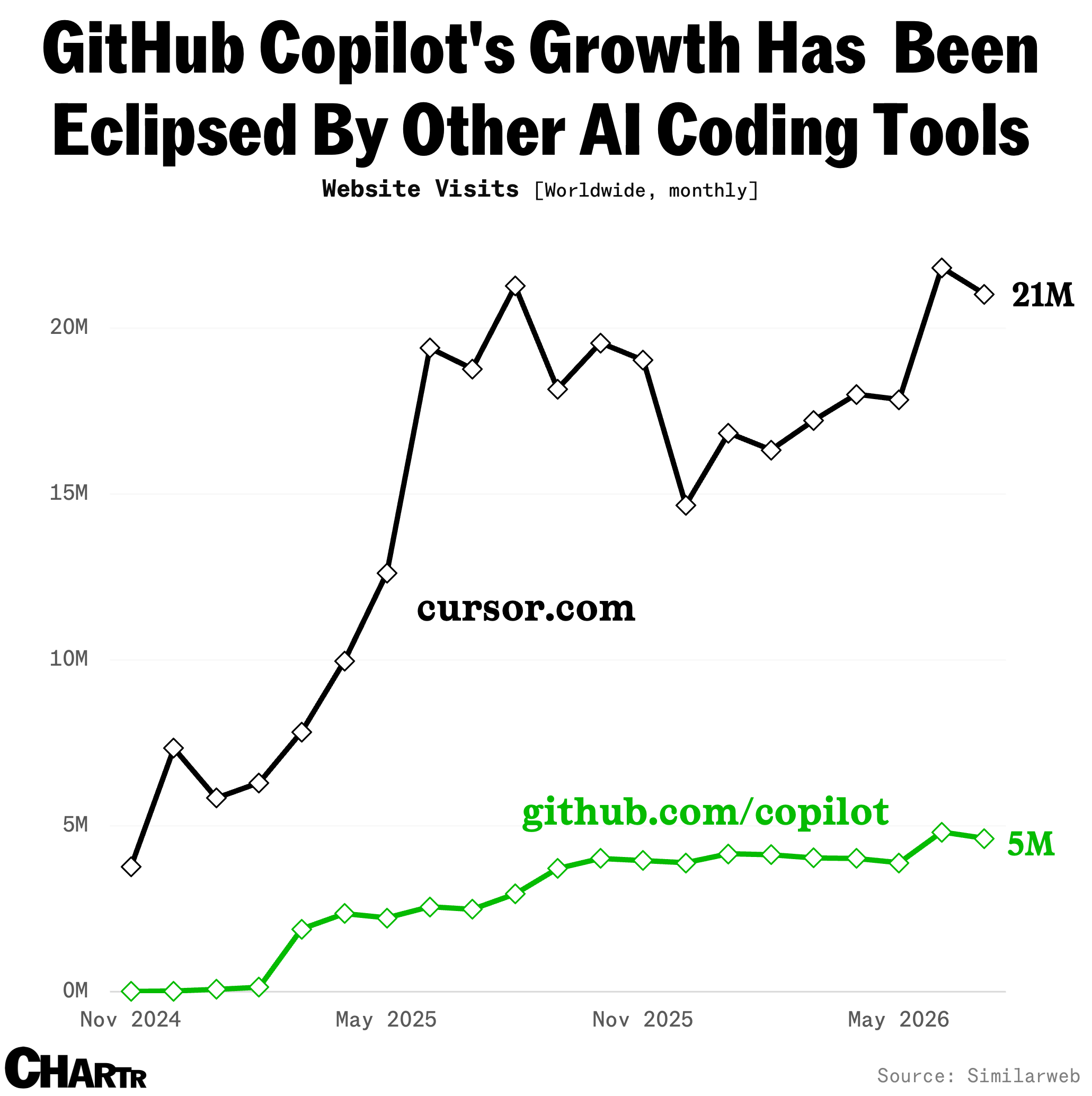
GitHub as a platform, on the other hand, saw nearly one-fifth of its entire projects created in 2025 alone as users increasingly used the mostly free service as a pipeline to develop projects amid an AI-powered usage boost. But in turn, gross margins in the company’s gargantuan Intelligent Cloud business took a hit from “increased GitHub Copilot usage” in the most recent earnings — and the unit recently posted an apology letter over its repeated outages (with the words “we are sorry”).
Adding to the platform’s troubles, yesterday it announced that hackers breached almost 4,000 of GitHub’s own internal code repositories, after an employee installed a malicious extension.
The tech giant may try to kill the threat from within, as the company considers making its own engineers switch from Claude Code to GitHub Copilot. The company has also announced a transition to a usage-based business model, presumably in a bid to protect the company’s margins from power users sucking up all of the compute. It might successfully do that, but it won’t reverse time to an era before the 3 C’s — Claude, Cursor, and Codex — existed, threatening GitHub’s place in the coding universe.




