


A direct appeal to Sundar Pichai, CEO of Alphabet, to please fix Google Finance’s most basic feature
Alphabet is a remarkable entity. Today, millions of people will fire up Google Chrome, check their Gmail, and then flick over to YouTube — now the biggest thing in TV, and potentially worth some $550 billion — all while Alphabet’s self-driving car division, Waymo, safely delivers thousands of people to their desired destination... and Google itself handles over 150,000 search queries every single second.
But one tiny bug in the Finance product is enough to make me forget all of that.
Disclaimer: If you aren’t in the mood to dive into a very petty — largely unimportant — gripe about stock charts, please stop reading.
When searching the web for a stock and using Google Finance’s “year to date” return function on its interactive module, the calculation is always, bafflingly, wrong. Take Tesla’s stock as an example.
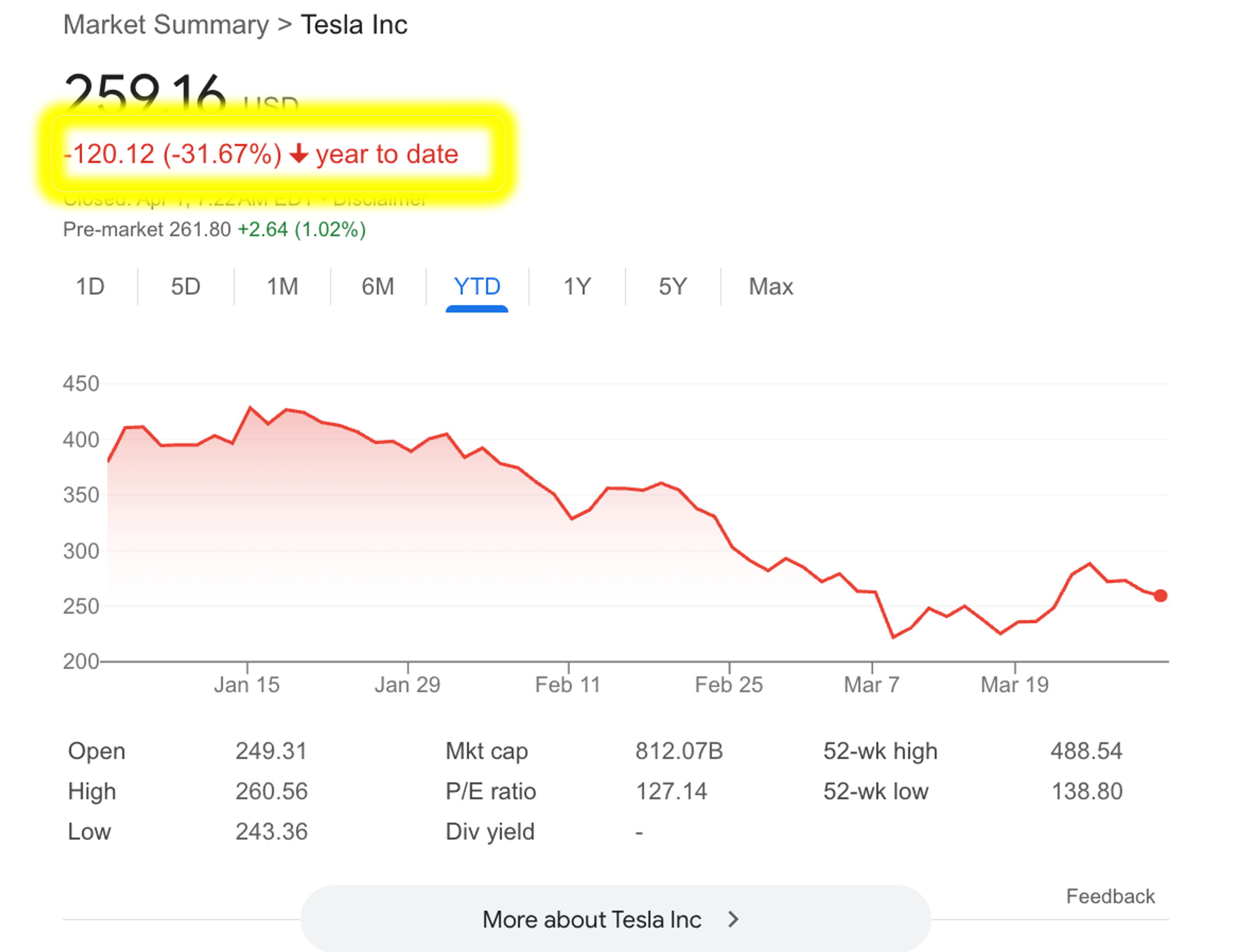
Per this Google module, Tesla’s stock is down 31.67% this year. From memory that sounds broadly correct — Tesla is having a bad year after all — but it’s not quite right.
Let’s do the calculation manually. Using the interactive chart, we can calculate the change from the end of December 31 to yesterday’s close (March 31).
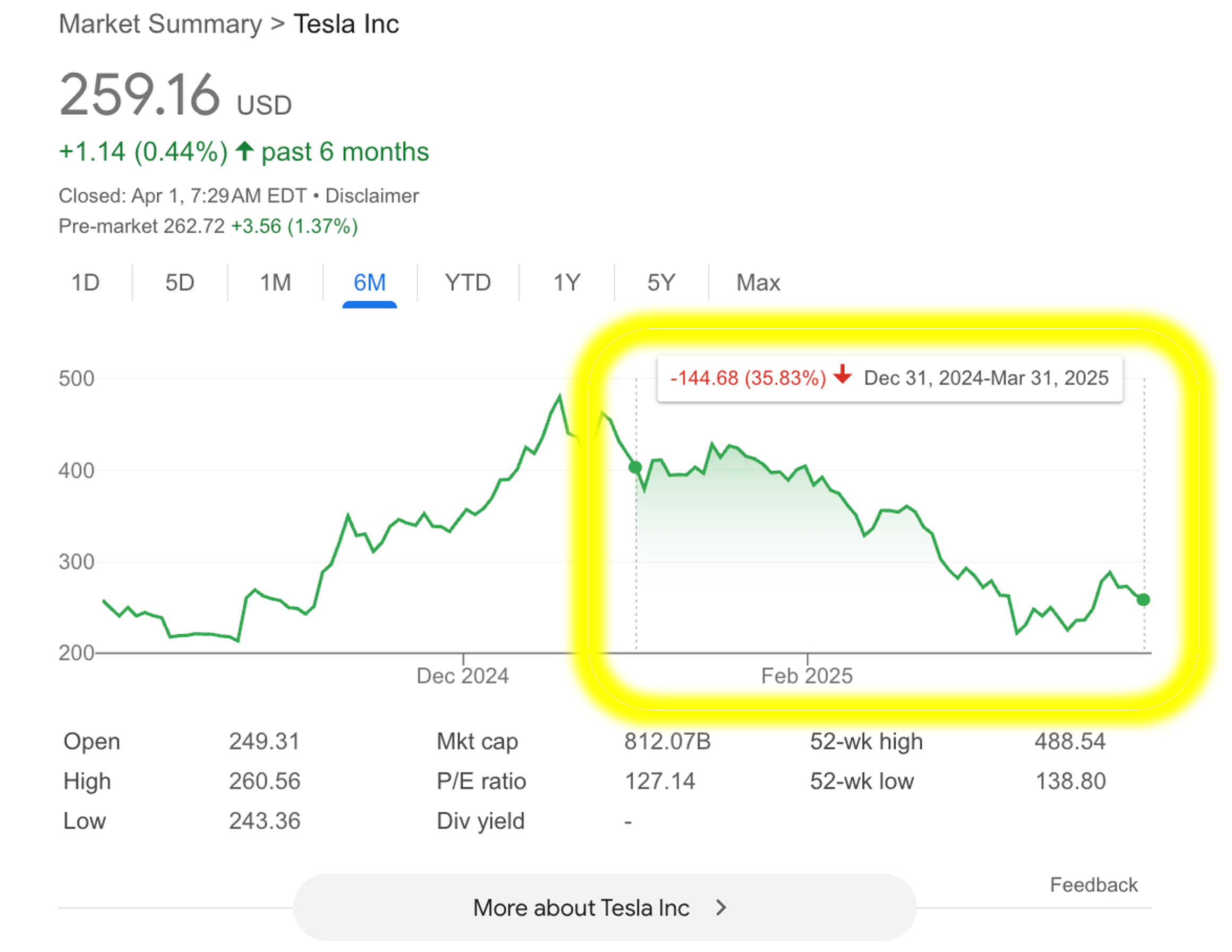
Doing that, we get -35.83%. About a 4% difference.
So, what’s going on?
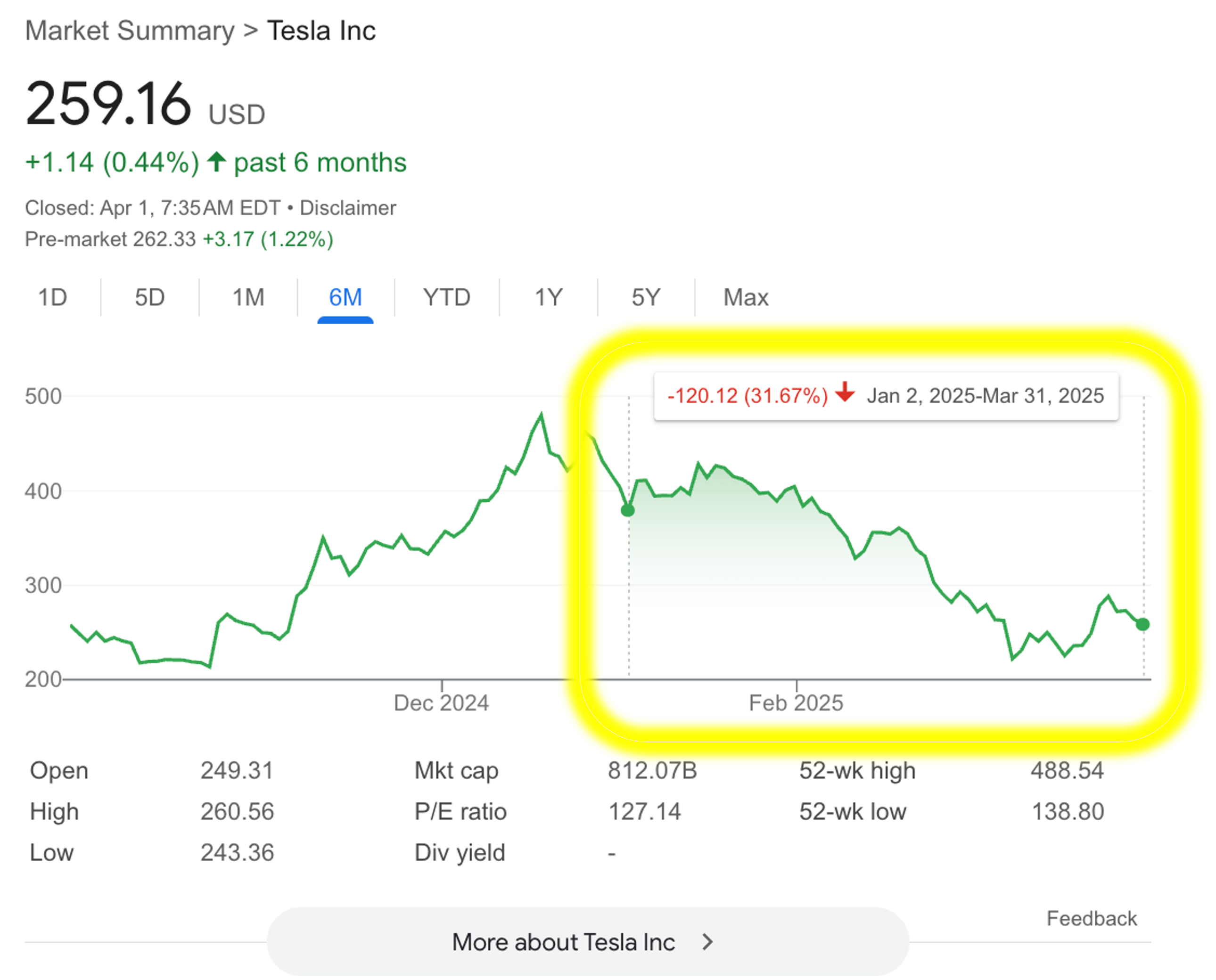
It turns out that Google Finance is using the close price from January 2 in the first case, essentially ignoring the first day of trading. We can see this in the below screenshot: drawing a line from January 2 to March 31 gives us Google’s YTD change of 31.67%. But, of course, January 2 should be counted. In this case, Tesla moved quite a bit on the day!
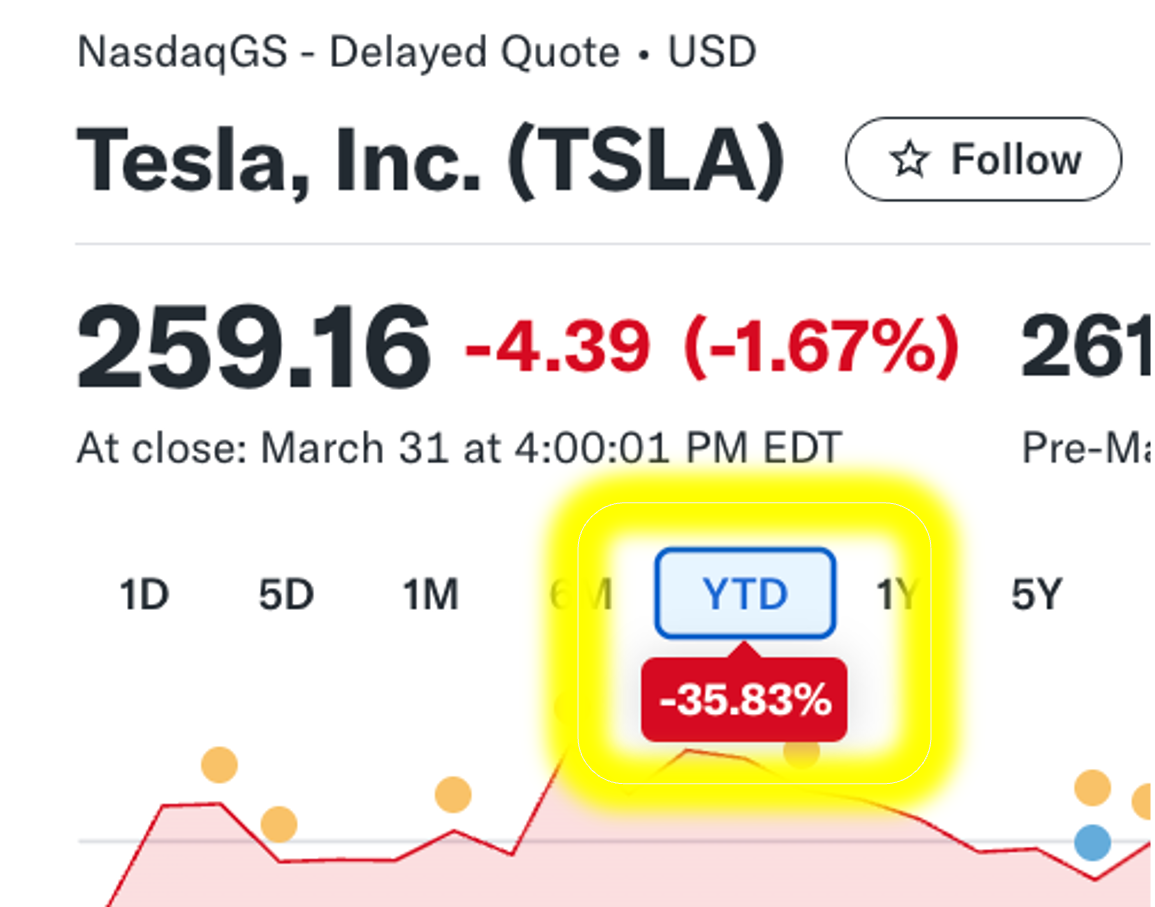
Rival provider Yahoo Finance correctly tells us it’s -35.83% on its website.
The weirdest thing, however, is that if I navigate to the actual Google Finance website (rather than just using the interactive module that appears at the top of Google Search), the problem fixes itself.
Still, Sundar, if you’re reading this, can you help us out here?
When searching the web for a stock and using Google Finance’s “year to date” return function on its interactive module, the calculation is always, bafflingly, wrong. Take Tesla’s stock as an example.
Per this Google module, Tesla’s stock is down 31.67% this year. From memory that sounds broadly correct — Tesla is having a bad year after all — but it’s not quite right.
Let’s do the calculation manually. Using the interactive chart, we can calculate the change from the end of December 31 to yesterday’s close (March 31).
Doing that, we get -35.83%. About a 4% difference.
So, what’s going on?
It turns out that Google Finance is using the close price from January 2 in the first case, essentially ignoring the first day of trading. We can see this in the below screenshot: drawing a line from January 2 to March 31 gives us Google’s YTD change of 31.67%. But, of course, January 2 should be counted. In this case, Tesla moved quite a bit on the day!
Rival provider Yahoo Finance correctly tells us it’s -35.83% on its website.
The weirdest thing, however, is that if I navigate to the actual Google Finance website (rather than just using the interactive module that appears at the top of Google Search), the problem fixes itself.
Still, Sundar, if you’re reading this, can you help us out here?


