
Tech
Mobile payment
Getty Images
War of apptrition

Data shows most new apps don’t just fail — they completely bomb

A new report shows that more than 80% of apps never reach $1,000 in monthly revenue in the first two years after launching.

Millie Giles

These days, you can’t do anything without signing up for something — with everything from (naturally) streaming services, to news sites, to chatbots, to airlines, to pet suppliers now operating on subscription models.

Luckily for Apple and Google, which take a cut of in-app payments through their respective app stores, many of those subscriptions now start through our phones.

But in the increasingly competitive battle for space on our precious home screens, most apps never even come close to getting enough subscribers to cover their costs.

According to the 2025 State Of Subscription Apps report from RevenueCat, published last week, just a handful of apps now dominate a huge share of users’ screen time. According to the research, the top 5% of newly launched apps make over 400x more in their first two years (~$8,888) than the bottom 25% (~$19). 

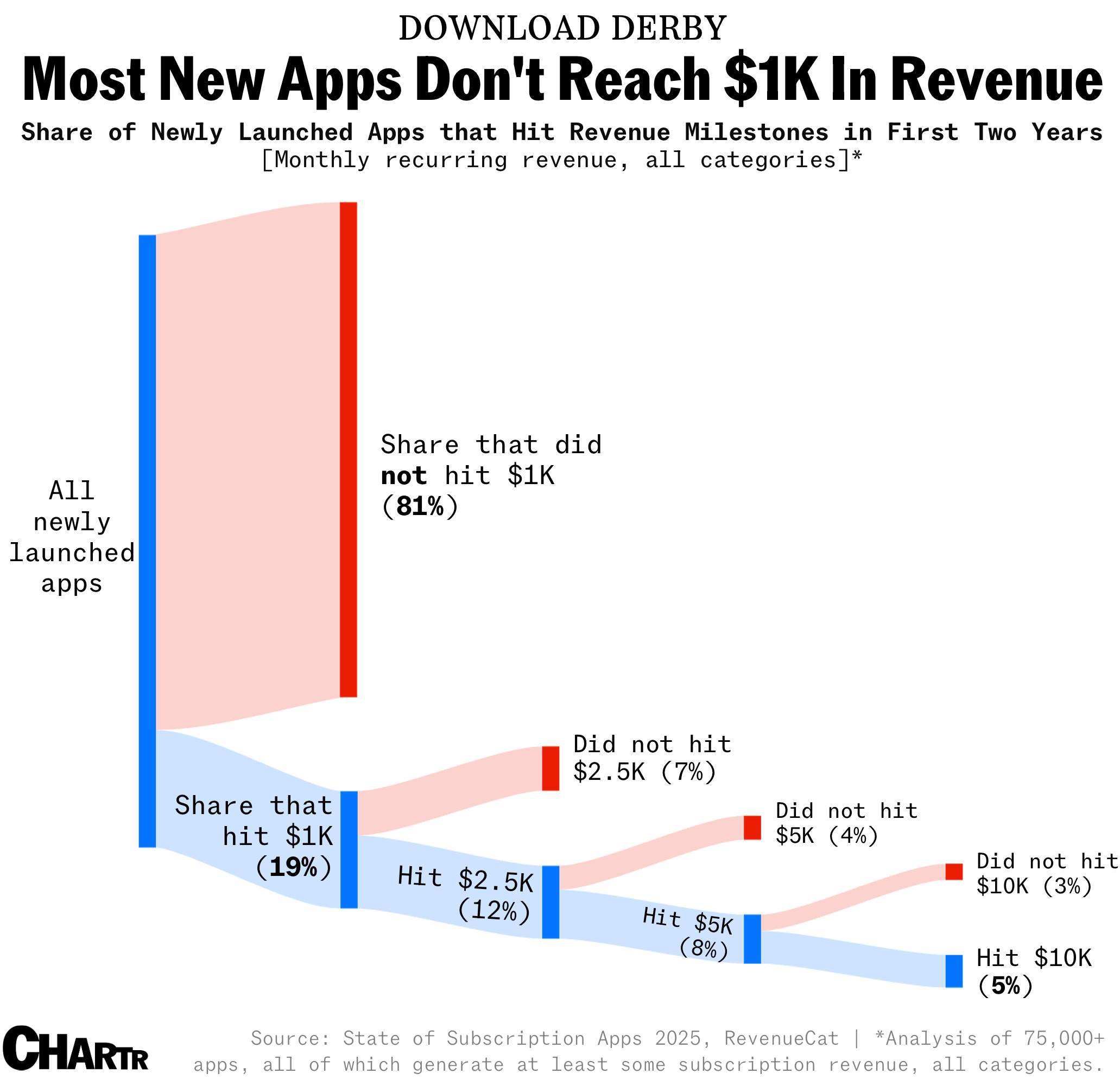
The report also outlined that only 19% of new apps across all categories generated $1,000 in monthly recurring revenue within two years of launch, implying that 81% failed to hit that threshold. After this, the drop-off is steep, with a large portion of apps failing to meet each consecutive monetary milestone. At the upper end, only 5% of all new apps reached $10,000 in revenue.
Mobile apps subscription models
Sherwood News

Clearly, subscriptions alone are no longer enough for many newly launched apps to survive on. Now, hybrid monetization structures are becoming more common, with 35% of apps overall mixing subscriptions with consumable or lifetime purchases — including ~62% of Gaming apps and ~40% of Social & Lifestyle apps — to fuel revenue growth from both new and loyal app users.

App-eat-app world

Different types of apps also have very different subscription strategies. Health & Fitness apps were uniquely focused on yearly plans, with 66.6% of app subscriptions sold on an annual basis. Clearly, developers in the health arena are hoping that users have enough motivation to instill good habits to commit to an entire year. Gaming apps were the opposite: just 5.7% of subscriptions sold were for an annual plan, while weekly plans dominated, comprising 78% of subscriptions sold in the category.

Overall, of the categories surveyed, Photo & Video apps were the most successful in generating revenue, with ~28% of these newly released apps reaching $1,000 and ~9% reaching $10,000 in their first two years.

More Tech

See all Tech
tech

OpenAI rolls out age prediction system ahead of allowing adult content

OpenAI is rolling out a new “age prediction” feature for ChatGPT users.

The company will look at various signals from users to predict if a user is underage.

In a blog post, the company said:

“The model looks at a combination of behavioral and account-level signals, including how long an account has existed, typical times of day when someone is active, usage patterns over time, and a user’s stated age.”

If the system suspects the user is a minor, it will reduce content with graphic violence, harmful viral challenges, sexual or romantic role play, depictions of self-harm, and material promoting “extreme beauty standards, unhealthy dieting, or body shaming.”

If a user is incorrectly flagged as under 18, they will have to submit a selfie to an identity verification service to have the restrictions removed.

An age verification system is part of OpenAI’s plan to reduce harmful mental health encounters with the chatbot, while also allowing ChatGPT to generate “erotica” in the near future.

“The model looks at a combination of behavioral and account-level signals, including how long an account has existed, typical times of day when someone is active, usage patterns over time, and a user’s stated age.”

If the system suspects the user is a minor, it will reduce content with graphic violence, harmful viral challenges, sexual or romantic role play, depictions of self-harm, and material promoting “extreme beauty standards, unhealthy dieting, or body shaming.”

If a user is incorrectly flagged as under 18, they will have to submit a selfie to an identity verification service to have the restrictions removed.

An age verification system is part of OpenAI’s plan to reduce harmful mental health encounters with the chatbot, while also allowing ChatGPT to generate “erotica” in the near future.

tech

Google’s YouTube maintains its top spot as streaming accounts for nearly half of all TV-watching time

People spent a record 47.5% of their TV-watching time on streaming platforms in December, according to new data from Nielsen, up from the previous record of 47.3% in July. Google’s YouTube once again was the most popular streaming service by time spent, but Netflix’s share inched slightly upward to 9% from 8.8% in July, while YouTube’s fell to 12.7% from 13.4%. The jump was largely thanks to Stranger Things, which was the most watched streaming title last month.

tech

Amazon CEO says tariffs are inflating prices and buyers are looking for bargains

While the legality of President Trump’s tariffs winds its way through the courts, their effects are beginning to show up in prices.

During an interview at the World Economic Forum in Davos, Switzerland, Amazon CEO Andy Jassy said he is starting to see tariffs “creep into” pricing, as some sellers are “passing on those higher costs to consumers in the form of higher prices.”

Jassy said that while consumers are still spending, they are becoming more price conscious.

“I think that wherever they can, they are trying to trade down in price — they are looking for bargains wherever they can find bargains,” he said. “I see people a little more hesitant on higher-priced discretionary items.”

Trump has maintained that other countries are footing the bill for his tariffs. But new research suggests Americans will ultimately be the ones paying those higher prices.

Jassy said that while consumers are still spending, they are becoming more price conscious.

“I think that wherever they can, they are trying to trade down in price — they are looking for bargains wherever they can find bargains,” he said. “I see people a little more hesitant on higher-priced discretionary items.”

Trump has maintained that other countries are footing the bill for his tariffs. But new research suggests Americans will ultimately be the ones paying those higher prices.

tech

Musk: Tesla restarting Dojo supercomputer effort as “AI5 chip design is in good shape”

Tesla CEO Elon Musk said in a post on X over the weekend that the company plans to restart work on its Dojo supercomputer, dubbed Dojo3, saying that the AI5 chip the company had been developing is in “good shape.”

The Dojo supercomputer trains Tesla’s AI models, including the one behind its all-important Full Self-Driving tech. The company stopped work on Dojo in August. “It doesn’t make sense for Tesla to divide its resources and scale two quite different AI chip designs,” Musk said at the time. “The Tesla AI5, AI6 and subsequent chips will be excellent for inference and at least pretty good for training.”

“Pretty good” appears to be good enough.

In the interim, Tesla relied more on companies like Nvidia and Advanced Micro Devices for AI training. Restarting Dojo suggests Tesla plans to bring at least some AI training back in-house.

Musk also runs AI company xAI, which has its own supercomputer and a substantial business relationship with Tesla. A plurality of Tesla shareholders recently voted in favor of investing in Musk’s AI company, but the board declined to approve the measure because of a large number of abstentions.

Latest Stories

Sherwood Media, LLC produces fresh and unique perspectives on topical financial news and is a fully owned subsidiary of Robinhood Markets, Inc., and any views expressed here do not necessarily reflect the views of any other Robinhood affiliate, including Robinhood Markets, Inc., Robinhood Financial LLC, Robinhood Securities, LLC, Robinhood Crypto, LLC, or Robinhood Money, LLC.