
Tech
Yellow cute robot with red pencil on blackboard background
Getty Images
machine learning

ChatGPT use is picking up again, just as students head back to school

Students are returning to AI chatbots in swaths after a summer lull.

Millie Giles

Pencil case? Check. Textbooks? Check. Large language model with multistep reasoning capabilities? Check.

With the long weekend signaling the final dregs of summer, students across the country are gearing up for the new term. And, in 2025, back to school for many high school and college students means reconnecting with their study buddy: ChatGPT.

Bot lull summer

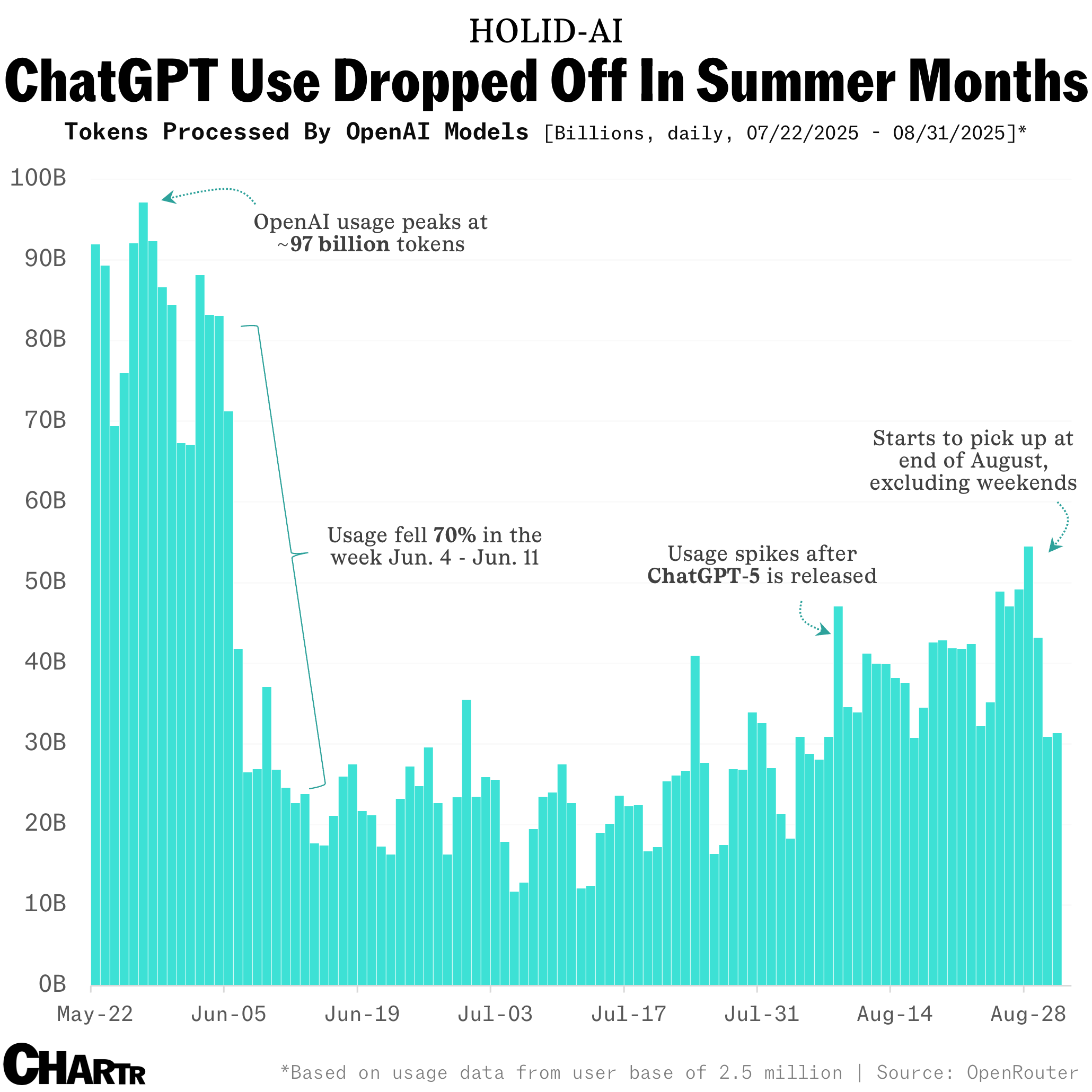
As reported by Futurism in August, daily usage of OpenAI’s flagship chatbot plummeted in early June, when summer semesters wrapped up, according to data from AI platform OpenRouter. Based on a 2.5 million-strong user base, peak usage coincided with the middle of finals season on May 27, as users generated 97.4 billion tokens (a unit for data processing equivalent to roughly four English characters). 

Soon after, average monthly usage more than halved from May to June, when summer vacation began, to 36.7 billion tokens per day, and remained low throughout July. Now, as a new school year looms, ChatGPT usage is picking back up again.
ChatGPT use June July
Sherwood News

Chat, eat my homework

Per Futurism, other drops in ChatGPT usage throughout the school year coincided with weekends; a Google report on shopping trends also outlined that searches for “AI laptops” more than quadrupled from mid-April to the end of May, during exam season; and a Pew Research survey from January found that the share of teens who said they use ChatGPT for schoolwork doubled to 26% from 2023 to 2025.

Though even the most esteemed institutes for learning advocate for supporting education with AI tools, the impact that overreliance on the tech could have on skill development, intellectual standards, and research integrity — particularly at the college level — is yet to be seen.

More Tech

See all Tech
tech

Google’s YouTube maintains its top spot as streaming accounts for nearly half of all TV-watching time

People spent a record 47.5% of their TV-watching time on streaming platforms in December, according to new data from Nielsen, up from the previous record of 47.3% in July. Google’s YouTube once again was the most popular streaming service by time spent, but Netflix’s share inched slightly upward to 9% from 8.8% in July, while YouTube’s fell to 12.7% from 13.4%. The jump was largely thanks to Stranger Things, which was the most watched streaming title last month.

tech

Amazon CEO says tariffs are inflating prices and buyers are looking for bargains

While the legality of President Trump’s tariffs winds its way through the courts, their effects are beginning to show up in prices.

During an interview at the World Economic Forum in Davos, Switzerland, Amazon CEO Andy Jassy said he is starting to see tariffs “creep into” pricing, as some sellers are “passing on those higher costs to consumers in the form of higher prices.”

Jassy said that while consumers are still spending, they are becoming more price conscious.

“I think that wherever they can, they are trying to trade down in price — they are looking for bargains wherever they can find bargains,” he said. “I see people a little more hesitant on higher-priced discretionary items.”

Trump has maintained that other countries are footing the bill for his tariffs. But new research suggests Americans will ultimately be the ones paying those higher prices.

Jassy said that while consumers are still spending, they are becoming more price conscious.

“I think that wherever they can, they are trying to trade down in price — they are looking for bargains wherever they can find bargains,” he said. “I see people a little more hesitant on higher-priced discretionary items.”

Trump has maintained that other countries are footing the bill for his tariffs. But new research suggests Americans will ultimately be the ones paying those higher prices.

tech

Musk: Tesla restarting Dojo supercomputer effort as “AI5 chip design is in good shape”

Tesla CEO Elon Musk said in a post on X over the weekend that the company plans to restart work on its Dojo supercomputer, dubbed Dojo3, saying that the AI5 chip the company had been developing is in “good shape.”

The Dojo supercomputer trains Tesla’s AI models, including the one behind its all-important Full Self-Driving tech. The company stopped work on Dojo in August. “It doesn’t make sense for Tesla to divide its resources and scale two quite different AI chip designs,” Musk said at the time. “The Tesla AI5, AI6 and subsequent chips will be excellent for inference and at least pretty good for training.”

“Pretty good” appears to be good enough.

In the interim, Tesla relied more on companies like Nvidia and Advanced Micro Devices for AI training. Restarting Dojo suggests Tesla plans to bring at least some AI training back in-house.

Musk also runs AI company xAI, which has its own supercomputer and a substantial business relationship with Tesla. A plurality of Tesla shareholders recently voted in favor of investing in Musk’s AI company, but the board declined to approve the measure because of a large number of abstentions.

tech
Jon Keegan

EPA: xAI’s Colossus data center illegally used gas turbines without permits

The Environmental Protection Agency has ruled that xAI violated the law when it used dozens of portable gas generators for its Colossus 1 data center without air quality permits.

When xAI set out to build Colossus 1 in Memphis, Tennessee, CEO Elon Musk wanted to move with unprecedented speed, avoiding all of the red tape that could slow such a big project down.

To power the 1-gigawatt data center, Musk took advantage of a local loophole that allowed portable gas generators to be used without any permits, as long as they did not spend more than 364 days in the same spot. That allowed xAI to bring in dozens of truck-sized gas generators to quickly supply the massive amount of power the data center needed to train xAI’s Grok model.

The new EPA rule says the use of such portable generators falls under federal regulation, and the company did need air quality permits to operate the turbines. xAI is also using dozens of such generators to power its Colossus 2 data center just over the border in Alabama.

To power the 1-gigawatt data center, Musk took advantage of a local loophole that allowed portable gas generators to be used without any permits, as long as they did not spend more than 364 days in the same spot. That allowed xAI to bring in dozens of truck-sized gas generators to quickly supply the massive amount of power the data center needed to train xAI’s Grok model.

The new EPA rule says the use of such portable generators falls under federal regulation, and the company did need air quality permits to operate the turbines. xAI is also using dozens of such generators to power its Colossus 2 data center just over the border in Alabama.

Latest Stories

Sherwood Media, LLC produces fresh and unique perspectives on topical financial news and is a fully owned subsidiary of Robinhood Markets, Inc., and any views expressed here do not necessarily reflect the views of any other Robinhood affiliate, including Robinhood Markets, Inc., Robinhood Financial LLC, Robinhood Securities, LLC, Robinhood Crypto, LLC, or Robinhood Money, LLC.
