Tech
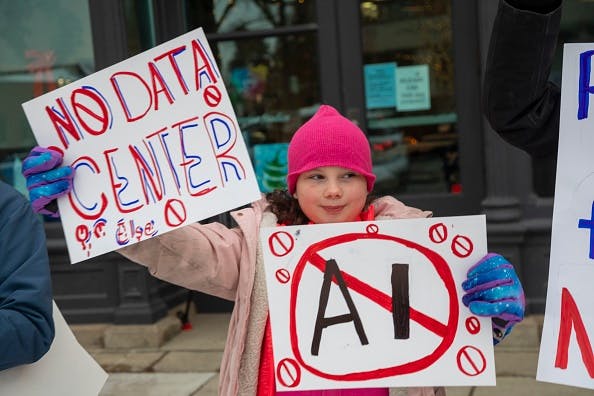
Protest Against Michigan Data Center
(Jim West/Getty Images)

As public pushback against data centers grows, AI companies promise they’ll be good neighbors

Communities concerned with energy prices, pollution, and water usage are starting to push back on Big Tech’s AI data center building spree. The companies are trying to assure the public that they will pay their way.

Small towns all across the US have been adjusting to the reality that some of the biggest companies in the world have just become their neighbors.

Big Tech’s unprecedented race to build AI data centers in rural, often poor areas has raised local concerns about pollution, water usage, and electricity supplies. The public is starting to push back on these often secretive projects, forcing tech companies to reassure communities that they will be good neighbors as massive data centers go up in their midst.

Even President Trump is aware of the public’s growing concern that all these data centers might be part of the reason why their electricity costs are soaring, posting on Truth Social:

“Under Sleepy Joe Biden and the Radical Left Democrats, the average American Household’s monthly Utility bills went up MASSIVELY — over 30%! I never want Americans to pay higher Electricity bills because of Data Centers.”

In his post, Trump said his team had been working with Microsoft to address the issue.

The company soon released a five-point “community-first AI infrastructure action plan” outlining steps it would take to lessen any negative impacts that its data centers might have on communities. While the plan largely reflects the steps the company has been taking so far — such as paying for the electricity it uses and minimizing water usage — formalizing it helps codify the approach, and it gives its competitors a model for how to do the same.

This week at the World Economic Forum in Davos, Switzerland, Amazon CEO Andy Jassy said the company would follow suit. Jassy said:

“We don’t expect other people to pay for us. We expect to fund the power that we need. And we create a lot of good jobs in the communities in which we’re building a lot of data centers. And we intend to continue to do so.”

Yesterday, OpenAI also got in line with a blog post announcing its own version of a community plan, called “Stargate Community.” The company is well into construction on its massive Abilene, Texas, Stargate data center, the first in a series of planned facilities around the world to achieve 10 gigawatts of computing power.

“Going forward, every Stargate site will have its own locally tailored Stargate Community plan, driven by community input and local concerns. They will all rest on this same core premise: Stargate is a partnership with communities, and we can only achieve our mission by being good neighbors.”

Like the other companies, OpenAI says it will pay for the energy infrastructure upgrades it requires. The company also said it would plan its energy needs “transparently” with local and state utility regulators.

Transparency has been an issue for other tech companies as they build out their massive AI data centers.

When Meta set out to build its Hyperion data center in Richland Parish, Louisiana, the company applied for its generator permits using a subsidiary named “Laidley LLC,” and made efforts to hide its identity from the public.

Organized efforts to slow or stop data center projects are spreading across the US. According to Data Center Watch, a research firm that tracks opposition to data center projects, an estimated $98 billion worth of data center projects were blocked or delayed in the second quarter of 2025.

More Tech

See all Tech
tech

Morgan Stanley expects Tesla to have 1,000 Robotaxis by the end of 2026. Musk had predicted 1,500 by the end of 2025

Ahead of Tesla’s earnings report next week, Morgan Stanley has released a note estimating that the company will scale its Robotaxi fleet much more slowly than CEO Elon Musk has said. The firm thinks the automaker will have 1,000 vehicles in its Robotaxi service by the end of 2026 — 500 fewer than Musk estimated a few months ago Tesla would have by the end of 2025.

More key to Tesla’s success, however, will be removing the safety monitors from those rides, which Morgan Stanley says will be a “precursor to personal unsupervised FSD [Full Self-Driving] rollout.” Musk, of course, had also promised to remove safety drivers in Austin by the end of 2025, but driverless rides are still in the testing stage.

tech

Meta says it’s delivered new AI models internally this month and they’re “very good”

Meta’s last AI model release, Llama 4, was marred by delays and accusations of rigged benchmarks, but the company says the latest models built by its Superintelligence Labs team look promising. CTO Andrew Bosworth told reporters at the World Economic Forum that the team delivered new models internally in January and they’re “very good.”

Bosworth didn’t specify what the models are, though The Wall Street Journal has reported that Meta is working on a large language model and an AI image and video model code-named Avocado and Mango, respectively.

tech

Two charts that show why Amazon is building a giant physical store

This week Amazon received approval to build a hybrid big-box store and fulfillment center outside Chicago that’s roughly twice the size of a typical Target. Why would the e-commerce giant want to wade into a costly and cumbersome physical store, especially after earlier brick-and-mortar iterations like Amazon Go have failed?

There are at least two reasons. First, despite e-commerce’s rapid growth, the vast majority of retail purchases still happen in physical stores, according to Census Bureau data:

Second, Amazon’s own customers regularly shop at competing big-box retailers: Consumer Intelligence Research Partners found that 93% have also shopped at Walmart. And as Amazon pushes further into groceries — a category still dominated by in-person shopping — CIRP estimates that basically all Amazon customers buy groceries elsewhere.

tech

OpenAI rolls out age prediction system ahead of allowing adult content

OpenAI is rolling out a new “age prediction” feature for ChatGPT users. The company will look at various signals from users to predict if a user is underage.

In a blog post, the company said:

“The model looks at a combination of behavioral and account-level signals, including how long an account has existed, typical times of day when someone is active, usage patterns over time, and a user’s stated age.”

If the system suspects the user is a minor, it will reduce content with graphic violence, harmful viral challenges, sexual or romantic role-play, depictions of self-harm, and material promoting “extreme beauty standards, unhealthy dieting, or body shaming.”

If a user is incorrectly flagged as under 18, they will have to submit a selfie to an identity verification service to have the restrictions removed.

An age verification system is part of OpenAI’s plan to reduce harmful mental health encounters with the chatbot, while also allowing ChatGPT to generate “erotica” in the near future.

“The model looks at a combination of behavioral and account-level signals, including how long an account has existed, typical times of day when someone is active, usage patterns over time, and a user’s stated age.”

If the system suspects the user is a minor, it will reduce content with graphic violence, harmful viral challenges, sexual or romantic role-play, depictions of self-harm, and material promoting “extreme beauty standards, unhealthy dieting, or body shaming.”

If a user is incorrectly flagged as under 18, they will have to submit a selfie to an identity verification service to have the restrictions removed.

An age verification system is part of OpenAI’s plan to reduce harmful mental health encounters with the chatbot, while also allowing ChatGPT to generate “erotica” in the near future.

Latest Stories

Sherwood Media, LLC produces fresh and unique perspectives on topical financial news and is a fully owned subsidiary of Robinhood Markets, Inc., and any views expressed here do not necessarily reflect the views of any other Robinhood affiliate, including Robinhood Markets, Inc., Robinhood Financial LLC, Robinhood Securities, LLC, Robinhood Crypto, LLC, or Robinhood Money, LLC.