

Anthropic really doesn’t want the US to help China with AI
Anthropic made its case for freezing China out of the AI race as much as possible in a new policy paper. The company warned that letting China catch up to US AI companies could risk AI-powered mass surveillance and huge risks to monitoring AI safety.
Anthropic may be in the midst of an existential legal battle with the US government, but that hasn’t stopped it from weighing in on how the US should deal with China when it comes to AI.
In a 5,500-word policy paper posted Thursday, Anthropic issued a dire warning for US leaders: the US must do everything in its power to stop China from catching up in AI.
Democratic AI
Anthropic painted a picture of two possible scenarios:
1. 🇺🇸 🥇 The US keeps its 12- to 24-month lead on Chinese AI
In the first scenario where the US keeps its lead, a mix of tough export controls on advanced AI chips, protection against “distillation attacks,” and industrywide transparency help build a bulwark against China’s race to build powerful, homegrown AI.
The paper argues this would give the US a military and national security edge against our largest adversary, and would have the effect of becoming a magnet for top AI talent around the world.
The leader of the industry gets to set the norms for transparency and safety, and it is crucial for the US to be in that position, according to the paper.
2. 🇨🇳 ⚖️ China catches up to US-built frontier models
If American companies just view China as another market for their advanced AI chips, Anthropic sees a number of negative outcomes for the world. China could close the 12- to 24-month gap between its best models and US-built frontier models that experts currently see.
China’s “AI-enabled techno-authoritarianism” could be used to power mass surveillance, enhancing its already strict control over Chinese citizens.
Having just warned the world of the potential cyber risks from its forthcoming Mythos model, Anthropic fears such an advanced tool could be used for offensive cyberattacks.
AI is accelerating research and development, and more capable models would help China make faster advances in all fields. China is focused on integrating its domestic AI tech into society to help speed advances, and even if it didn’t have the most advanced models, China could export its tools around the world:
“If the CCP integrates near-frontier AI systems quicker and more effectively into China’s economy and the CCP security apparatus, and drives global adoption of subsidized, low-cost AI, then it could secure advantages over democracies that overcome an intelligence deficit.”
Export controls work
The term “export controls” appears 16 times in Anthropic’s paper, and it spends a lot of ink arguing for their efficacy and necessity.
Enforcing strict export controls on the most advanced chips — like those from Nvidia — keeps China at a disadvantage as it struggles to match advanced chip manufacturing and design from companies based in liberal democracies like ASML(the Netherlands), AMD (the US), TSMC (Taiwan), and Samsung (South Korea). Anthropic argues that the innovations created by these companies could only happen in democratic countries.
China still has a ways to go on chips. It reportedly has a working prototype of an chip fab that employs extreme ultraviolet lithography (EUV), a technology currently only mastered by one company: ASML. Faster chips would result in more powerful AI.
What grows in the shadows
Anthropic, OpenAI, and other AI labs have a tradition of releasing detailed and transparent technical papers that describe capabilities and detail safety risks. The paper notes that more and more Chinese model releases have not matched this level of transparency, and are starting to keep models proprietary. This could greatly increase the risk of AI models being used to help develop chemical, biological, or nuclear weapons.
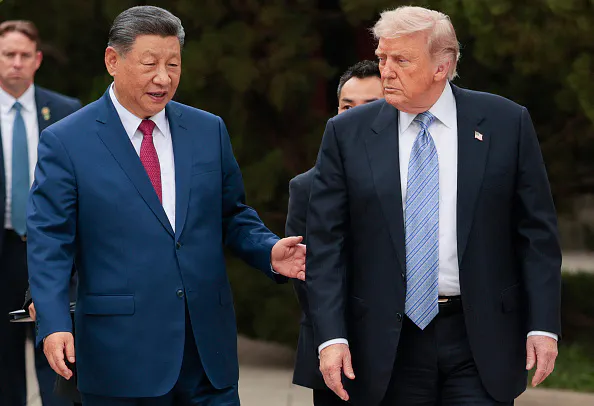
President Trump just returned from his trip to China, along with Nvidia CEO Jensen Huang. It’s not clear yet exactly what was discussed relating to AI and chips. But for now, Anthropic will be keeping an eye on its rearview mirror as China’s models improve.




